Haplogroups and Noble Lines Haplogroup R1b1a1b1a1a1 At Edix Hill in Cambridgeshire, an early Anglo-Saxon cemetery used in the sixth century AD, one man identified as EDI064c carried the Y-DNA haplogroup R1b1a1b1a1a1. That looks, at first glance, like a very technical footnote. In fact it is rather a useful historical clue, because this same paternal branch turns By Sven • 6 min read
Haplogroups and Noble Lines Haplogroup I2 At Sigersdal Mose on Zealand, one of the oldest men in this set lived around 7090 BC. He is recorded here as sample NEO759, an early Mesolithic individual from Denmark, and he matters because he sits very near the beginning of a long European story carried in part by Y-DNA By Sven • 5 min read
Haplogroups and Noble Lines Haplogroup I2a At Vasilevka in Ukraine, one of the oldest men in this set of evidence, sample NEO492, is dated to about 8705 BC. That is an arresting place to begin, because it shows haplogroup I2a attached not to a late historical dynasty or a neatly documented kingdom, but to the deep By Sven • 5 min read
Haplogroups and Noble Lines Haplogroup R1a1a1b At Leubingen in Thuringia, a cluster of Early Bronze Age males dated to around 1950 BC offers one of the clearest starting points for thinking about Y-DNA haplogroup R1a1a1b. The site is better known in wider archaeology for the Unetice world of early metalworking and elite burial landscapes, but for By Sven • 5 min read
Haplogroups and Noble Lines Haplogroup R1a1a1 At Leubingen in Thuringia, two men from the Unetice world of the Early Bronze Age, sample IDs LEU008 and LEU033, are both associated here with Y-DNA haplogroup R1a1a1. They lived around 1950 BC in a region that archaeologists know as one of the key centers of early metalworking and social By Sven • 5 min read
Haplogroups and Noble Lines Haplogroup A1b One of the strangest things about haplogroup A1b is that it turns up where many readers would least expect it. Take sample ATP_PSN_935 from Cherry Hinton in medieval England, dated around AD 1055. Or THE006 from Luxor in Egypt, around 690 BC. Or, going much further back, OAK014_ By Sven • 6 min read
Haplogroups and Noble Lines Haplogroup R1b1a1b1b At Winterborne Kingston in Dorset, archaeologists working at the Durotriges center often called Duropolis recovered an intriguing later burial: sample WBK193, dated to about AD 125. By that point the old Iron Age stronghold had long been living in Rome's shadow, yet the man carried a Y-chromosome line By Sven • 6 min read
Haplogroups and Noble Lines Haplogroup R1b1a1b1a1 At Magdalenenberg near Villingen-Schwenningen in southwest Germany, one of the best known elite burials of early Celtic Europe has also become a genetic landmark. Among the ancient individuals linked with the paternal line R1b1a1b1a1 is sample MBG013, dated to around 530 BC and associated with the great burial mound complex By Sven • 5 min read
Haplogroups and Noble Lines Haplogroup R1b1a1b1a1a At Rosemarkie Cave on Scotland's Black Isle, a cluster of Pict-era men dated to around AD 541 has become one of the more striking signposts for haplogroup R1b1a1b1a1a. Several individuals from the site - including KD001, KD001_2, KD001_3, KD001_4, KD001_6a, and KD001_6b - By Sven • 6 min read
Haplogroups and Noble Lines Haplogroup R1b1a1b1a1a2c1 At Wetwang Slack in East Yorkshire, a cluster of Iron Age burials has become one of the clearest windows onto the paternal history behind haplogroup R1b1a1b1a1a2c1. Several men from this cemetery and its wider Arras Culture setting, dated to around 225 BC, are associated here with the branch: among them By Sven • 6 min read
Haplogroups and Noble Lines Haplogroup R1b1a1b At Magdalenenberg in southern Germany, two men from an elite Celtic burial setting, MBG003 and MBG014, dated to around 530 BC, help anchor an unusually vivid chapter in the history of Y-DNA haplogroup R1b1a1b. That matters because Magdalenenberg is not just any cemetery. It belongs to the early Celtic world By Sven • 6 min read
Haplogroups and Noble Lines Haplogroup G2a2b2b At Anghelu Ruju in Sardinia, two Neolithic men dated to around 4000 BC, samples I15947 and I15944, carry the Y-DNA haplogroup G2a2b2b. That matters because Anghelu Ruju is not just any prehistoric site. It is one of the island's best-known burial landscapes, part of the deep Mediterranean world By Jamie L • 5 min read
Haplogroups and Noble Lines Haplogroup Q1b1a1a1k1 At Laguna de los Condores in the cloud forests of northern Peru, a remarkable cluster of late pre-Hispanic burials has given geneticists something unusually valuable: not just one ancient man tied to the Y-DNA haplogroup Q1b1a1a1k1, but several closely related sample designations from the same Chachapoyas context around AD 1455. By Jamie L • 4 min read
Haplogroups and Noble Lines Haplogroup G2a3b1a2 At Collegno, just outside Turin in northern Italy, a cluster of sixth-century burials has become one of the clearest windows into the unsettled world after the fall of the Western Roman Empire. Among the men buried there, several samples associated with Y-DNA haplogroup G2a3b1a2 stand out: COL_136, COL_136b, By Jamie L • 5 min read
Haplogroups and Noble Lines Haplogroup G2a2a1a2a1 At Oberbipp in Switzerland, two men from the Late Neolithic, both dated to around 3190 BC and identified as MX182 and MX183, carry the same paternal signal used for this article: G2a2a1a2a1. That is immediately interesting because Oberbipp sits in the world of Europe's first established farming communities, By Jamie L • 5 min read
Haplogroups and Noble Lines Haplogroup A1b1b2a At Oakhurst in the Western Cape of South Africa, ancient DNA has put a very old paternal line into unusually clear focus. Two men dated to around 4400 BC, identified as OAK003_B0101 and OAK003_B0103, and another individual from the same region dated to about 3400 BC, OAK014_A0103, By Jamie L • 5 min read
Haplogroups and Noble Lines Haplogroup N1a1a1a1a1a1a7a One of the more arresting appearances of haplogroup N1a1a1a1a1a1a7a comes not from a remote prehistory, but from a named medieval ruler: Grand Prince Dmitry Alexandrovich of the Rurik dynasty, dated to AD 1294 and identified here as sample Nev2. That matters because it places this paternal line in a dynastic By Jamie L • 4 min read
Haplogroups and Noble Lines Haplogroup C2a1a At Leobersdorf in Lower Austria, one early medieval grave stands out not because it was royal or lavishly described, but because it helps pin a very old paternal line to a very mobile world. The man catalogued as LEO008, dated to about AD 720 and identified with an Avar-period burial, By Jamie L • 5 min read
Haplogroups and Noble Lines Haplogroup L1b1 At Las Gobas in northern Spain, one of the more arresting details is not a sword, a brooch, or a grand inscription, but a Y-chromosome result. A man dated to about AD 860, sample ldo050, carried the paternal lineage L1b1. That matters because L1b1 is not the sort of branch By Jamie L • 5 min read
Haplogroups and Noble Lines Haplogroup C2a1a3 One of the clearest clues for Y-DNA haplogroup C2a1a3 in this set of ancient evidence comes from the mausoleum associated with Jochi Khan in Kazakhstan, where sample CZK002 is dated to around 1227 AD. That is already enough to make an archaeologist sit up a little straighter. Jochi was the By Jamie L • 5 min read
Haplogroups and Noble Lines Haplogroup R1b1a1b1a1a2a2 At Winterborne Kingston in Dorset, the ancient cemetery of the Durotriges has produced a small but striking cluster of men dated to around AD 125: WBK103, WBK105, and WBK23. That matters because this is not a vague appearance of a broad western European Y line somewhere in Britain. It is By Jamie L • 5 min read
Haplogroups and Noble Lines Haplogroup T1a2b1a1 At Segesta in medieval Sicily, two men from a Muslim burial ground, identified as SGBN7 and SGBN7c, bring T1a2b1a1 into unusually sharp focus. Their graves belong to around AD 1140, a moment when Sicily was politically under Norman rule but still socially and culturally mixed: Arabic-speaking communities, Greek Christians, Latin By Jamie L • 5 min read
Haplogroups and Noble Lines Haplogroup G2a2b2a3 At Asparn-Schletz in Lower Austria, archaeologists uncovered one of the starkest scenes from Europe's early farming age: human remains scattered in and around a ditched settlement, dating to around 5000 BC. Among the ancient men from this site, samples I24892, I27778, I24891, and I24276 have been associated here By Jamie L • 5 min read
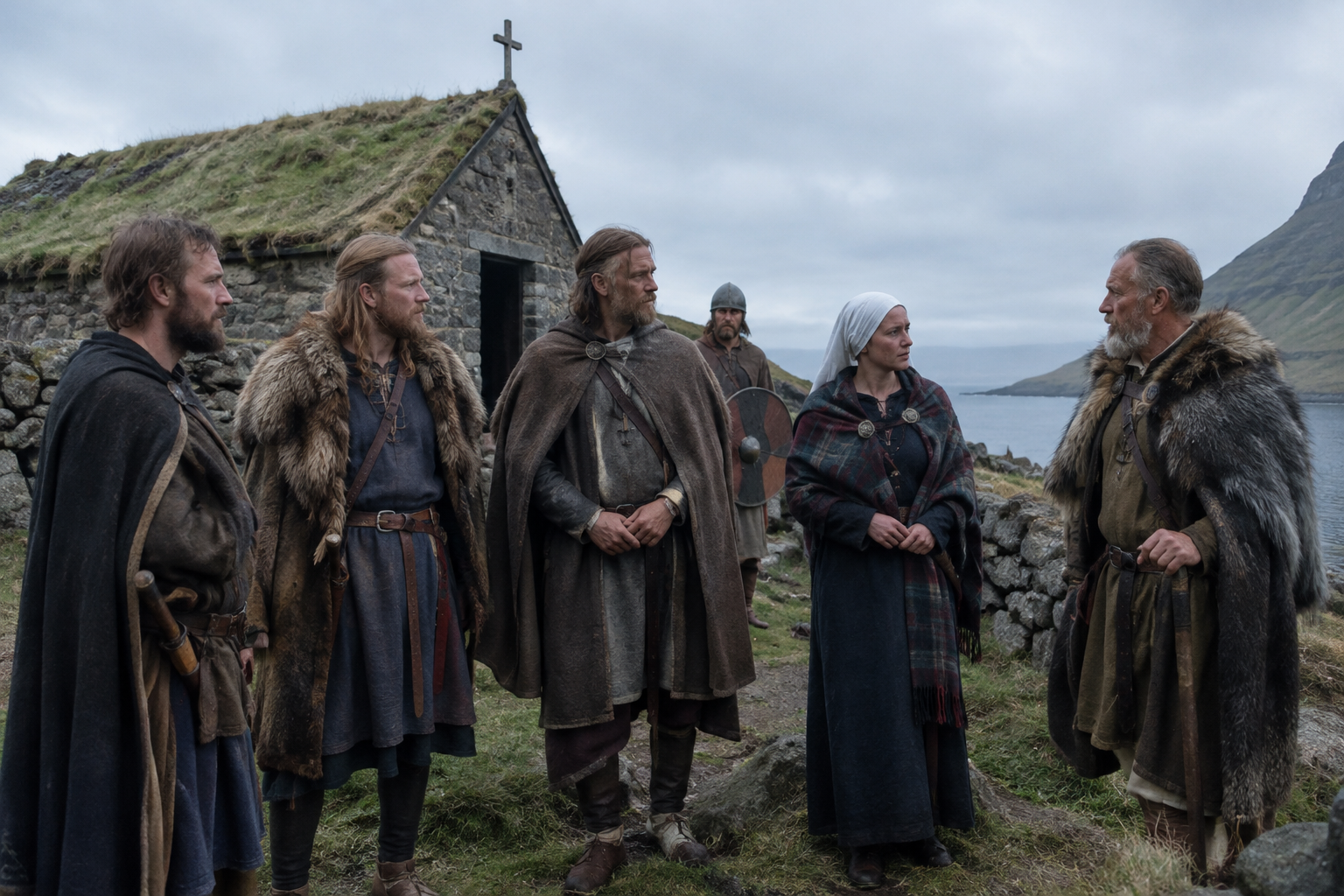
Haplogroups and Noble Lines Haplogroup R1a1a1b1a3a2b1a At Sandoy Church in the Faroe Islands, two men buried around AD 1600, identified as VK46 and VK245, carry a paternal line associated here with R1a1a1b1a3a2b1a. That is already an interesting finding, not because a single grave can explain an island population, but because the Faroes sit at one of By Jamie L • 5 min read