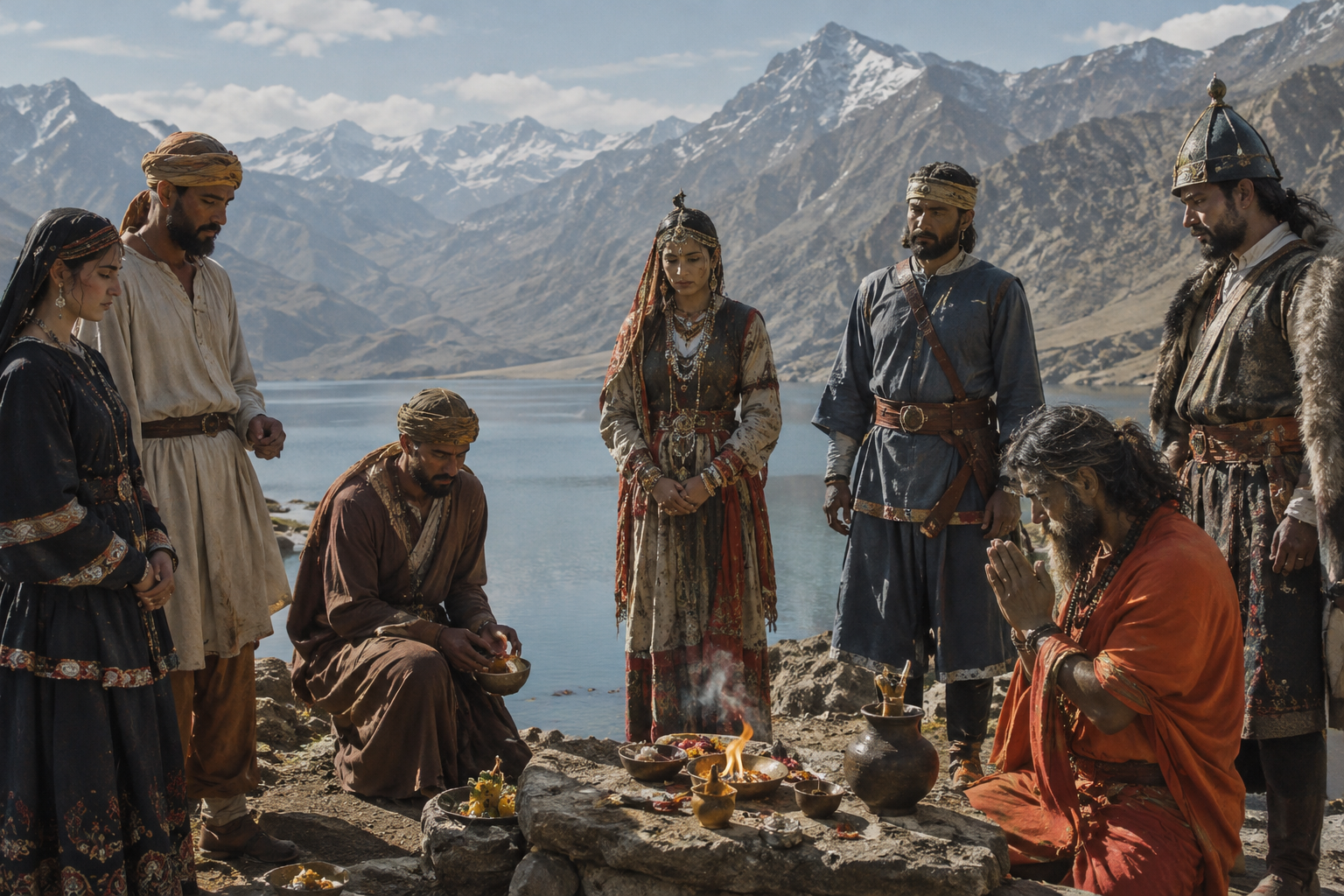
Haplogroups and Noble Lines Haplogroup N/A At Chokhopani in Nepal, one ancient male sample stands out simply because of where and when he lived. CHO003, dated to around 785 BC, comes from a high-altitude Himalayan context where survival, trade, and movement all depended on mountain corridors rather than easy plains travel. That matters because the Y-DNA By Jamie L • 5 min read
Haplogroups and Noble Lines Haplogroup G2a2b2a1a1c1a1a2 At Polizzello in central-western Sicily, a cluster of Iron Age males dated to around 800 BC offers an unusually tight glimpse of one paternal line in one community. Four individuals from the Sicani context there - I13382, I13389, I13383, and I13385 - have been associated with the Y-DNA haplogroup G2a2b2a1a1c1a1a2, By Jamie L • 5 min read
Haplogroups and Noble Lines Haplogroup J2a1a1a2b2 The oldest clue in this small but telling trail of J2a1a1a2b2 comes from southeast Anatolia, where sample I4478 is dated to around 2100 BC at Tatika in the Early Bronze Age. That matters because it places this paternal line, or a lineage reported within its immediate branch, in one of By Jamie L • 5 min read
Haplogroups and Noble Lines Haplogroup R2a2b1 At Gol-Afshan Tepe near Semirom in Iran's Isfahan province, three closely labeled records - IRN24, IRN24a, and IRN24b - point to the same striking archaeological horizon: the Proto-Elamite period, around 3740 BC. That is already enough to make Y-DNA haplogroup R2a2b1 interesting. Instead of appearing first in a By Jamie L • 5 min read
Haplogroups and Noble Lines Haplogroup E1b1b1a1a2 At Selinunte on the southwest coast of Sicily, one ancient male sample stands out for what it quietly suggests about Mediterranean history. Sample I21195, dated to around 550 BC and associated with Hellenic Sicily at Selinunte-Case Manuzza, belongs to the Y-DNA haplogroup E1b1b1a1a2. That is a very particular paternal signal By Jamie L • 5 min read
Haplogroups and Noble Lines Haplogroup N1a1a1a1a2 At Szakony-Kavicsbanya in western Hungary, one of the best known graves of the 10th-century conquering elite yielded an individual labelled SZAK-1, dated to about AD 950. He matters here not because one grave can explain a people, but because his paternal line is reported within the branch N1a1a1a1a2 - a By Jamie L • 5 min read
Haplogroups and Noble Lines Haplogroup I2a1b1a2b1a At Sint-Truiden in medieval Belgium, one man labeled ST0552 was buried around AD 900 in the Onze-Lieve-Vrouwekerk, the Church of Our Lady. On its own, that sounds modest enough: one grave in one church in one town. But for the Y-DNA haplogroup I2a1b1a2b1a, ST0552 matters because he does not stand By Jamie L • 5 min read
Haplogroups and Noble Lines Haplogroup R1b1a1b1a1a1c2b2b1a1a1 At Bruecken in Saxony-Anhalt, two men dated to around AD 500 stand out for anyone tracing the deep paternal trail of haplogroup R1b1a1b1a1a1c2b2b1a1a1. They are recorded as BRC054x, described as a Nordic tribe individual from Saxony-Anhalt, and BRC053x, identified as a Saxon from the Migration Period at the same site. By Jamie L • 5 min read
Haplogroups and Noble Lines Haplogroup G2a2b2a1a1c1 At Motya on the western coast of Sicily, a Middle Bronze Age man identified as I22238 pushes this Y-chromosome line far earlier than the island's famous Phoenician and Carthaginian chapters. Dated to around 1755 BC, he matters because haplogroup G2a2b2a1a1c1 appears here not first in an imperial port By Jamie L • 5 min read
Haplogroups and Noble Lines Haplogroup I1a2a1a1d2 At Sint-Truiden in medieval Belgium, one excavated man from the Onze-Lieve-Vrouwekerk cemetery, sample ST0006, lived around 1345 AD. On its own that might sound like a local story, one parish grave among many. But for the Y-DNA haplogroup I1a2a1a1d2, it is part of a much longer pattern: a paternal line By Jamie L • 5 min read
Haplogroups and Noble Lines Haplogroup I2a1a1a1 At Abri Sandron in Belgium, several late Neolithic men dated to roughly 2884-2691 BC have been associated with Y-DNA haplogroup I2a1a1a1. That is immediately interesting because Abri Sandron is not a lone burial standing in splendid isolation. It is a small cluster, with individuals including I13633, I13659, I13655, and I13660, By Jamie L • 5 min read
Haplogroups and Noble Lines Haplogroup R1a1a1b1a1a1c1h One of the clearest signposts for haplogroup R1a1a1b1a1a1c1h comes not from a vague prehistoric horizon, but from a named medieval ruler: VK541, identified as Izjaslav Ingvarevych of Dorogobuzh, a prince of the Rurik dynasty who died in 1223 AD. That matters because ancient DNA very rarely lets us place a By Jamie L • 5 min read
Haplogroups and Noble Lines Haplogroup I2a1b1a2a1 At Aquae Calidae on the Black Sea coast of modern Bulgaria, a Late Roman grave linked to a Gothic community produced one of the clearest signposts in this set of evidence: sample I40571, dated around AD 350. On its own, that may sound like a single technical detail. But once By Jamie L • 5 min read
Haplogroups and Noble Lines Haplogroup R1a1a1b1a3a1c At Vasterhus in central Sweden, a cluster of medieval burials dated around AD 1313 offers a rather good reminder that a Y-chromosome lineage is not an abstract label on a map. It belonged to real men living in a Christian community, buried in a churchyard, and now known to us By Jamie L • 5 min read
Haplogroups and Noble Lines Haplogroup IJ At Scarbantia-Hegyko in western Hungary, two men buried in the Longobard period around AD 525, identified as HMU018 and HMU020, carry an unusually broad label in Y-DNA terms: IJ. That may sound almost too large to be useful, but in fact it is exactly what makes them interesting. In a By Jamie L • 5 min read
Haplogroups and Noble Lines Haplogroup Q1b1a3a1 At Eleke Sazy in eastern Kazakhstan, one of the most striking Iron Age burial landscapes of the steppe has yielded an individual dated to around 260 BC: sample ESZ012. That matters here because this burial places the Y-DNA haplogroup Q1b1a3a1 in a world we can actually picture historically: the mounted By Jamie L • 5 min read
Haplogroups and Noble Lines Haplogroup R1a1a1b1a At Sint-Truiden in medieval Belgium, one excavated individual from the Groenmarkt cemetery, sample ST2653, dates to around AD 1090. On its own, that may sound like just one more town burial from the High Middle Ages. But when a paternal lineage such as R1a1a1b1a turns up here, and again in By Jamie L • 5 min read
Haplogroups and Noble Lines Haplogroup R1b1a1b1a1a2b1c2 At Felsina, the Etruscan city beneath modern Bologna, one ancient male dated to around 600 BC was assigned sample ID I29157. He matters here not because he can stand in for all Etruscans - he cannot - but because he places the Y-DNA branch R1b1a1b1a1a2b1c2 in a very particular Iron By Jamie L • 5 min read
Haplogroups and Noble Lines Haplogroup I2a1b1a1a1b1 At Monkton Up Wimborne in Dorset, a Neolithic family burial dated to around 3225 BC preserves one of the clearest early appearances in this set of evidence for the Y-DNA line I2a1b1a1a1b1: sample muw001. That matters because this is not an isolated wanderer from some vague prehistoric map. It is By Jamie L • 5 min read
Haplogroups and Noble Lines Haplogroup R1b1a1b1a1a2a1b1a At Wetwang Slack in East Yorkshire, two men dated to around 225 BC, sample IDs I36774 and I36777, carry the Y-DNA haplogroup R1b1a1b1a1a2a1b1a. That is a very precise paternal label, but the setting is broader and easier to picture: Iron Age Yorkshire, in territory associated archaeologically with the Arras culture By Jamie L • 5 min read
Haplogroups and Noble Lines Haplogroup R1b1a1b1a1a2c1a2a At Wetwang Slack in East Yorkshire, several men buried in the centuries just before the Roman conquest have become unexpectedly important for the history of one paternal line. Among them are I36970, I31009, and I30904, all dated to around 225 BC and associated with the Iron Age community often described By Jamie L • 5 min read
Haplogroups and Noble Lines Haplogroup N1a1a1a1a1a At Janakkala in Kanta-Hame, an early medieval burial dated to around AD 1190 produced an individual labelled JAN001. That find matters because it places the Y-DNA haplogroup N1a1a1a1a1a in a firmly northern setting at the close of Finland's medieval transition, when local communities were tied into both Baltic By Jamie L • 5 min read
Haplogroups and Noble Lines Haplogroup J2a1a1a2b2a2b2 At Amiternum in Abruzzo, two men buried in the early medieval cemetery of Santa Maria in Civitate, ASM_S34 and ASM_S35, offer the clearest starting point for thinking about Y-DNA haplogroup J2a1a1a2b2a2b2. They date to around AD 800 and AD 876, in a landscape where Roman urban life had By Jamie L • 5 min read
Haplogroups and Noble Lines Haplogroup H1a1a4b At Gonur in Bronze Age Turkmenistan, one ancient male sample stands out for anyone interested in haplogroup H1a1a4b: I10409, dated to around 2000 BC. Gonur was one of the major centers of the Oxus Civilization, also known as the Bactria-Margiana Archaeological Complex, a world of fortified settlements, irrigation, and long-distance By Jamie L • 4 min read