Clan Colville

– 3 min read


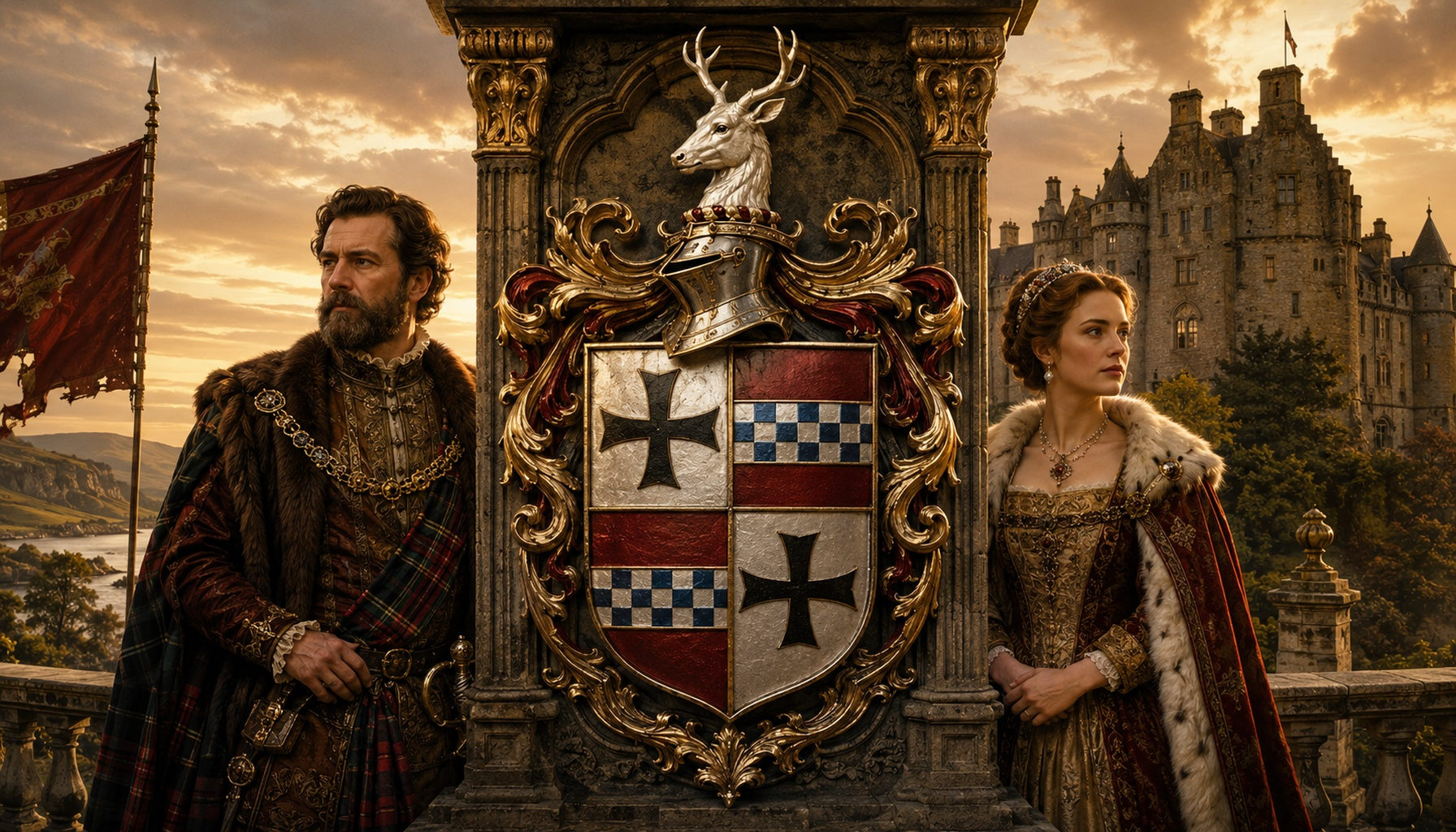
Clan Colville was a Scottish noble family of Norman origin, rooted in the feudal world that spread from northern France into Britain after the 11th century, and in genetic tagging terms is here linked with haplogroup R1b1a1b1a1a2a3 as the primary family haplogroup. Historically, the Colvilles belong to that very recognisable pattern of Norman houses which arrived with continental habits of lordship, land tenure, and heraldry, then gradually became unmistakably Scottish in outlook, politics, and identity. Their story is tied especially to Fife, Lothian, and the wider Lowland aristocratic sphere, where status was built not by romantic mist alone, but by land, service, marriages, and usefulness to the crown.
The surname itself points back to a place-name origin, almost certainly from one of the Colleville localities in Normandy, which is exactly the sort of practical medieval naming habit one would expect: you were called after where you came from. By the 12th century the family had appeared in Scotland, with Philip de Colville recorded in 1159, showing how early the name entered the kingdom's documentary world. Over time the family established branches and influence through estates and office-holding. Later figures such as Robert Colville (1532-1585) and Alexander Colville, 1st Lord Colville of Culross (1555-1597), show the family not merely surviving but adapting to the intense political shifts of Reformation and crown politics. In that sense the Colvilles are not an oddity but a textbook example of Norman-Scottish continuity: foreign in origin, thoroughly Scottish in development, and stubbornly durable.
A key Colville anchor is Culross in Fife, and especially Culross Abbey, one of those places where stone does a good deal of the talking. The abbey began as a Cistercian house in the 13th century, founded in 1217, and much of what survives today reflects later rebuilding and adaptation. Its church is particularly striking because it preserves layers of medieval and post-medieval religious life in one structure: monastic origins, later parish use, and a setting bound up with the fortunes of local nobility, including the Colvilles of Culross. The site sits in the old royal burgh of Culross, itself one of the most atmospheric historic settlements in Scotland, with steep lanes, mercat cross, and a remarkable sense that the early modern town never quite packed up and left. Culross Abbey can still be visited today, and it remains one of the best places to grasp how a noble family such as the Colvilles was tied not only to title and land on paper, but to an enduring sacred and local landscape.
From an ancient DNA point of view, the Colville haplogroup tag R1b1a1b1a1a2a3 sits within a very broad and well-travelled western European paternal story. Related or linked samples under this branch appear across a striking range of periods and places, which is precisely the point: not direct descent from named burials, but a wider genetic backdrop. Among the more relevant linked examples are Medieval Northern Spain Las Gobas samples such as ldo066, ldo037, ldo046, ldo048, ldo040, and Dark Ages ldo062; Iron Age and Roman Britain examples including WBK106 and WBK36 from the Durotriges of England, Roman Era Fenstanton sample FEN008, and Pict-era Rosemarkie Cave individuals KD001, KD001_2, KD001_3, KD001_4, KD001_6a, and KD001_6b from Scotland. Go back further and the same broader lineage appears in Bronze Age and Bell Beaker contexts such as SMGB54 in France, BRE445FK in Aube, VLI092 in Bohemia, and even elite Celtic burials in southwest Germany like APG001, APG003, LWB001, and LWB002_ss. What that gives us is not a family tree for the Colvilles, but a deep archaeological frame for the kind of paternal lineage that later turns up among many western European and British populations, including the medieval societies from which Scottish noble families emerged.
If you are exploring Colville heritage, this is where history and DNA can become genuinely interesting together. Uploading your DNA to MyTrueAncestry may help you see whether you match the family's tagged haplogroup R1b1a1b1a1a2a3 or show connections to related ancient samples from medieval Britain, Pict-era Scotland, Iron Age Europe, and Norman-linked western European populations. It will not magically prove a noble pedigree, and thank goodness for that, but it can place your own story in the same long human landscape that families like the Colvilles inhabited.
Comments