Welsh Royalty

– 3 min read


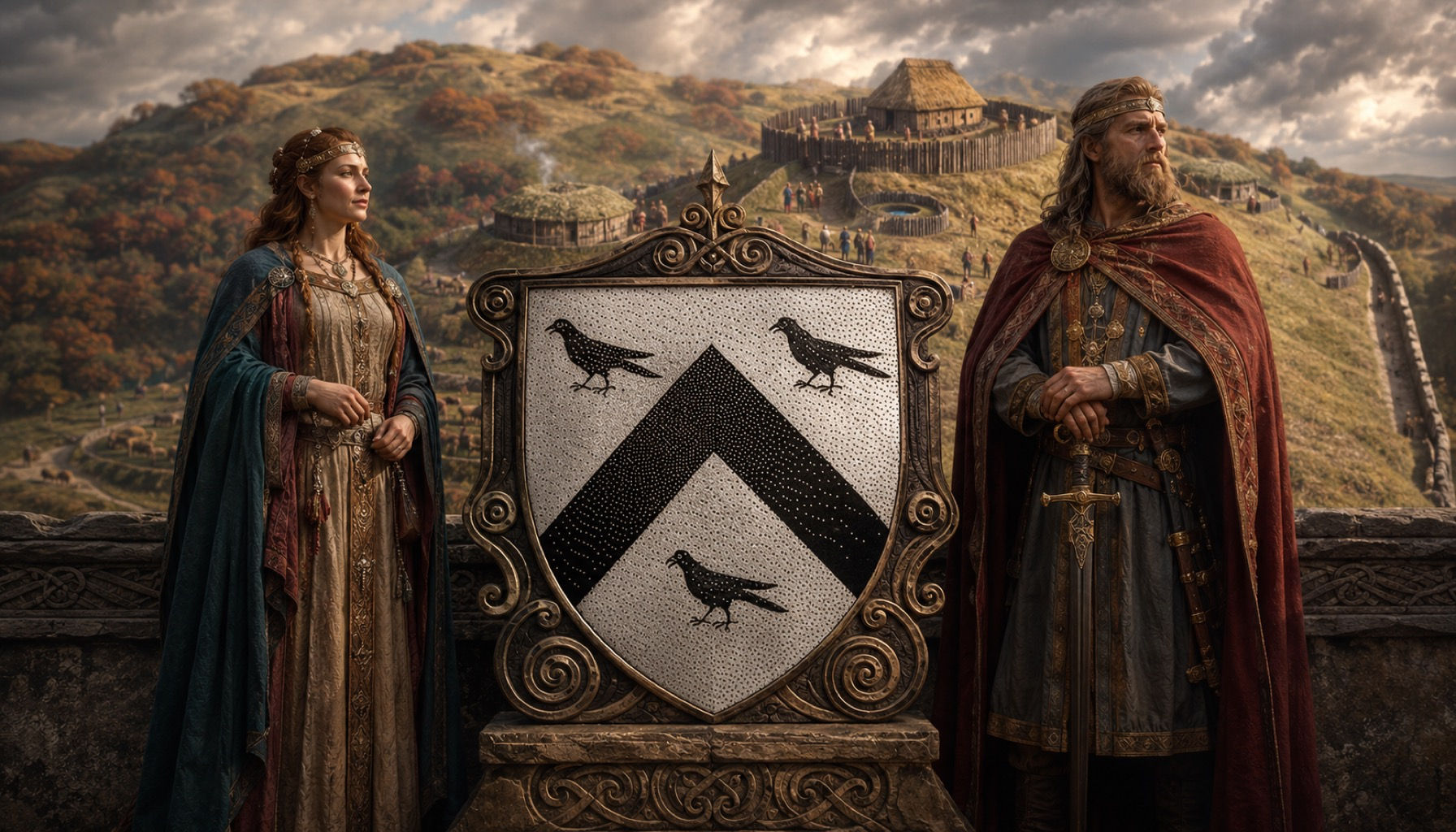
The House of Rheged belongs to that misty but very real world of early Brittonic kingship, when northern Britain after Rome was not empty, not chaotic in any simple sense, but full of native kingdoms defending old lands, family honor, and political survival. Rheged is remembered as one of the great realms of the Hen Ogledd, the Old North, where Brittonic-speaking rulers held power across parts of what is now northern England and southern Scotland. In hereditary memory, this is Welsh royal heritage carried northward into a frontier landscape of war bands, alliances, praise poetry, and shifting borders. The primary haplogroup linked here is R1b1a1b1a1a2c1a5a1, a branch well at home in the long paternal story of Atlantic and Celtic Britain.
What makes Rheged so compelling is that it survives not only in dry king lists but in the literary afterlife of heroic Britain. Urien of Rheged became one of the most celebrated warrior-kings in Welsh tradition, a ruler praised for defending his people against rivals in the post-Roman north. Later figures associated with the family, including Pasgen ap Urien and King of Gwyr (522), sit within that broader royal pattern: sovereignty rooted in kinship, military reputation, and remembered ancestry. This is not a dynasty of marble palaces and tidy archives. It is a dynasty of memory, song, battlefield prestige, and the stubborn endurance of Brittonic identity.
Read more about the Princely House of Powys
Rheged itself is usually placed in the Old North, often associated with the Cumbric-speaking zone around Cumbria and neighboring territories stretching toward Galloway and the Solway region, though scholars still debate its exact core. That uncertainty is rather typical for the age: kingdoms were not neatly surveyed nation-states but power zones built around strongholds, tribute, pasture, and control of movement. One enduring location anchor often connected with this northern Brittonic world is the landscape around Cumbria, especially the old Roman and post-Roman corridors that remained strategically vital after imperial rule faded. These places can still be visited today, and that matters, because the physical setting helps explain Rheged better than any tidy textbook sentence. You can stand in the northwestern British landscape, with its hills, routes, and defensible valleys, and immediately see why a warrior kingdom could flourish there while also being vulnerable to pressure from Bernicia, fellow Brittonic rivals, and later political transformations.
Explore the Royal House of Dinefwr
On the ancient DNA side, R1b1a1b1a1a2c1a5a1 is linked or related to a broad spread of ancient samples rather than to any proven individual member of Rheged itself, and it is important not to overclaim that connection. Relevant linked examples include several Celtic Durotriges individuals from Duropolis at Winterborne Kingston in England, such as WBK12, WBK20, WBK29, WBK41, WBK05, WBK30, WBK43, WBK06, WBK08, WBK18, and WBK191, alongside later and wider finds like Post Roman Worth Matravers Dorset England (I11580), Celtic Briton Carsington Pasture Cave Derbyshire England (I12775), Celtic Briton Lechlade-on-Thames Gloucestershire England (I12783), Iron Age Worlebury Somerset England (I11991), and Bradley Fen Cambridgeshire England (I11156). The wider linked cluster also reaches into Bronze Age Britain and Ireland, including Amesbury Down (I2417), Upavon Bell Beaker (I4950), Bedfordshire samples I7576 and I7577, South Lanarkshire Boatbridge Quarry (I5473), Hinxton Iron Age (HI2), Thames Early Bronze Age (I5377), and Rathlin1B and Rathlin2B from Copper Age Ireland, with additional related appearances across Roman and early medieval Europe. What that suggests, in broad historical terms, is a paternal line deeply woven into the long population history of western Europe and especially the Celtic-speaking world from prehistory into the early medieval age.
See ancient DNA in post-Roman Britain
If the House of Rheged speaks to your own family story, this is exactly the kind of heritage worth exploring: a royal line remembered through poetry, a northern Brittonic kingdom shaped by the collapse of Rome, and a genetic signature tied to the deeper male-line history of Britain and western Europe. Upload your DNA to MyTrueAncestry and see whether you match the House of Rheged or any of the related ancient DNA samples linked with haplogroup R1b1a1b1a1a2c1a5a1.



Comments