Post-Viking Early Christian DNA of Children in Scandinavia
– 4 min read


Children's bones are notoriously difficult to interpret—smaller, more fragile, and resistant to the methods that reveal sex, age, and status in adults. Yet without children, no picture of past society is complete. In early Christian Scandinavia, this challenge intensifies: the spread of Christianity replaced furnished Viking Age burials with plain inhumations, forcing archaeologists to read the cemetery itself—body position, burial location, and neighbouring graves—far more carefully.
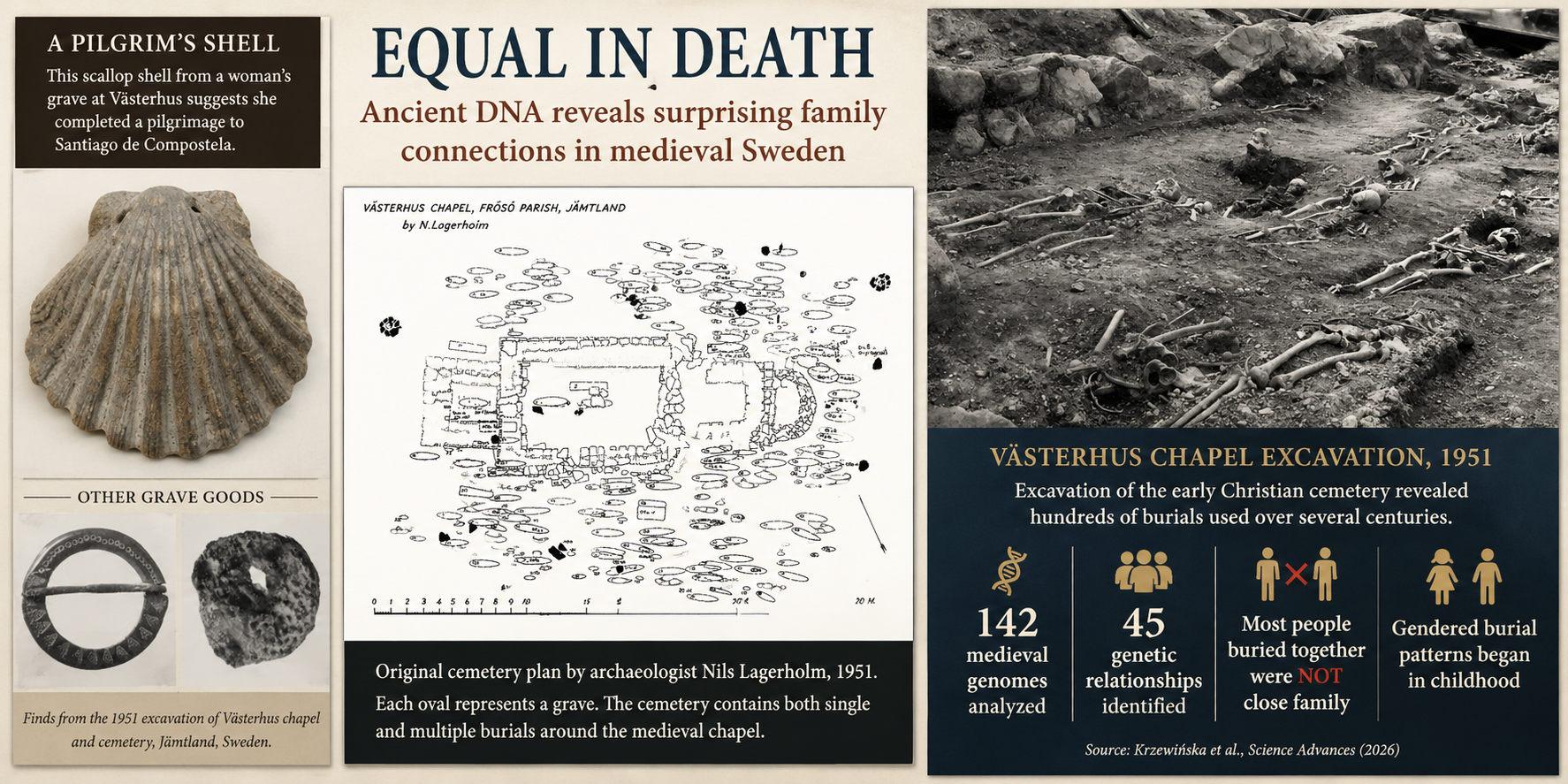
The cemeteries at Västerhus, Sigtuna, and Fjälkinge reward that careful reading. At Västerhus, boys clustered on the southern side of the churchyard alongside men; girls clustered on the northern side alongside women. Gender, it seems, was socially assigned from an early age, marked in death long before adulthood. Yet the pattern was not rigid. A few girls appeared in the predominantly male southern zone, including infants laid beside men or boys. These exceptions reveal that burial custom was not a machine. Family circumstance, local status, the timing of death, and anxieties about baptism could all bend the rules.
Infant and fetal burials were especially sensitive. Christian teaching created uncertainty around those who died unbaptised, yet grieving families rarely acted with cold consistency. Small bodies were tucked into shared graves, placed at the edges of sacred buildings, or buried in ways that half-followed and half-evaded official expectation. Such acts capture what no legal text can: human negotiation between grief and doctrine.
Shared graves invite obvious stories—spouses, parents and children, victims of disaster. Yet across Västerhus, Sigtuna, and Fjälkinge, the biological evidence repeatedly refuses those assumptions. Most adults and children buried together were not close relatives. They were not parent and child, nor usually even grandparent and grandchild. This finding overturns one of archaeology's oldest interpretive habits.
Medieval households were broad and layered, encompassing servants, foster-children, dependants, and distant kin. A shared grave likely reflects household membership rather than blood, a bond of residence rather than parentage. The grave announces belonging; the bones deny immediate family. Historians must therefore ask what other kinds of belonging counted: fosterage, shared labour, common patronage, or simply dying at the same time.
The most striking pattern is the frequency of same-sex adult-and-child burials—men with boys, women with girls—suggesting that gender affinity, not kinship, sometimes governed placement. A child buried with an unrelated adult of the same sex may have been classified by social role rather than genealogy. The grave was doing social work, sorting persons as much as disposing of bodies. Shared graves therefore open onto medieval belonging in its widest sense: practical, emotional, religious, and social all at once.
Each site carried its own rhythm. Västerhus was a rural Jämtland churchyard, tightly organised, with generations accumulating around the church building. Its spatial logic was clear: gendered zoning, prestige locations near the altar, and exceptions that prove the rule. Among its graves, one burial contained a scallop shell—the emblem of pilgrimage to Santiago de Compostela. To find that object in a northern rural cemetery is to feel the vast reach of medieval Christian travel, linking a remote Swedish parish to one of Europe's greatest sacred destinations.
Sigtuna was an urban centre, royal and ecclesiastical, full of traders, clergy, and migrants. Its burial grounds are only partially excavated, but the impression is of looser organisation—heterogeneous rather than tightly zoned, reflecting mobile populations without deep local ancestry. Fjälkinge reaches back into the Late Viking Age, before Christian burial custom had settled into disciplined form. There, no clear spatial sex segregation appears. This is not disorder but a different order, one still rooted in the flexible funerary world of the Viking Age.
Together, the three sites trace a movement from experimentation to regulation. Rural Västerhus embodies mature Christian zoning. Urban Sigtuna reflects institutional Christianity in motion. Fjälkinge preserves an earlier horizon of coexisting old and new rites. None is interchangeable, and that variety insists on local texture within the broader story of Scandinavian Christianisation.
Wider kinship networks shaped Västerhus as a whole even when they did not dictate individual graves. Enough biological connections survive to reconstruct extended kindreds stretching across the churchyard, turning a scatter of individuals into a social landscape threaded with family ties. One prominent kindred clustered near the church, in positions suggesting prestige and long-standing local influence. Nearness to the building carried spiritual and social value; a family repeatedly buried there was no ordinary household.
The woman buried with the scallop shell stood within or near this network, making her still more significant. Whether she walked to Santiago herself or acquired the shell through other devotional means, the object announced long-distance travel, religious achievement, and participation in an international Christian world. Placed among socially prominent kin, she was not an isolated curiosity but a glamorous representative of a family whose horizons stretched beyond the parish.
Christian burial austerity did not erase social difference; it merely shifted the medium. Where Viking Age graves once displayed status through weapons and jewellery, Christian graves displayed it through location, rare devotional objects, and association with important kin. The cemetery at Västerhus remains a deeply human archive—preserving ambition, devotion, local power, and family memory, with individuality stubbornly visible beneath the plain surface of the churchyard earth.
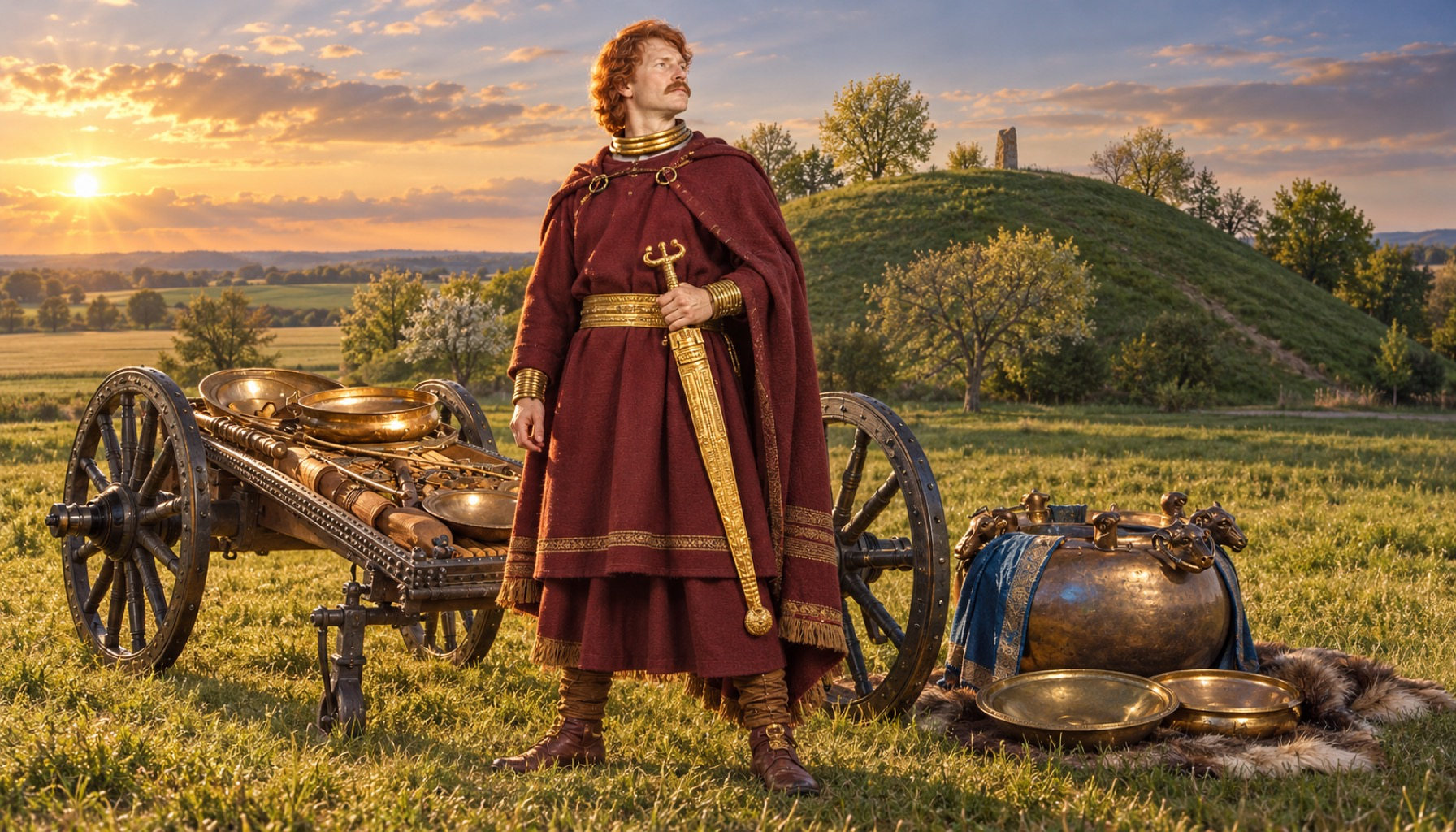
Viking Age burial was theatrical and varied: cremation or inhumation, ships or mounds, rich grave goods, even possible sacrifice. Christianity replaced this with uniform inhumation—body extended, east-west aligned, church-centred, largely unfurnished. The churchyard became sacred territory shaped by theology and ecclesiastical control, arranging the dead in a moral geography that mirrored the living social order.
The transition was neither instant nor uniform. Old habits lingered; regional variation persisted; law codes and local custom diverged. Yet over time, the churchyard imposed its logic. Children were fitted into gendered zones, reflecting how thoroughly Christian order had entered daily life. Infants could trouble the system where baptism was uncertain, and their exceptional placements show lived religion negotiating official demand.
These cemeteries show what Christianisation looked like on the ground: grave goods disappearing, sacred space acquiring new meaning, children slotted into a gendered map of the dead, and rules occasionally bent so that difficult burials could still be made meaningful. Viking Age and Christian Scandinavia both arranged the dead to express belonging and difference. What changed was the language—from the flamboyant vocabulary of pyres and rich goods to the quieter grammar of zones, orientation, and select devotional signs. The dead still spoke for the living, now in a more restrained but no less eloquent Christian tongue.

Comments