The Noble House of Bardolf

– 3 min read


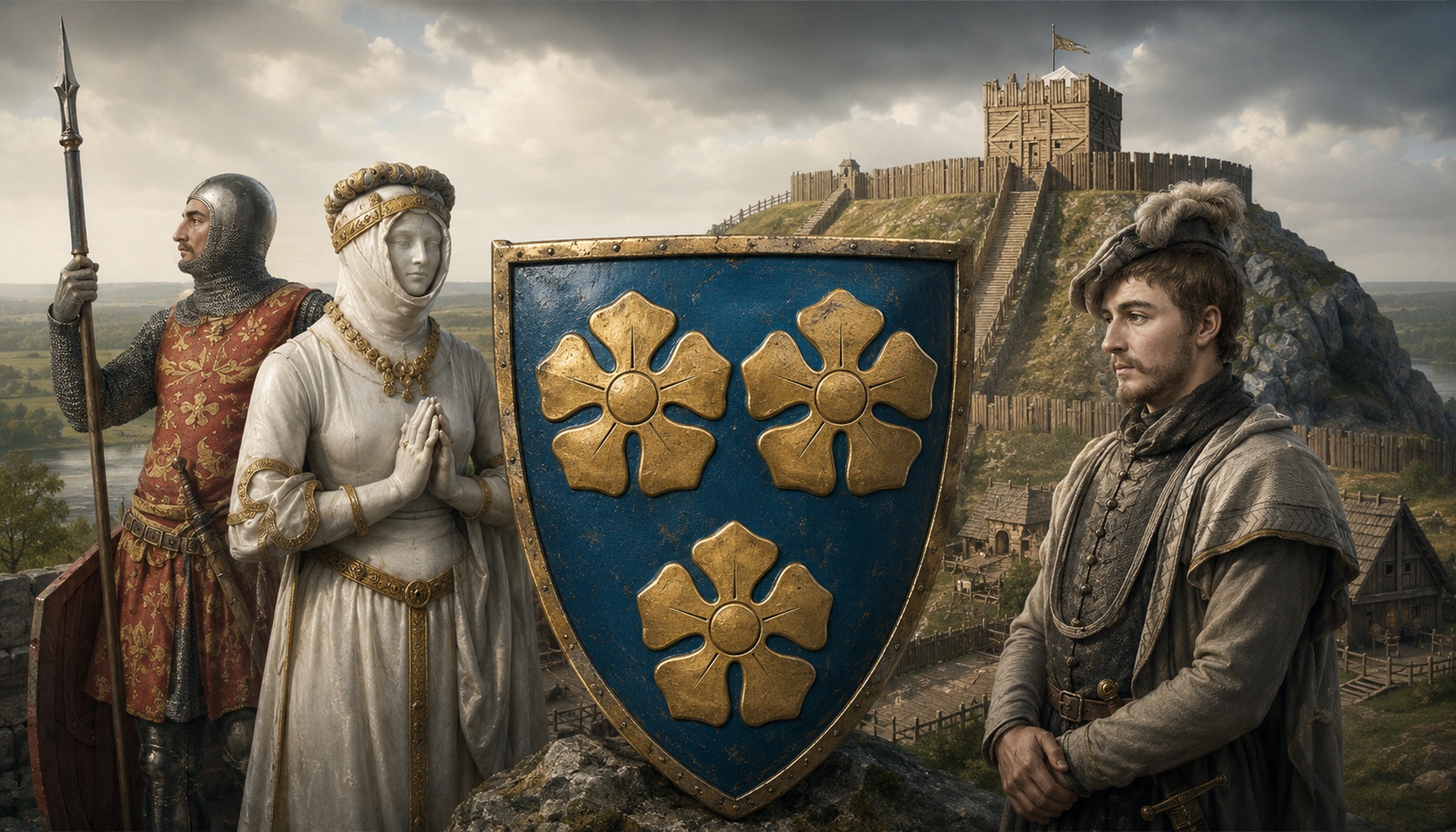
The Bardolf family were a medieval English baronial house, rooted above all in eastern England and especially in Norfolk, and their story belongs squarely to the hard-edged world of Plantagenet aristocracy. Their linked primary haplogroup here is R1b1a1b1a1a2a1a1, a branch associated in ancient DNA with a wide spread of western European lineages over a very long timespan. Historically, the Bardolfs rose not because they were romantic storybook nobles, but because they did what medieval barons had to do: hold land, serve kings, fight when called, marry well, and keep themselves useful at court. That was the machinery of noble power in thirteenth- and fourteenth-century England, and the Bardolfs worked it effectively for generations.
The family likely took its name from a place-name and emerged from the post-Conquest aristocratic world in which landed identity, lordship, and royal favor were tightly bound together. By the time we meet the great named Bardolfs, they were fully embedded in the upper ranks of English society. Hugh Bardolf, 1st Baron Bardolf (1259-1304), helped establish the family's standing; Thomas Bardolf, 2nd Baron Bardolf (1282-1357), John Bardolf, 3rd Baron Bardolf (1312-1363), and William Bardolf, 4th Baron Bardolf (1349-1386) carried that inheritance through a period marked by royal warfare, service, and shifting alliances. Then came Thomas Bardolf, 5th Baron Bardolf (1369-1408), whose rebellion against Henry IV ended in catastrophe after the Battle of Bramham Moor. In that one grim episode, the whole fragility of noble life is on display: one generation could inherit banners, estates, and rank; the next could lose everything through a failed choice of king, ally, or cause.
Read more about the House of de Lacy
The Bardolfs are especially anchored to Wormegay Castle in Norfolk, one of those places that makes medieval lordship feel suddenly real. Wormegay was not a fantasy castle of soaring towers, but a Norman earthwork-and-masonry stronghold whose surviving remains still speak very clearly of feudal control over land, movement, and people. The site includes a large motte and bailey, later strengthened with masonry, and it occupied a strategic position in the fen-edge landscape of west Norfolk. In other words, this was a working lordly center: administrative, defensive, symbolic, and practical all at once. It represented exactly the kind of seat from which a baronial family like the Bardolfs projected authority into the countryside. The earthworks remain visible today, and the site can still be visited from the exterior area, making it a rare chance to stand in the landscape that shaped the family's power and identity.
From a DNA perspective, the Bardolf-linked haplogroup R1b1a1b1a1a2a1a1 connects not to a proven single family line in the records, but to a wider web of related ancient male lines found across Europe and beyond. Among linked or related samples are Medieval Northern Spain Las Gobas (ldo049), Medieval England Cherry Hinton (ATP_PSN_950), Merovingian Frankish Eltville Germany (EV8), Anglo-Saxon Sedgeford in Norfolk (SED018, SED020, SED021), Bronze Age Melton Quarry in East Riding of Yorkshire (I7629), Bronze Age Constantine Island Cornwall (I16454), Celtic Briton Brassington Derbyshire (I12771), Iron Age Briton Worlebury Camp Somerset (I11143), Celtic Briton Thornholme Yorkshire (I14327), Celtic Briton Pocklington Yorkshire (I12413), and Viking-period or later northern European examples such as Hedeby (SWG006), Ribe (VK329), and Bogovej (VK365). The same broader lineage also appears in a striking range of Iberian and continental contexts, including multiple Bronze Age Murcia Almoloya Pliego samples such as ALM036, ALM039, ALM050, ALM052, ALM058, ALM063, ALM064, ALM070, and ALM081, as well as Iron Age and Roman-era sites in France, Sicily, Sardinia, Iberia, Bohemia, Hungary, Portugal, and even later historic burials such as St. Mary City Chapel Field Cemetery in Maryland (I35260) and a soldier of Napoleon's Grande Armee at Vilnius (YYY095A). None of this proves direct descent from the Bardolfs themselves, but it does place their linked haplogroup inside a deep, mobile, and unmistakably European archaeological story.
Read more about the Noble House of Percy
If the House of Bardolf catches your imagination, it is because their history shows medieval nobility in its full dramatic range: land, military duty, heraldry, royal service, ambition, and sudden ruin. Uploading your DNA to MyTrueAncestry can help you see whether you match this family's linked haplogroup, or related ancient DNA samples from medieval England, Anglo-Saxon Norfolk, Bronze Age Britain, and the wider European world that formed the backdrop to families like the Bardolfs.


Comments