The Howard Family
– 3 min read


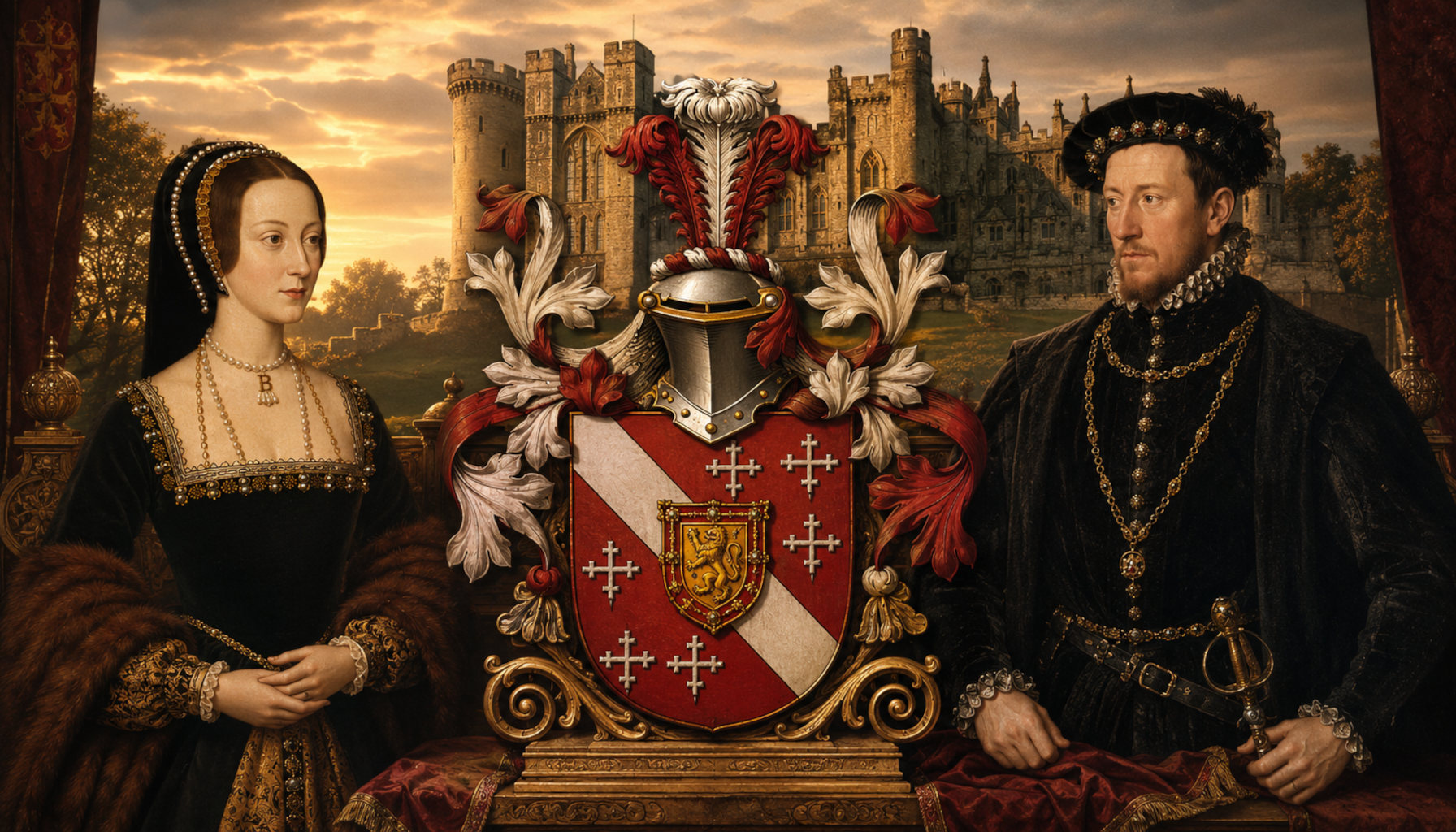
The Howard family was one of the great powerhouses of English noble history, a house of dukes, earls, soldiers, courtiers, and survivors, most famously known as the family of the Dukes of Norfolk and the Earls of Arundel. In haplogroup terms, the primary family line here is tagged as E1b1b1a1a1c1. Their story is rooted in late medieval England, where noble status was never simply inherited and safely kept, but had to be defended, enlarged, and sometimes rescued from disaster through service to the Crown, careful marriage alliances, and sheer political stamina.
The Howards emerged into the front rank of English aristocracy through a mixture of military achievement and inheritance, especially in the turbulent world of the 15th and 16th centuries. Thomas Howard, 2nd Duke of Norfolk (1443-1524), stands at the center of that rise: a major magnate who lived through the closing convulsions of the Wars of the Roses and helped carry his family into the Tudor age. The Howard name became tied to royal ceremony through the hereditary office of Earl Marshal, but also to royal danger. Their kinship network reached into the orbit of Henry VIII through Anne Boleyn and Catherine Howard, both connected to the Howards, and that proximity to the throne brought not just glory but recurring suspicion, factional struggle, imprisonment, and brushes with treason. Their arms themselves advertise memory and status, especially the augmentation recalling Flodden in 1513, where Thomas Howard, then Earl of Surrey, played a leading role in the English victory over the Scots.
One of the strongest architectural anchors for the family is Castle Howard in North Yorkshire, near York, a vast country house set in a carefully designed landscape of lakes, avenues, temples, and monumental views. Despite the name, it is not a medieval fortress but a grand baroque house begun at the end of the 17th century for Charles Howard, 3rd Earl of Carlisle, to the designs of Sir John Vanbrugh and Nicholas Hawksmoor. Its great dome, long facades, formal gardens, and later additions make it one of the most theatrical aristocratic houses in Britain, a place built as much to project dynastic confidence as to provide a residence. It has also become famous in modern cultural memory through film and television. Castle Howard can still be visited today, which is part of its appeal: it allows visitors to step into the world of elite display, lineage, and landscape-making that later branches of the wider Howard family cultivated so magnificently, even if the ducal Norfolk line is more closely associated historically with Arundel Castle in Sussex.
Read more about the Noble House of Arundell
The Howard family's tagged primary haplogroup, E1b1b1a1a1c1, also appears in a striking spread of ancient and medieval contexts. Related or linked samples include Phoenician Achzib Coastal Israel Acre individuals I11794 and I11788, Medieval Villa Magna Italy R59, and Kenya Kokurmatakore PIA I8904, as well as several individuals from Kulubnarti in Nubia: Makurian samples I19015, I19138, I6336, and I6252, and Early Makurian samples I18514, I18610, and I18612. That does not mean direct descent from any one of these people, and it would be quite wrong to pretend otherwise. What it does show is that this paternal lineage has a deep and geographically wide history, appearing in different societies around the Mediterranean, northeast Africa, and beyond. In other words, a noble English surname may sit atop a much older human story, one that archaeology and ancient DNA are only now letting us glimpse with any clarity.
The Howard family reminds us how noble history is never just about crowns and coats of arms. It is about survival across centuries, about land, marriage, ambition, memory, and the risks of standing too close to power. If you have Howard roots, or simply want to see whether your DNA connects with this family or with related ancient E1b1b1a1a1c1-linked samples, you can upload your DNA to MyTrueAncestry and explore the deeper human story behind your heritage.




Comments