The House of Habsburg
– 3 min read


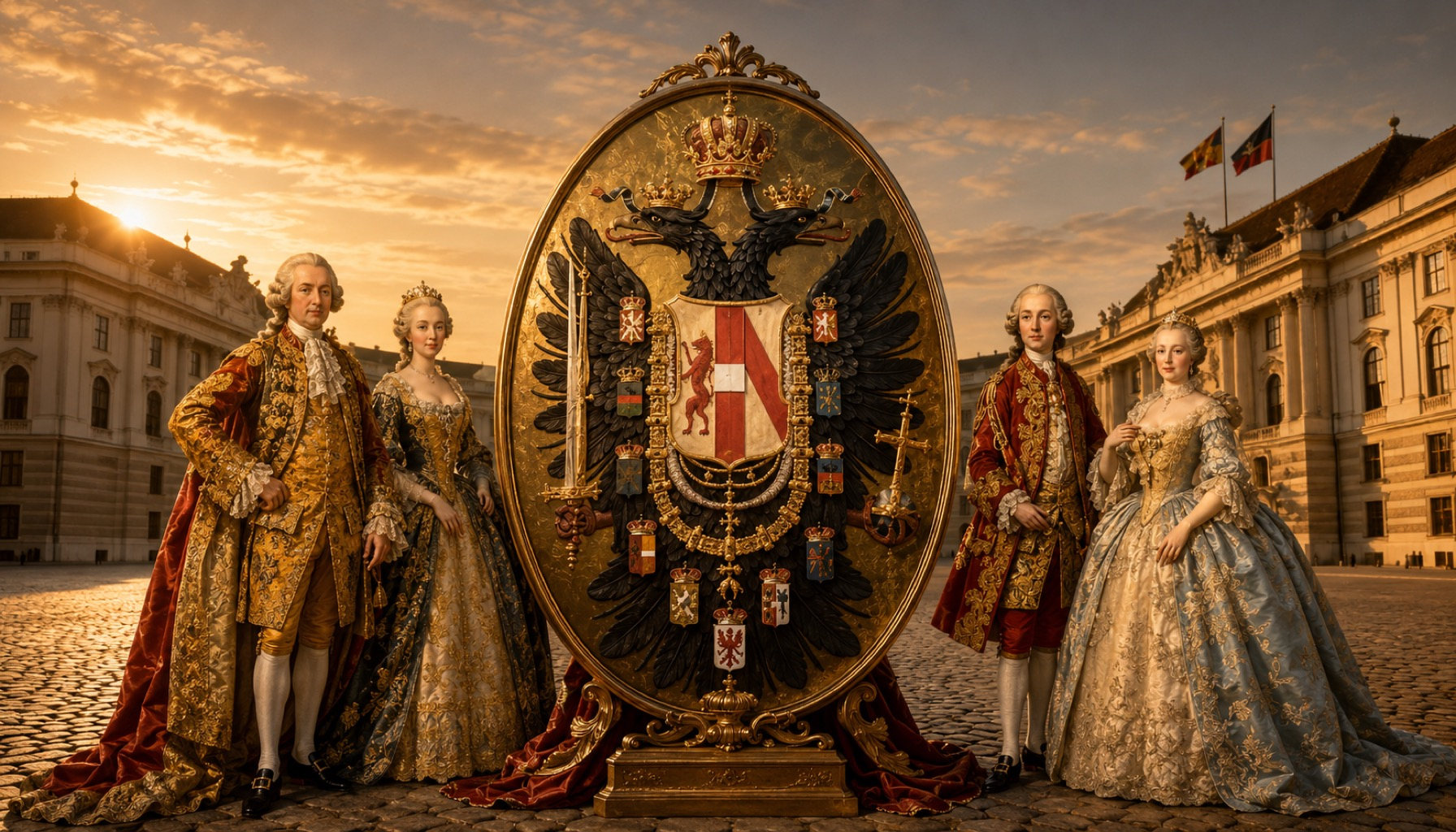
The House of Habsburg was one of the great ruling dynasties of Europe: a family that began as regional nobles in the Upper Rhine world, linked originally to Habsburg Castle in what is now Aargau in northern Switzerland, and rose over centuries into emperors, kings, archdukes, and queens ruling Austria, the Holy Roman Empire, Bohemia, Hungary, Spain, the Low Countries, and much of Italy. In genetic-tag terms, the primary family haplogroup associated here is R1b, one of the major Y-chromosome lineages found across western and central Europe. As ever, haplogroups are only one small thread in a much larger historical tapestry, but they give a useful deep-time marker for paternal-line discussion.
The remarkable thing about the Habsburg story is not that they suddenly appeared in imperial robes, but that they climbed with great patience through frontier lordship, marriage politics, and steady territorial accumulation. Before the later imperial glitter of Vienna and Madrid, there was the long Babenberg-Habsburg world of Austria and the eastern marchlands of the Empire, shaped by border warfare, Christian expansion, noble patronage, and the politics of the Danube. Figures such as Leopold I, Margrave of Austria, Henry I, Margrave of Austria, Adalbert, Margrave of Austria, Ernest, Margrave of Austria, Leopold II, Leopold III, Leopold IV, Henry II, Leopold V, Frederick I, Leopold VI, and Frederick II belong to that earlier Austrian ruling tradition that formed the political landscape the later Habsburg imperial house would inherit and dominate. By the later Middle Ages and early modern period, the Habsburgs perfected the family strategy summed up in their famous motto about letting others wage war while they married: dynastic marriage as statecraft, and family as empire.
Explore the Royal House of Wittelsbach
If one place captures the mature Habsburg world, it is the Hofburg in Vienna. This vast palace complex was not a single neat building but a layered accumulation of medieval fortress, princely residence, imperial court, administrative center, chapel, treasury, library, ceremonial apartments, and later monumental wings added across many centuries. In other words, it is exactly what one would expect from a dynasty that ruled not one tidy kingdom but a sprawling multinational monarchy. The Hofburg became the winter residence of the Habsburg rulers and the political heart of their courtly universe, where Spanish etiquette, Austrian government, Catholic ceremony, military planning, and dynastic display all came together under one roof, or rather under many roofs built in stages from the Middle Ages into the modern era. Today it remains one of Vienna's great historic sites and can still be visited, with sections such as the Imperial Apartments, Sisi Museum, Imperial Treasury, the chapel tradition, and surrounding monumental spaces offering a very tangible encounter with Habsburg power.
Read more about the Royal House of Savoy
For readers interested in the deeper population background behind a dynasty like the Habsburgs, the relevant point is not to claim direct descent from named ancient individuals, but to notice the broad and recurring presence of R1b-linked paternal lines across the archaeological record of Europe and neighboring regions. Related or linked samples include Neolithic Black Sea Ukraine Zaporizhzhia (UKR008), Middle Bronze Age Russia Kurgan Ergeninskiy (ERG007), Roman Era Cambridgeshire Duxford (DUX009), Roman Era Cambridge Outsider Vicars Farm (VIC003), Lombard Warrior Elite Collegno Northern Italy (COL_143, COL_143b, COL_143x), Lombard Collegno Northern Italy (COL_128), Avar Elite Hungary Hajdunanas (HNJ002), Post Roman Empire South Tyrol Malles Burgusio Santo Stefano (2428, 2428a, 2428b), Iron Age Bohemia Radosevice (I17614), Medieval Piast Era Poland Silesia Milicz (PCA0559), Medieval Kingdom of Poland Piast Dynasty Zielonka Poznan (PCA0571), Medieval Belgium Sint-Truiden samples such as ST2073 and ST2525, Bell Beaker and Bronze Age central European samples such as I0559, I0439, poz929, and several Czech and Bavarian finds. Taken together, these do not identify "the Habsburg DNA" in any simple sense, but they do place a dynasty associated with Austria and the old Holy Roman world inside a long archaeological corridor of R1b-bearing populations stretching through central Europe, the Danube zone, and western Europe over millennia.
Explore ancient DNA of Hungary's Arpad dynasty
The Habsburgs matter because they show how a family could become a framework for governing half a continent: through marriage contracts, inherited crowns, court ritual, religious identity, and the stubborn mechanics of dynasty. If your own family history points toward Austria, Hungary, Bohemia, Spain, the Low Countries, Germany, or the wider Habsburg orbit, uploading your DNA can help you see whether you match this family story or related ancient R1b-linked samples from the same broad historical world.




Comments