The Royal House of Savoy
– 3 min read


The House of Savoy was one of Europe's oldest ruling dynasties, born in the Alpine lands of Savoy between modern France, Italy, and Switzerland, and traditionally linked here with the haplogroup R1b1a1b1a1a2b1a. That setting matters enormously. This was not a family that emerged from some sleepy corner of Europe, but from a hard-edged frontier of passes, tolls, castles, bishops, and rival kingdoms. In the early Middle Ages, the Savoys rose as counts in the old Burgundian world, steadily turning mountain geography into political power. Whoever held the routes through the western Alps could tax movement, control armies, and broker diplomacy between northern Europe and the Italian plain. The family did all three with remarkable skill.
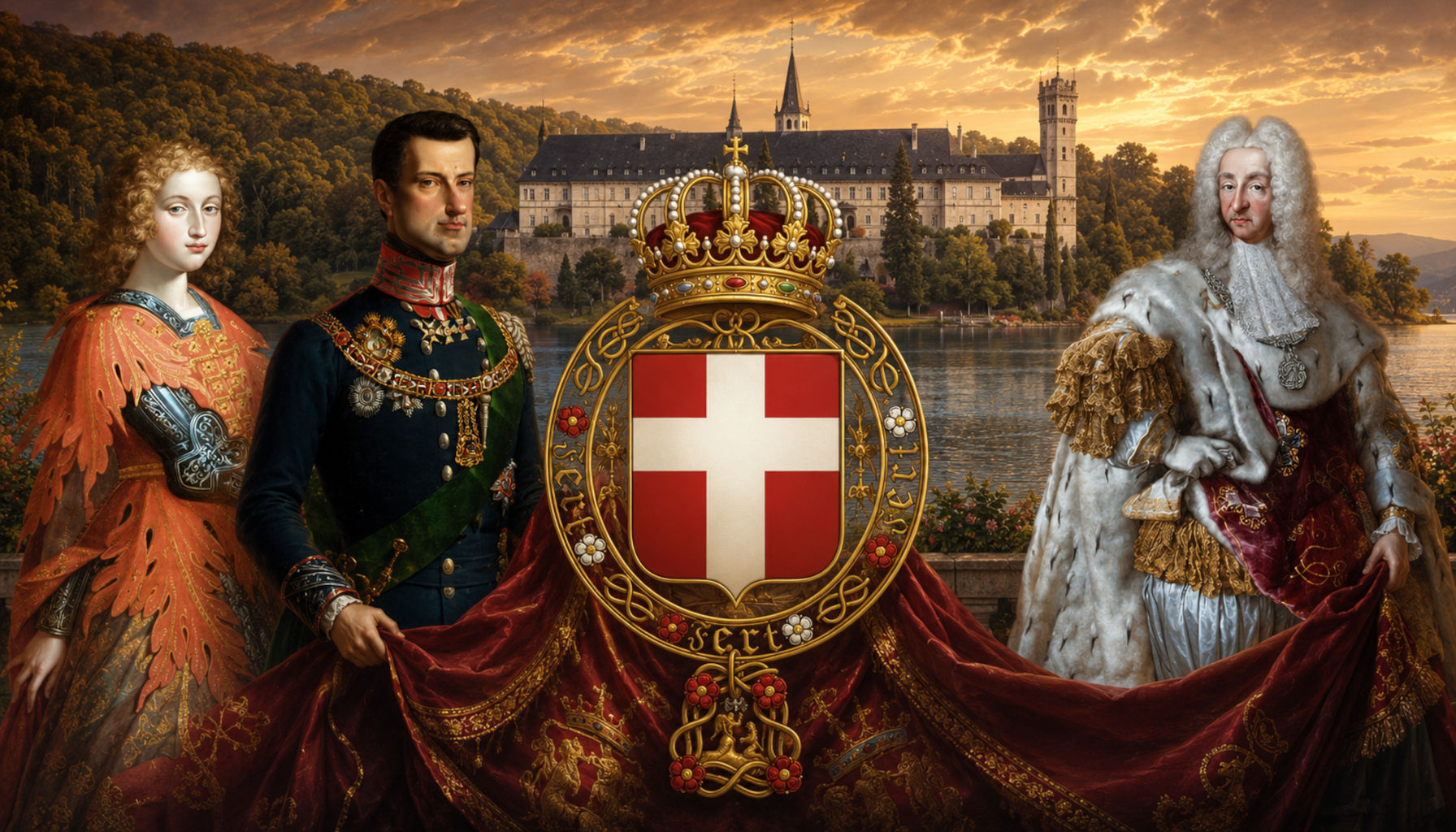
Tradition places Humbert Count of Savoy, often called Humbert Whitehands, around the year 980 at the beginning of the line's clear historical ascent. From there the dynasty expanded by marriage, military service, ecclesiastical alliances, and careful opportunism. Over centuries they became counts, then dukes, then rulers of Sardinia, and finally kings at the heart of Italian unification. Their famous red shield with a white cross became one of the great visual brands of dynastic Europe, instantly recognizable and freighted with crusading, chivalric, and sovereign meaning. Figures such as Emmanuel Philibert, Victor Amadeus II, Charles Albert, and Victor Emmanuel II, first king of united Italy, show just how far this Alpine house travelled: from frontier lordship to the throne of a modern nation-state. Hautecombe Abbey on Lake Bourget, long a burial place of the dynasty, helped turn family memory into sacred ancestry, the dead themselves enlisted in the business of legitimacy.
Explore the Royal House of Wittelsbach
A key location anchor for the dynasty is the Chateau des ducs de Savoie in Chambery, which became one of the most important political centers of the Savoyard state. More than a single medieval fortress, it developed over centuries into a complex seat of residence, ceremony, and administration, reflecting the family's growth from regional counts into major European rulers. The castle was tied to the period when Chambery served as capital of the States of Savoy, before the political center shifted toward Turin. Its fabric preserves that layered history: fortified elements, residential wings, courtyards, chapels, and later alterations that speak not just of defense but of government and display. In other words, this is exactly the sort of place where one sees monarchy being built in stone, office by office and chamber by chamber, not simply inherited in a blaze of heraldry. The site still stands in Chambery and can be visited, making it a particularly vivid stop for anyone trying to understand how Savoy turned Alpine authority into durable state power.
Read more about the Royal House of Stewart
From an ancient-DNA perspective, the Savoy-linked haplogroup R1b1a1b1a1a2b1a belongs to a very wide and deeply rooted western and central European paternal landscape. It appears in related or linked ancient samples from many periods and regions rather than in any one single "Savoy" population. Among the more geographically relevant examples are Gallo-Celtic Switzerland Pont de Cornaux-Les-Sauges samples 3434x, 3434, and 3439, Dark Ages Italy Bardonecchia samples Bard_T2 and Bard_T6, the Gallic Cenomani samples from Verona such as 3220 and US3159, and Etruscan-era Tarquinii samples including TAQ018A, TAQ018B, and TAQ018x. Wider parallels include Medieval Northern Spain Las Gobas samples ldo066, ldo037, ldo048, and ldo062; elite Celtic burials in Germany such as APG001, APG003, and LWB001; Roman and Gallo-Roman examples like FEN008 and the Metz Lunette Sablon group; and still older Bronze Age finds from Unetice contexts in Thuringia such as LEU024, LEU025, and LEU055. None of these individuals should be described as direct ancestors of the House of Savoy on present evidence. But together they show how a lineage of this kind sat within long-running networks of Alpine, Celtic, Italic, Burgundian, and western European population history stretching back well before the dynasty first appears in medieval records.
If the story of the House of Savoy speaks to your own family history, the next step is wonderfully concrete: upload your DNA and see whether you match the family or related ancient DNA samples connected with this wider R1b1a1b1a1a2b1a world. It is a chance to place your results against real archaeological individuals and the long human story behind dynasties, frontiers, and kingdoms.

Comments