Regional adaptation to Neolithic farming in ancient Western Eurasian genomes
– 5 min read


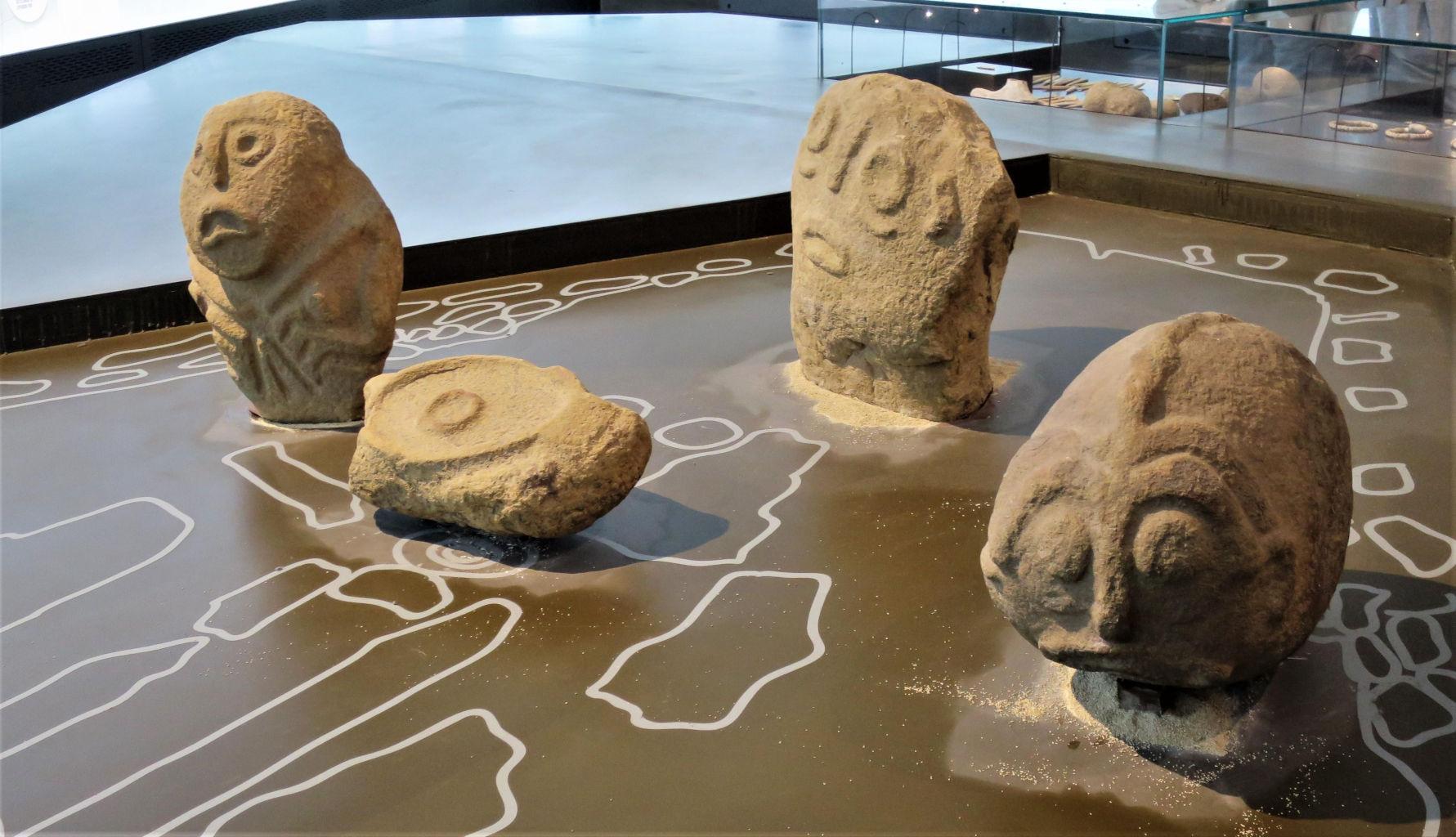
Along the Danube's great gorge, prehistoric Europe produced one of its most extraordinary landscapes. Lepenski Vir, the region's best-known site, challenges old assumptions about hunter-gatherers as scattered nomads. Here stood communities with architecture, monuments, and elaborate burials suggesting deep attachment to place. The settlement's trapezoidal buildings, laid with lime plaster floors, housed sculpted boulders bearing fish-like and human features — among Europe's earliest monumental carvings. The river fed this world both physically and symbolically.
What makes the Iron Gates remarkable is that it became a meeting ground. Incoming farmers from the southeast brought domesticated plants, animals, and new ways of life into contact with established foragers. The evidence lives in the bodies of ancient individuals themselves. One person, living before 6000 BCE, carried ancestry from both hunter-gatherers and farmers — pushing the story of mixture to an unexpectedly early date. This was not farmers replacing foragers. It was people meeting, having children, and reshaping one another's worlds.
Burials here are particularly vivid. The dead were placed within or beside houses, binding them to the spaces of the living. Bodies arranged near hearths, floors, and sculpted stones carry ceremonial force beyond any inventory list. The Iron Gates stands as one of Europe's best places to witness adaptation as lived history: individual lives and local graves opening into one of prehistory's great turning points.
Farming changed almost everything — diet, movement, settlement, disease, and how the dead were remembered. Before this shift, European communities lived as hunter-gatherers, often semi-settled and deeply knowledgeable about local landscapes. Then came people connected to the first farming worlds of the Near East, bringing not just crops and animals but entirely new rhythms of life. A field must be watched. Herds must be managed. A village binds people together — and traps them in one another's company.
This transformation was not a single event. In some regions farmers mixed quickly with local foragers; elsewhere the process was slower. Graves capture the changing world beautifully: carefully placed bodies accompanied by pottery, stone tools, and ornaments signalling new forms of wealth and belonging. Specific individuals make this vivid — a person of mostly farmer ancestry appearing in a landscape still shaped by forager traditions, their very bones a record of cross-cultural connection.
Early farming could be biologically costly. Skeletons show nutritional stress and heavy labour. Yet farming supported denser, reproducing communities, driving long-term demographic expansion. Crucially, local hunter-gatherer knowledge remained valuable. The people who flourished were often those in already-blended worlds — part farmer, part forager, part migrant, part local.
Once farming spread and populations mixed, which inherited traits helped people thrive? The answer is neither simple nor one-sided. Traits from both farmers and hunter-gatherers mattered, and what proved useful varied by region.
Immunity produced the strongest signals. Larger settlements and close contact with domesticated animals transformed the disease landscape, favoring variants in pathogen-recognition systems — though a more reactive immune response also risked harmful inflammation. Diet left traces too: some late Neolithic groups show selection for variants linked to higher haemoglobin levels, possibly helping offset iron deficiency from starchy, meat-reduced diets.
More surprising signals emerged around behaviour, reproduction, and even smell. Hunter-gatherer-linked variants near genes affecting taste and olfactory perception suggest that navigating different foodways involved inherited sensory differences. Variants connected to fertility hint that demographic expansion was tied to reproductive biology, not food production alone. Throughout, the pattern is regional rather than universal — mixed communities in Ireland, Germany, and Portugal favored different variants. Local ecology, disease, and diet shaped outcomes differently everywhere, making adaptation look less like progress and more like a patchwork.
Whole-genome analysis reveals adaptation beyond single DNA changes. Larger structural features — deleted or duplicated stretches, repetitive sequences once dismissed as clutter — show their own prehistoric stories. Several such changes differed sharply between farmers and hunter-gatherers, suggesting adaptation involved major genomic rearrangements, not just small tweaks.
A duplication more common among early farmers affected a region possibly protective against autoimmune overreaction — fitting the broader tension between immunity and inflammation in farming settlements. Hunter-gatherer deletions clustered near smell-related genes, raising the tangible possibility that different environments favored different sensory capacities. Even repetitive sequences varied between populations, with mixed communities showing patterns beyond simple blending of their source groups.
Every structural signal comes from a real buried person. A deletion or duplication belonged to someone who lived in a house, ate particular foods, survived or succumbed to infection, and was buried by others. The genome is an archaeological site in itself — full of major features, minor traces, and unexpected architecture. Prehistoric adaptation emerges as intricate, regional, and thoroughly human.
Few discoveries make the ancient past feel more immediate than evidence of disease. In the remains of an early farming individual from the Iron Gates, researchers detected hepatitis B virus — enough to reconstruct the ancient strain in detail. Dating to around 6000 BCE, this represents one of the earliest known examples of a Neolithic-associated hepatitis B lineage, placing the Balkans once again as a gateway — not only for people and farming, but for pathogens.
The individual's bones may even show deterioration consistent with chronic infection. Archaeology usually deals in collectives; here, disease restores a singular life. The find fits a compelling pattern: farming's larger, denser settlements made transmission easier, domesticated animals altered the surrounding microbial world, and greater human movement carried infections further. The Neolithic was not just a food revolution — it was an epidemiological one.
Seeds, animals, pottery, people, and pathogens travelled together. That continuity is startling — a virus still familiar today preserved in an eight-thousand-year-old burial beside the Danube. It reminds us that the rise of farming transformed not just fields and villages, but the intimate biological relationships between humans and the organisms that lived with, within, and against them.
 View ORCID Profile
Comments