Genetic ancestry of ancient Amiternum from Roman to early medieval Italy

– 5 min read


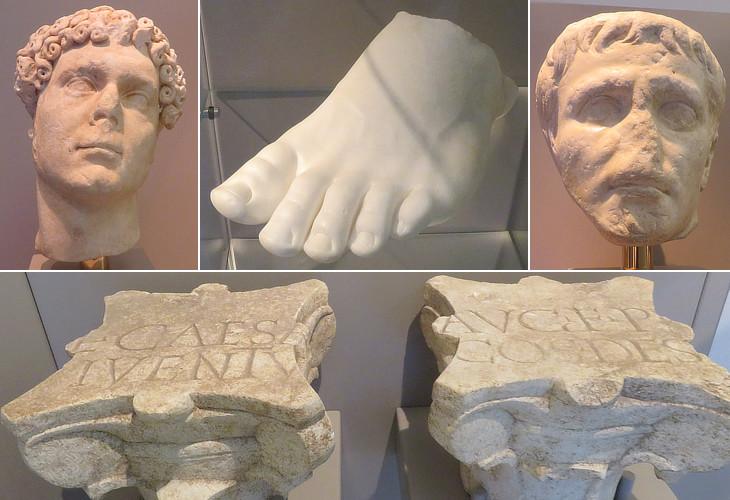
In the uplands of Abruzzo, near modern L'Aquila, the buried city of Amiternum occupies a curious space between grandeur and ruin. Once a proper Roman town with public buildings and civic swagger, it later became a Christian landscape of bishops, churches, and burial grounds. That long life is what makes the site arresting. It is not one frozen moment in time but a place that changed its face repeatedly while people kept returning, building over the old, burying their dead beside walls already ancient.
The most dramatic focus is the Cathedral of Santa Maria in Civitate, built within the old urban fabric. Excavation revealed no simple single-phase building. Beneath it lay traces of construction stretching back into the Roman period. The cathedral grew from a landscape already heavy with memory. Stones were reused. Sacred space was layered onto civic space. A city became a holy place.
That transformation is one of the great stories of late antiquity. Forums and baths lost their central role while churches and cemeteries took on new importance. Amiternum is a vivid example because the archaeology lets that change be seen almost underfoot. The old city was not destroyed but reshaped, with Christian communities settling into the bones of the Roman town and making them their own.
Something especially striking is that most graves belonged not to warriors or aristocrats but to infants, children, and young people. The archaeology speaks of family loss and the careful use of sacred space over time. The great historical shifts of post-Roman Italy are seen here not in kings and conquests but in the burial of children beside a chapel wall.
The burial ground at Santa Maria in Civitate is remarkable not for splendid objects but for what it reveals through space, age, and repetition. Sixteen individuals were sampled, nearly all from graves associated with the cathedral complex. Their arrangement matters enormously: some in single burials, some in double burials, most grouped tightly in a funerary chapel attached to a Lombard-period building.
The strongest impression is the concentration of young dead. Infants appear again and again alongside small children and one young woman. The funerary chapel seems to have been a privileged space. Thirteen individuals were buried there in a relatively small area, suggesting the spot was desirable. In the early medieval Christian world, burial close to an altar carried deep symbolic weight, bringing the dead physically near the liturgy and spiritually near the holy.
Grave goods are mostly absent. No weapons, jewelled brooches, or lavish ornaments define rank. Instead, privilege lies in location. Space itself was the currency of status. One object stands out: a plain two-handled cup found with a double burial, modest almost stubbornly so, pointing to changing customs as display faded and sacred setting grew more important.
Radiocarbon dating places most burials between the late seventh and ninth centuries, with one individual extending into the eleventh century. Generations returned to the same sacred precinct across centuries, suggesting memory attached not only to the church but to particular burial areas within it.
Among all individuals uncovered at Amiternum, one stands apart with almost theatrical force. The only adult male, the only burial dating centuries earlier than the rest, and the only person placed outside the main cathedral cemetery. An older adult, perhaps late thirties to fifty, he was buried in a small masonry structure near what later became the cathedral complex.
His date places him in late antiquity, roughly the third to seventh centuries, predating the cluster of early medieval graves by several hundred years. His grave was not simply dug in ordinary earth but constructed with architectural care, suggesting special standing. More intriguing still, it lay close to one of the earliest Christian structures in the area, possibly an oratory linked to the emerging local community, raising the tantalising possibility that he held a distinctive role as patron or cleric.
The contrast with later graves is striking. He is an adult among children, early among late, separate among clustered. His burial belongs to a phase when interment near an urban building was unusual and notable. He represents the late Roman community from which the later Christian and medieval community emerged, and his existence proves the area held funerary importance long before the dense sequence of child burials began.
Several children buried in the chapel were close biological relatives, turning a cluster of graves into a family story unfolding across sacred ground. Three children were especially close, probably siblings or near-equivalent first-degree relatives. Two were buried in the same grave while a third lay nearby. Two further children showed more distant third-degree kinship, suggesting a broader network of related people using the same chapel area over time.
This matters because family identity was one of the great organising forces of early medieval society. A chapel attached to a church wall was not merely convenient ground but a prized location where remembrance and religion overlapped. To bury one child where an older relative already lay was to insert that death into an existing family narrative.
The predominance of children makes the story all the more poignant. In a world with high child mortality, grief was painfully familiar. Yet the chapel burials preserve the accumulated sorrow of repeated childhood death and the determined response of a community that gave those children sacred space. Since almost no lavish objects exist, place itself did the work. The walls of the chapel, the nearness to liturgy, and the repeated use of the same burial area created meaning where material display was absent.
The grand historical theme running through Amiternum is transformation: the long shift from the Roman world to the medieval world in central Italy. The older adult male buried here belongs to a broad Roman horizon of mobility and mixture. The early medieval cathedral burials tell a different story: a locally coherent community using church burial as its central expression of identity, with sacred site replacing civic city as the social centre.
The cathedral cemetery catches the moment when medieval Italy was taking shape, spanning the transition from Lombard to Carolingian control in the late seventh to ninth centuries. One striking conclusion is that burial location mattered more than grave wealth. The dead are defined by where they are laid, not what they carry, a sign of a medieval Christian order where sacred topography expressed rank, family identity, and communal belonging.
The site reflects a blend of continuity and change. Earlier architecture was incorporated into the later sacred complex. The Roman past was not erased but reused and transformed. Meanwhile the population represented by the burials was shaped by post-Roman movements while retaining a strongly Mediterranean base. Medieval central Italy was formed from both local roots and incoming influences, and Amiternum lets one watch that formation happening.
What survives in the ground is the human texture of that change. Not the slogans of conquerors but the choices of mourners. Not armies but the quiet insistence that a child should lie near the altar, that kin should rest together, that old urban space could be made holy. The transformation from Roman to medieval Italy was made of countless such acts, and Amiternum preserves them with unusual clarity.
https://www.cell.com/iscience/fulltext/S2589-0042(26)03164-0



Comments