Paleogenomics of Ancient Italian Islands
– 6 min read


Sicily's earliest people survive not in chronicles but in caves: limestone chambers holding broken bones, stone tools, and burials that have become almost characters in their own right. Grotta di San Teodoro, Grotta d'Oriente, Grotta dell'Uzzo, and Addaura together open a window onto Ice Age and Mesolithic hunter-gatherers navigating a changing island world.
San Teodoro, near Acquedolci, is a human archive. Seven individuals were recovered there, including ST1, among the oldest securely dated Sicilians, living roughly fifteen thousand years ago. The cave's burials suggest these chambers were meaningful places where the dead remained within the living landscape. Genetic study reveals these people belonged to the broad world of western European hunter-gatherers, yet their island setting gave the story a special edge. Sicily was not a dead end but a threshold between mainland Italy and sea routes now partly drowned by rising seas.
Grotta d'Oriente on Favignana provides intimacy. When sea levels were lower, Favignana was connected to the mainland. Its burials include Oriente B, a nearly complete Mesolithic skeleton rare anywhere in the Mediterranean, and Oriente C, reaching back into the Late Upper Palaeolithic. The cave was returned to and reused across centuries, hinting at shared traditions and landscapes of belonging.
Grotta dell'Uzzo spans hunter-gatherers into the first farming communities, revealing that Sicilian forager life was not static. Earlier and later groups differ subtly, suggesting the island connected occasionally to wider European movements, turning the stereotype of the closed island on its head. Addaura adds vivid cave art alongside fragmentary skeletal finds, confirming that Late Ice Age Sicily was culturally rich, not marginal.
These earliest Sicilians stand before farmers, bronze, Phoenicians, and Greeks. They are not merely ancient islanders; they are the first chapter of Sicily itself.
Farming reached the islands not through drifting ideas but through people moving by boat, bringing crops, herds, and pottery. Sicily and Sardinia were stepping stones and destinations in this transformation, not remote spectators.
Grotta dell'Uzzo preserves both the end of the hunter-gatherer world and the beginning of farming in one location. Human remains show that the earliest farming groups were markedly different from the Mesolithic people before them. New people had arrived carrying the wider genetic signature of Europe's first farmers. Fossato di Stretto Partanna in the province of Trapani reinforces this picture, aligning with the first farmer profile seen across the continent.
Neolithic life meant pottery, grinding tools, stored foods, herded animals, and more lasting claims to place. Burials reflect these changed rhythms of sowing, harvest, and livestock care. Communities rooted to land began making the dead visible markers of ancestry and territory.
Sardinia's Neolithic evidence, though sparser initially, blossoms at sites including Sant'Elia Taramelli, Cuccuru is Arrius, Sinzureddus, and Grotta Rifugio di Oliena. These connect the island's first farmers to the same broad ancestry seen elsewhere in Europe. Cuccuru is Arrius, set amid rich wetland resources, evokes communities balancing cultivation, herding, fishing, and gathering. The break between earlier hunter-gatherers and incoming farmers was substantial on both islands, with older Mesolithic populations contributing little to later farming groups. Yet crossing the sea was never trivial. Every migration required built boats, transported animals, and the willingness to trust an unknown shore.
The Bronze Age brings recognisable societies into view: tombs, fortified settlements, distinctive pottery, and far-reaching exchange. The dead remain the best witnesses, now accompanied by grave goods and signs of ambitious contact.
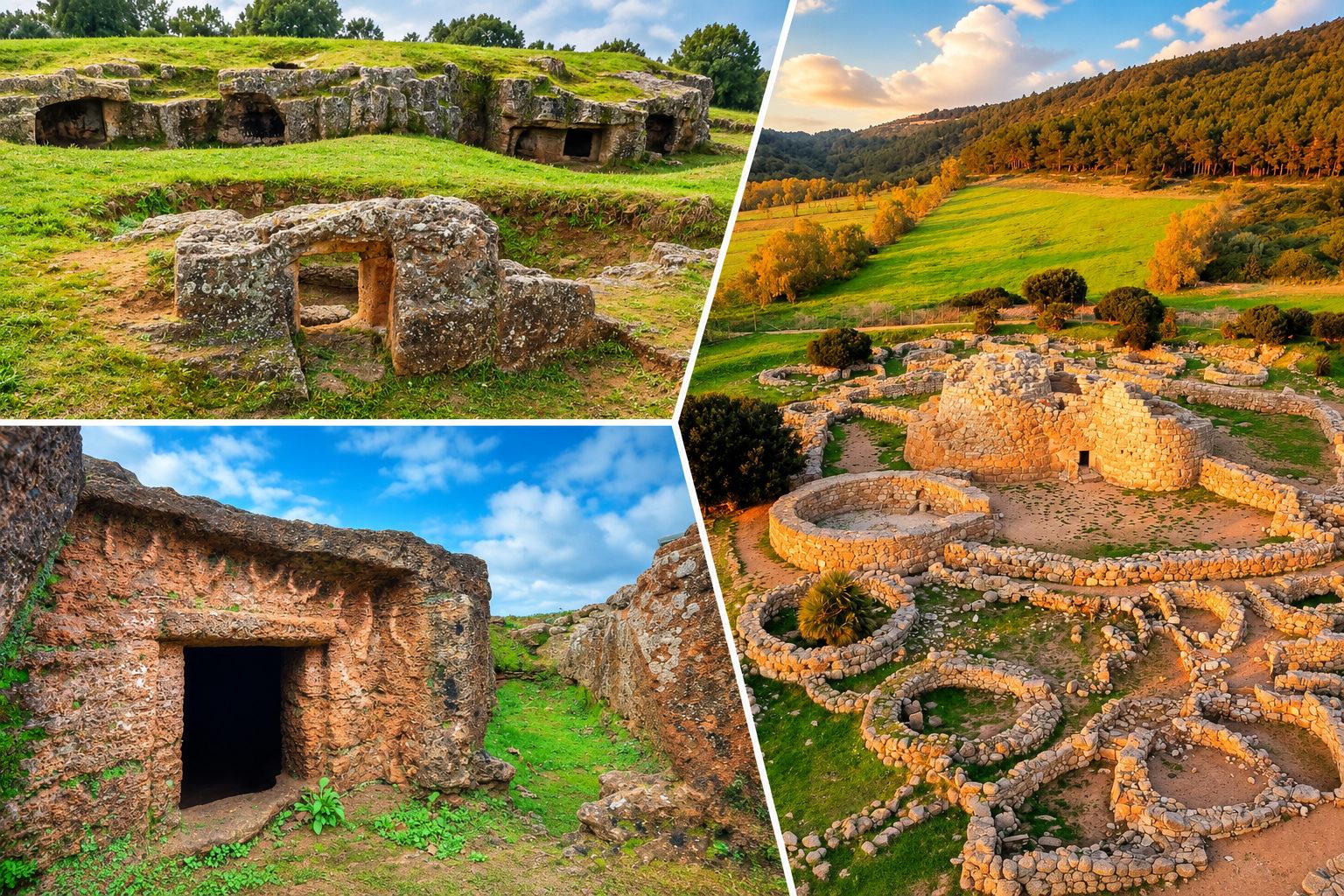
In Sicily, the Castelluccian culture at sites like Contrada Granaro at Comiso produced rock-cut chamber tombs and local ceramics. Mokarta in western Sicily offers a commanding settlement with nearby burials rooting its inhabitants in a world of households, exchange, and regional identity. Ispica adds further rock-cut funerary features, showing communities shaping the landscape through durable tomb architecture.
The question of new ancestry makes Sicilian Bronze Age especially exciting. The steppe-linked ancestry that reshaped much of mainland Europe appears delayed and uneven here, suggesting Sicily filtered wider movements in its own way. One individual associated with Bell Beaker culture lacked the expected steppe ancestry entirely, a reminder that pottery styles can travel farther than migrants.
Sardinia's Bronze Age is dominated by the Nuragic world. Stone towers called nuraghi dot the island, representing organised labour, strong identity, and impressive architecture. Giants' Tombs at sites like Gesico Muttas Nieddas gathered dozens of individuals across generations, making them powerful stages for reading kinship, hierarchy, and memory. Mont'e Prama adds extraordinary stone sculptures of warriors and archers, where the dead were buried beneath figures larger than life.
A great discovery for Sardinia is genetic continuity. Through the Neolithic, Copper Age, and Bronze Age, the island maintained a relatively stable profile, meaning the Nuragic world was built by descendants of earlier islanders rather than intrusive arrivals. Yet contacts across the sea were real, and one individual even showed North African-related ancestry, illustrating the Mediterranean truth that strong local traditions and wide networks can coexist.
The Iron Age brings a full cast onto the stage. Indigenous groups, Phoenician traders, Greek colonists, Punic communities, Romans, and later Byzantine powers all leave marks. Cemeteries multiply, cities appear, and burials tell stories of mobility, mixture, and cultural ambition.
Polizzello in inland Sicily is one of the most important sites for understanding a Sican world. Individuals recovered there share a profile distinct from later, more cosmopolitan Sicilians, possibly preserving Bronze Age continuity while coasts grew entangled with Mediterranean powers. Baucina offers another indigenous context touched by Greek influence, where pottery style, body treatment, and ancestry do not always tell the same story.
Mozia, situated on a small island off the west coast, was a major Phoenician and Punic settlement. Its burials reveal how mobile Punic Sicily could be. Some individuals show stronger eastern Mediterranean or North African connections; others sit closer to local Sicilian backgrounds. A trading colony pulls in merchants, sailors, labourers, and local partners, and the dead at Mozia preserve this complicated community in human form. Selinunte, originally Greek but later Punic, shows both worlds meeting in its cemeteries. Marsala, ancient Lilybaeum, adds further western Sicilian burials marked by heterogeneity.
The burial from Lipari carries a strong North African signal, a fitting reminder that the Roman empire was a machine of mobility. Modica offers two likely related individuals from around the late Republican period, sharpening the emotional edge of archaeology by introducing family into the record. Licodia Eubea carries the story into Late Antiquity, anchoring the island's later sequence near the threshold of medieval Sicily.
Sicily's burial grounds from Polizzello to Licodia Eubea are chapters of one island that never stopped receiving and reshaping people. It was one of the busiest crossroads in the ancient Mediterranean, and its cemeteries knew it first.
Sardinia kept strong local traditions for a very long time, but it was never frozen. Across the Iron Age, Punic period, Roman rule, Late Antiquity, and the Middle Ages, new people and ideas kept arriving, especially along the coasts.
By the early first millennium, Phoenician traders were drawn to Sardinia's harbours. Bithia in the south became part of the network linking the island to Carthage and the wider central Mediterranean. Its burials show some individuals close to older Sardinian patterns while others hint at stronger outside connections, exactly what a port community should look like: mixed, active, and socially layered. Ortacesus, though inland, produced a large Punic-into-Roman cemetery where dozens of individuals reveal variety within the community itself, including differences of ancestry and burial treatment.
Sarroch gives a Roman coastal perspective. San Saturnino in Cagliari opens the window onto early medieval Sardinia, where cemeteries belong to Christian centuries and urban reorganisation yet remain archaeologically powerful by connecting later city-dwellers to much older islanders buried beside nuraghi. Bastione di Santa Caterina and San Lucifero carry the story into medieval and early modern Cagliari, showing an island still open to movement.
Castelsardo in the north is particularly valuable. Its early modern individuals differ from some southern Sardinian groups, reflecting northern exposure to movement from Corsica, Tuscany, and the Tyrrhenian world. Sardinia is not one genetic block but an island of regions, where harbour and route matter as much as time period in shaping identity.
Despite all external contact, much of Sardinia still preserves an unusually strong inheritance from its early farming populations. Later arrivals changed the island but did not replace it. Giants' Tombs proclaim collective ancestry in stone; Punic cemeteries mark maritime exchange; Roman burials reflect imperial mobility; medieval graves register Christian urban change. Each burial ground captures a moment in one long island biography, showing Sardinia not as a sealed relic but as a resilient society in constant conversation with the sea.
Comments