Balkan Hunter-Gatherers Shaped Post-Ice Age Europe
– 5 min read


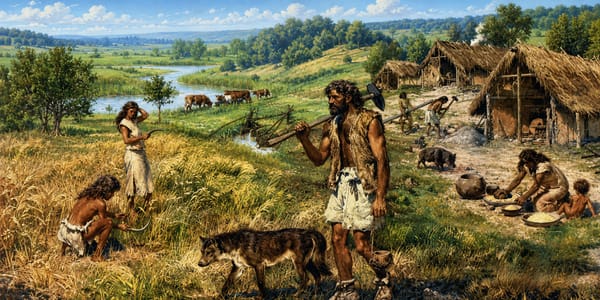
When ice and bitter cold gripped most of Europe during the last Ice Age, the Balkans emerged as one of prehistory's great human refuges. River valleys, caves, and sheltered landscapes allowed people to endure where others could not. Far from a forgotten backwater, this region became a powerhouse of survival and renewal.
Three sites anchor this story: Climente II in Romania, Badanj Cave in Bosnia and Herzegovina, and Franchthi Cave in southern Greece. These were hunter-gatherer places — caves and rock shelters used by mobile communities who followed game, knew rivers intimately, and buried their dead in meaningful locations.
Climente II is especially vivid. Three individuals spanning roughly 14,800 to 11,200 years ago reveal a sequence of human continuity: an adult male from near the Ice Age's end, a buried neonate whose tiny grave speaks of grief and tenderness, and a later adult male who lived as climates warmed. The neonate's burial is particularly moving — even in a hard world of hunting and seasonal movement, infant death was marked with ceremony recoverable thousands of years later.
Badanj Cave pushes deeper still. Its individual dates to around 16,500 years ago, showing this Balkan population already present in the western Balkans shortly after the worst cold. At that time, sea levels were dramatically lower and a vast plain now drowned beneath the Adriatic connected Italy to the Balkans — a lost corridor where animals ranged and humans travelled, hunted, and met.
Franchthi Cave's Mesolithic male, dated to roughly 10,500 years ago, appears to preserve unmixed Balkan ancestry well into the post-glacial world, suggesting remarkable continuity across centuries of change.
Italy has long been seen as a sealed Ice Age refuge. The evidence tells a more dynamic story. When the Balkans expanded westward across the partly dry Adriatic plain, they transformed Italy's population through sustained movement and mixture rather than simple conquest.
The resulting population carried roughly three quarters Balkan-related ancestry, about one fifth from older Italian groups, and a small remainder linked to populations farther west. This was absorption on a grand scale — messier and more human than clean replacement, producing a patchwork of regional variation.
A woman from Grotta Romanelli in Apulia, dated to around 13,300 to 12,800 years ago, exemplifies this mixed population. Her southern Italian location, facing the Balkans across what was once a narrow and partly connected sea, places her precisely where contact would have been most intense. Sicily's Mesolithic inhabitants show even higher Balkan-related ancestry, suggesting continued maritime connection long after the Adriatic plain flooded. Sardinia, too, was touched by these changes, as a Mesolithic man from S'Omu e S'Orku dated to around 9,400 to 9,100 years ago suggests.
Italy ultimately served as both meeting ground and launching point. Through this mixed population, Balkan ancestry gained a new form and a far wider future across western Europe.
Long before the first farmers arrived, the Aegean was already a zone of movement and mixture. Two sites reveal this clearly: Franchthi Cave on the Greek mainland and Maroulas on the Cycladic island of Kythnos.
The Franchthi man represents continuity — Balkan ancestry surviving intact in mainland Greece into the Mesolithic. Maroulas tells a different story. A woman dated to around 9,000 to 8,650 years ago and a male child from several centuries later both carry ancestry intermediate between Balkan hunter-gatherers and ancient Anatolians. The sea was not a barrier but connective tissue, and the blending had already occurred generations before these individuals lived.
The Maroulas child is particularly compelling — a young person buried on an Aegean island, part of a seafaring community already carrying blended heritage centuries before farming transformed the region. When agriculture eventually arrived, it did not enter a sealed world. It encountered populations already shaped by mobility and cross-sea interaction.
The Balkan refugium's reach extended far beyond the Mediterranean. Post-glacial hunter-gatherers across Scandinavia, eastern Europe, and regions stretching toward Central Eurasia owe their European ancestry primarily to the Balkans — not through Italy, but directly.
As climates warmed and habitats opened, Balkan-derived people followed retreating ice northward, settling cold forests and coastal margins. In Scandinavia, their descendants met groups carrying ancestry linked to ancient Siberia, producing a blended population adapted to far northern conditions. No comparable contribution came from Iberian or Italian refugia to these northern and eastern populations — the Balkans supplied the dominant European component across a vast continental arc.
The long-term consequences are astonishing. Balkan hunter-gatherers contributed ancestry to populations of the forest-steppe and steppe zones, which later produced groups whose descendants spread dramatically across Eurasia. Small foraging communities that weathered the Ice Age in southeastern Europe helped shape human populations reaching into Central and South Asia.
Behind every genetic pattern lies a real person. The adult man from Climente II knew the Danube landscape's routes and dangers. The neonate from the same site reminds us that someone carried that tiny body and chose where to place it — a gesture of grief meeting the earth, recovered millennia later by archaeologists. The woman from Grotta Romanelli lived through a peninsula being remade by new arrivals. The child on Kythnos grew up in an island community already shaped by sea crossings between continents.
These are not princely tombs filled with gold. Their richness lies in context: body placement in meaningful caves, repeated burial at cherished sites, the chemistry of bone preserving ancient diets. Ancient DNA reveals continental connections, but archaeology gives those connections texture and locality.
Together, these individuals form a cast list for Europe after the Ice Age — a man in a Romanian cave, a buried newborn, a coastal Greek forager, a woman and child on a Cycladic island, a woman in Apulia, a man on Sardinia. Through them, immense prehistoric transformation becomes personal. Mourned and buried, remembered briefly by those who loved them, then hidden for millennia, they now reveal that even at the edge of the Ice Age, human lives were already as complex, connected, and emotionally meaningful as any that followed.
 View ORCID Profile
Comments