Early Medieval Population History of the Rhineland

– 7 min read



The Rhineland in late antiquity and the early Middle Ages was a borderland, and borderlands are rarely quiet. For centuries the Roman world had shaped life here, building roads, forts, and a frontier along the Rhine. The river was a stage on which soldiers, merchants, farmers, migrants, and rulers all played their parts. Goods, customs, people, and ideas moved back and forth long before political power changed hands.
By the third and fourth centuries, Franks and Alamanni were named as opponents and neighbours. Military service increasingly involved men from beyond imperial boundaries. Some rose high in the army, buried with richly decorated objects declaring rank and ambition. These were not anonymous masses but individuals and families living through the breakdown and remake of power.
As the western Roman Empire fell in the fifth century, the Frankish kingdom expanded into the region. Under Childeric and Clovis, a Roman frontier became part of a new political world. The Rhineland remained a meeting place between cultures, languages, loyalties, and lineages.
Burial practice vividly reflects this transformation. Huge inhumation cemeteries replaced earlier cremations, their graves furnished with weapons, jewellery, buckles, and tools — deliberate statements of identity. A sword proclaimed martial status; beads and dress fittings signalled wealth or fashion; a spindle pointed to daily labour. The sixth century offers unusually precise dating because fashions changed fast, letting archaeologists track social change with rare precision.
By the seventh century, Christianity and church institutions reshaped burial customs again. Grave goods became fewer and cemeteries moved closer to consecrated ground. Display of identity in death changed form, not importance.
Some individuals stand out sharply. At Wesel-Bislich, a man was buried with a gold ring engraved with his name: BODI. Astonishingly present across the centuries — not just a skeleton, but a named man. The so-called Master of Morken, buried around 600 with richly decorated weapons, lay apart from an ordinary nearby cemetery, aristocratic splendour set beside a farming community.
The Rhineland's story is visible in burial rows, worn teeth, broken bones, and named individuals. Roman rule, Frankish expansion, migration, and religious change all collided here, producing a new social world. In these cemeteries, one can watch that world being made, grave by grave.
Archaeology in the Rhineland unfolds against a dramatic backdrop: rescue excavation on an immense scale, carried out in a landscape torn open by lignite mining. Whole villages have been moved. Ancient settlements, cemeteries, and churches have been threatened or destroyed. Yet the mining simultaneously created one of Europe's richest opportunities to investigate entire ancient landscapes.
Excavation teams working across the Garzweiler, Hambach, and Inden mining zones have produced an archaeological archive of astonishing depth. Several sites stand out.
Alt-Inden, excavated in 2004, contained roughly 870 burials spanning 400 to 800 — a vast cemetery representing generations returning to the same sacred ground. Geuenich produced more than 300 Merovingian inhumations, a substantial community burial ground layered with adults, children, and families.
Jülich is especially important, containing both late Roman and early medieval burial zones. Its eastern graves aligned in the Roman provincial manner, while younger sixth-century burials lay nearby — making Jülich a rare place to test physically what happened to Roman-associated populations after imperial authority faded.
Bonn-Kölnstraße lies west of the legionary camp at Bonn. Its burials are not abstract troops but dead individuals buried in the shadow of a fortress that once anchored imperial power on the Rhine.
Most striking is the contrast between Bedburg-Königshoven, with nearly 500 burials, and the nearby princely burial of Morken, only 400 metres away. A richly equipped elite grave beside an ordinary community cemetery: hierarchy written into the terrain itself.
Euskirchen-Kuchenheim adds something stranger still — an Iron Age double burial accompanied by an extra human skull, a reminder that archaeology is also about rites, symbols, violence, and memory.
These sites were often excavated against destruction, saving the stories of the dead before machines erased them. That lends them double poignancy: ancient loss recovered in the face of modern loss. Together they form a living map of a region in transition.
The dead do not speak, but their bones can be eloquent. Skeletal remains from Alt-Inden, Geuenich, and Altdorf I — covering 269 individuals — preserve traces of age, labour, disease, and hardship that transform anonymous counts into communities of real bodies.
Life expectancy averaged roughly thirty years, dragged down by high child mortality. Those who survived childhood could live much longer. A sharp cluster of women dying between twenty and forty points grimly to the dangers of childbirth — a constant intimate risk underlying every family.
Teeth tell especially rich stories. Caries, mineral build-up, tooth loss, and severe wear were common. One individual from Geuenich suffered such severe decay that the jaw itself bore marks of long-term suffering. Some front teeth show wear suggesting habitual use as a tool — gripping fibres or leather — a microscopic social history of daily labour.
Linear enamel defects record childhood episodes of illness or poor nutrition. One child from Alt-Inden showed very marked stress lines suggesting serious hardship in infancy. Healed fractures appear across the sample, including one dramatic dislocated femur whose owner survived a major break with long-term consequences. Spinal stress, arthritis, and joint wear confirm lives of heavy physical work.
Memorable individuals emerge. At Geuenich, a man had a healed puncture wound in the skull — struck in the head, surviving long enough for bone to knit. Another showed hip changes suggesting habitual horse-riding, conjuring status and a specific way of moving through the world. At Alt-Inden, one skeleton preserved evidence of a probable benign tumour; another of severe joint disease.
Adult men stood roughly in the mid-to-upper 160s centimetres; women in the mid-150s to 160s. More vivid than averages are the individuals themselves: the notably tall woman at Geuenich, the rider, the skull-wound survivor, the body marked by decades of labour.
These cemeteries contain people who worked hard, suffered dental pain, endured childhood hunger, broke bones and survived, bore children, and sometimes died young. Skeletal evidence turns broad history into lived history — felt in the jaw, the spine, the hip, and the scars of a half-healed break.
If bones reveal how people lived in their bodies, ancient DNA reveals how populations were connected and how a region changed through time. Analysis of 250 individuals across Rhineland sites and one comparative cemetery in France shows a world more intricate than any simple story of replacement.
The rural early medieval Rhineland carried blended ancestry — broadly northern and southern components combined — reflecting the mixture expected in a border zone shaped by Roman power and post-Roman mobility. Yet Roman-associated cemeteries at Bonn-Kölnstraße and Jülich showed distinct genetic profiles, warning against imagining all Roman sites as socially identical.
Bonn is especially striking: some genetic links point strongly towards central and eastern Europe, including the Carpathian basin. This becomes intelligible through Roman military history. Troops moved. Soldiers and families were relocated. Communities around military sites mixed locals, migrants, and their descendants. Jülich shows a different pattern — a northern profile in its late Roman phase, adding a southern component in the early medieval period, suggesting change through mixture rather than rupture.
Kinship patterns sharpen the picture. At Alt-Inden and Jülich, close biological relatives were buried together across generations. At Bonn, such close relations were far less visible — perhaps because the excavated area served a specialised social group whose kin were buried elsewhere.
More distant genetic links reached across Europe: Britain, central Europe, the Carpathian basin and beyond. Communities were part of broad networks of descent shaped by generations of contact and intermarriage. In a period once labelled simply the "migration age," these results make mobility real without reducing everything to invasion stories.
The early medieval Rhineland population does not map neatly onto modern northern Germans, suggesting further population change after the Merovingian period. Comparison with Allonnes in France — where people align more closely with present-day French patterns — suggests stronger continuity there than in the Rhineland.
The essential finding is straightforward: the early medieval Rhineland was not made by one people replacing another in a single dramatic episode. It was made by mixture, local family life, and long-distance connections operating simultaneously. Ancient DNA enriches archaeology rather than replacing it, revealing brothers, mothers' lines, communities — and showing that the human landscape after Rome was continuously remade by living populations.
Every so often archaeology produces a grave that stops ordinary explanation in its tracks. The Iron Age burial at Euskirchen-Kuchenheim — dating roughly 150 to 50 BCE — is one of those cases: unsettling, theatrical, and charged with questions about ritual, violence, and the treatment of the human head.
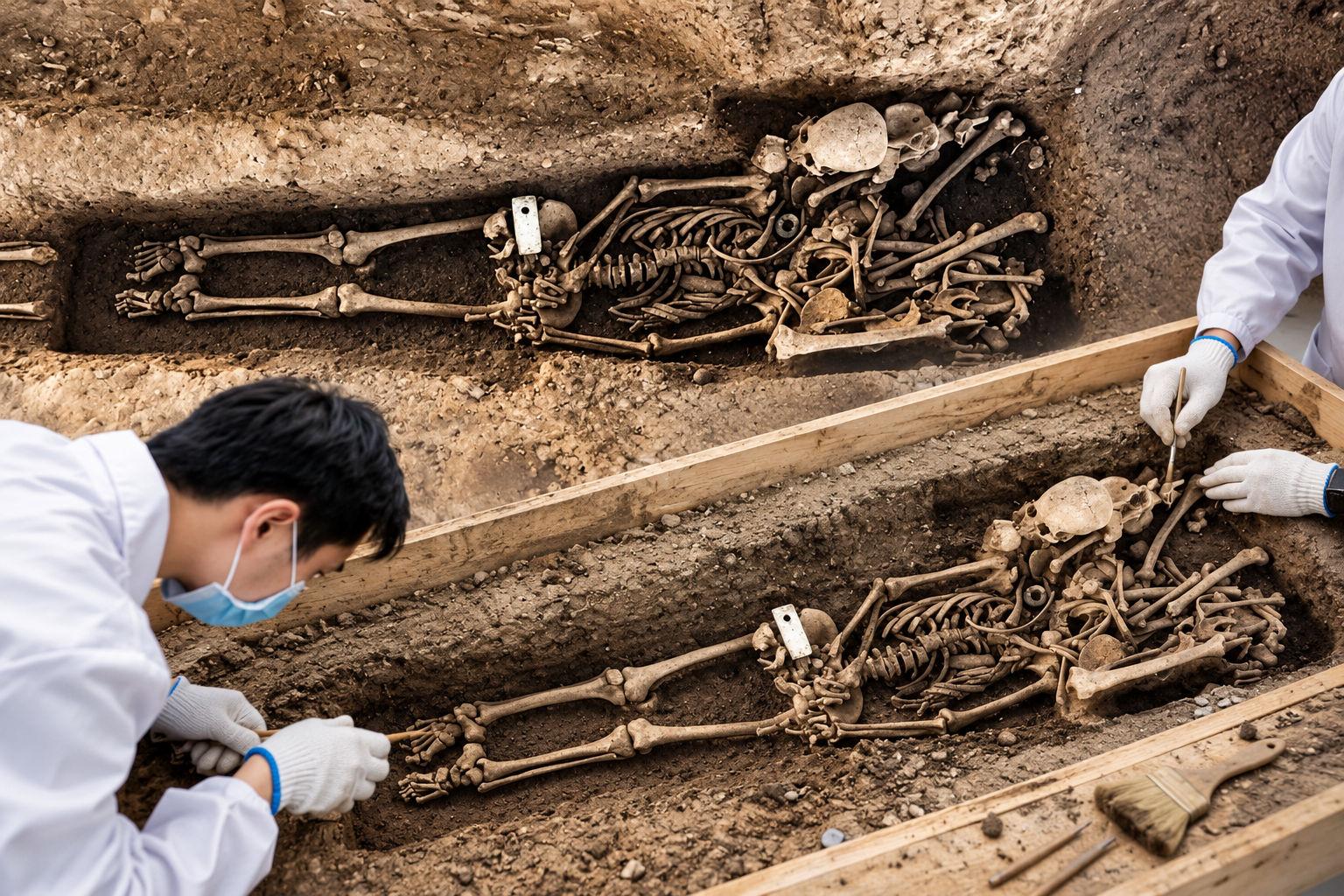
Among the site's discoveries was an exceptional grave: a double burial containing two young adult men, with an additional male skull placed deliberately between them. Cut marks on the vertebrae attached to the skull confirmed it had been removed while still connected to the body — a deliberate decapitation, not scattered bone.
Such finds have long been discussed under the heading of "skull cult," suggesting trophy-taking, ancestor veneration, or sacrifice. These ideas drift easily into romance. Here, ancient DNA changed the terms of debate entirely.
All three men were genetically male. More remarkably, they shared the same mitochondrial sequence — inherited through the maternal line. They were closely related, the relationships falling somewhere between first and fourth degree depending on the pair. This was a family matter. These men were kin.
That single discovery transforms interpretation. Trophy-taking from an outsider becomes implausible when the skull owner was biologically related to those beside him. Instead, this appears to be a carefully staged deposition of related men — one of whom had been decapitated. The mystery becomes more intimate, not less.
Why decapitate a relative and bury his head with kinsmen? The possibilities are disturbing and multiple: funerary rite, violent death followed by respectful inclusion, punishment, sacrifice, or ceremonial treatment of the head as the body's most potent part. The burial resists neat closure, as it should. But the combined evidence has done something important: it has made the grave more specific and more human.
These were young men, roughly twenty to thirty years old — not faceless ritual victims but related individuals, buried together in a highly charged and deliberate arrangement at the centre of a settlement. Death here was not merely mourned. It was arranged, composed, and performed.
Euskirchen-Kuchenheim reminds us that archaeology is not only about migration or state formation. Sometimes a single grave forces a confrontation with the full complexity of human ritual — personal, deliberate, and meaningful in ways that remain just beyond our reach.





Comments