Ancient DNA reveals family ties, ancestry, sex, and bone disease in degraded Song Dynasty remains

– 3 min read


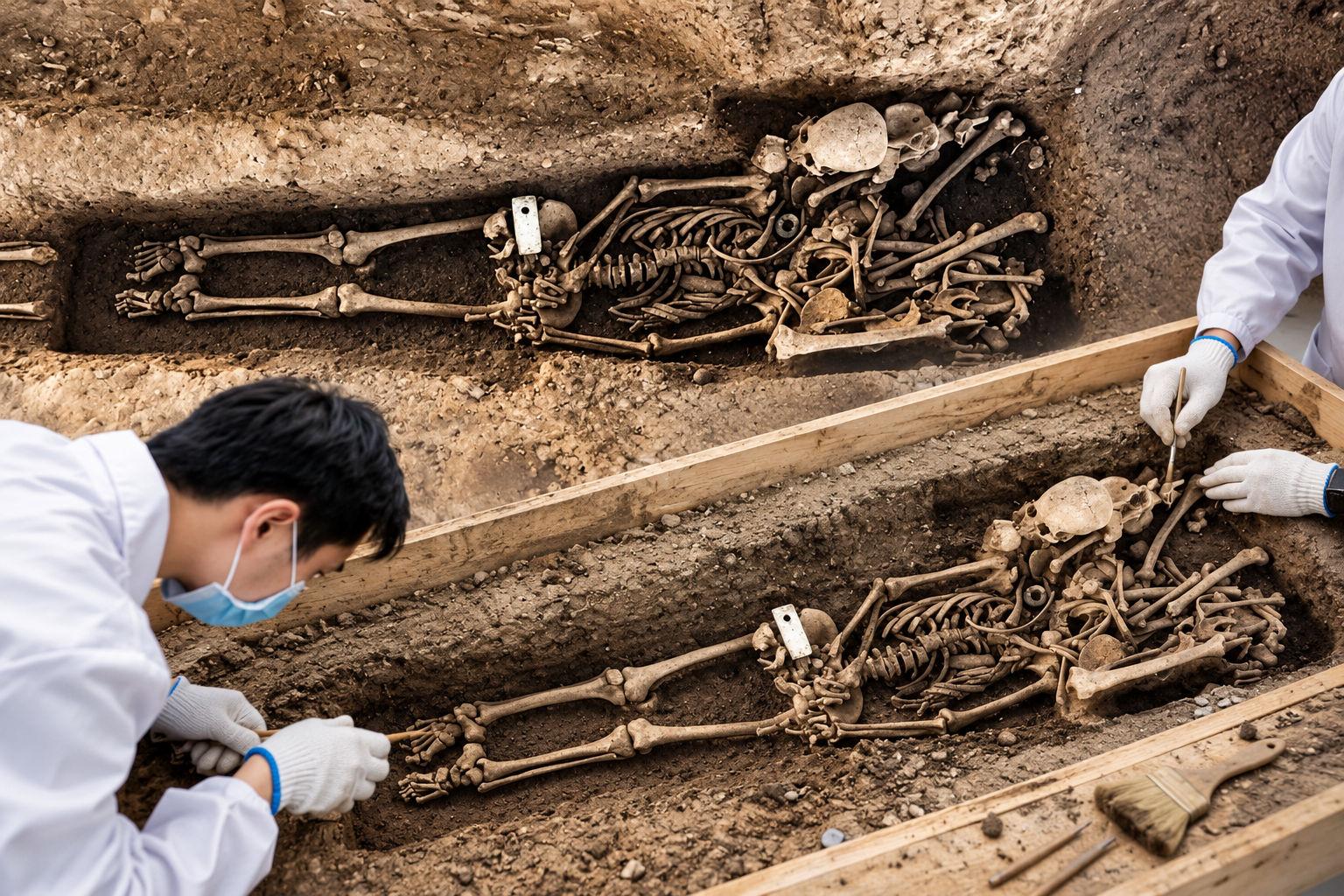
In the river-shaped landscapes of eastern China, the Zhangliu site opens a vivid window into the Song Dynasty world. Located in Huai'an, Jiangsu Province, this burial ground sits in the great meeting zone between north and south China. It is not a dramatic royal tomb, but something arguably more interesting: a place where ordinary lives, family ties, illness, and ancestry survived in fragile bone and broken traces, waiting for archaeology to coax out their stories.
The remains were highly degraded. Bones had decayed so badly that standard methods for determining sex, age, and health largely failed. The burial ground seemed to resist being read. Yet against the odds, it yielded remarkable evidence in the form of ancient DNA. From some of the most damaged remains came precise clues about identity, ancestry, kinship, and inherited disease. Three individuals buried during the Song Dynasty emerged from analysis as a father, a mother, and their son. That moment of recognition is one of the most arresting things archaeology can offer.
The genetic evidence demonstrated direct biological ties between three burials. One man and one woman were the parents of a boy, a finding confirmed through molecular analysis rather than inferred from grave arrangement. This matters enormously. Neighbours or ritual companions are sometimes buried near one another and wrongly assumed to be kin. Here, the biological tie was shown directly.
A disease-linked variant found in the mother was also present in the son, reinforcing both the kinship finding and the pattern of inheritance. Biology and family history confirmed one another. The cemetery preserved not only blood ties but hereditary transmission across generations.
The discovery also sharpens attention to grief and memory. To place relatives in relation to one another in burial is to declare continuity between the living family and the dead. Their names are gone, but their roles within one another's lives endured. Kinship became a surviving form of identity.
Read more on kinship in a Tang Dynasty clan
The three individuals revealed a much larger historical panorama stretching back thousands of years before the Song Dynasty. Their ancestry connects strongly to Late Neolithic millet farmers of the Yellow River region. The Huai River sits between the northern millet-farming world and the southern rice-growing Yangtze basin, making it exactly the sort of zone where movement, contact, and mixture might be expected.
The results suggest that once northern-related populations became established in the Huai area, their biological legacy remained durable over long periods. The cemetery at Zhangliu captures both movement and settlement: the memory of migration and the reality of continuity. A medieval burial ground turns out to preserve traces of Neolithic population history. The Song-period dead of Huai'an were linked to prehistoric processes that reshaped eastern China.
Explore 6,000 years of Yellow River genomic history
Preservation at Zhangliu was so poor that standard skeletal sex assessment failed entirely. Ancient DNA provided a way forward, identifying biological sex even when bones could no longer show it clearly. Information that had vanished from the visible body survived in molecular form.
The same genetic evidence solved several problems at once. Instead of describing three poorly preserved burials in uncertain terms, investigators could identify two males and one female and reconstruct a parent-parent-child group connected to deep northern-related ancestry. The dead acquired historical definition from remains once considered too damaged for ordinary analysis.
The wider lesson is powerful: absence of visible evidence is not absence of information. Even badly damaged burials may still yield stories. This shifts archaeological attention away from magnificent tombs alone and back toward ordinary people who left little else behind, restoring historical visibility to those whom skeletal analysis alone could barely describe.
The mother and son shared a variant linked to osteopetrosis through the LEMD3 gene, a disease-associated change passed between generations in a pattern consistent with direct inheritance. Osteopetrosis involves abnormally dense bone that can affect growth, movement, and overall health. Here, the condition appears not as a vague possibility but as a confirmed inherited trait tied to a reconstructed family.
Additional variants connected the individuals to broader East Asian populations. One involved the EDAR gene linked to shovel-shaped incisors, a distinctive dental trait. Another involved ABCC11, associated with earwax type. These details make the individuals feel less abstract and more physically present within regional biological history.
Taken together, the findings create a layered portrait. The Zhangliu family carried deep ancestry connected to northern East Asian populations, ordinary regional physical traits, and, within one branch, a medically significant variant passing from mother to son. Illness, variation, and vulnerability belonged to medieval lives no less than to ours. History is written not only in empires and texts, but in families and in flesh.
See broader population history of the Yellow River world
https://onlinelibrary.wiley.com/doi/epdf/10.1111/arcm.70243
If this Zhangliu family makes you wonder how your own DNA might connect to ancient people, you can upload your DNA to MyTrueAncestry and explore whether you match this family or related ancient DNA samples from the wider historical world.






Comments