Genetic Diversity in Medieval Sicily
– 5 min read


Medieval Sicily was one of the great stages of the Mediterranean world, positioned between Europe and North Africa with the Near East within reach by sea. Ships, merchants, armies, pilgrims, and rulers all passed through its harbours, producing a human landscape of striking variety shaped by conquest, trade, and everyday movement.
Sicily passed through several powers: Byzantines, Muslim forces from the ninth century, then Normans and later Christian dynasties. But life on the ground was far messier than textbook summaries suggest. Regime change did not mean whole populations vanished. Ports functioned, fields were worked, and communities adapted in ways both subtle and dramatic.
Palermo emerges as a place of astonishing cultural complexity, with quarters occupied by different faith communities yet sharing habits and urban life. Excavated sites across the island — from Castello San Pietro and La Gancia in Palermo, to Segesta, Monte Maranfusa, Agrigento, and Villa del Tellaro — form a map not just of burials but of a deeply connected world. These cemeteries allow historians to ask what actually happened among ordinary people: Did new rulers bring new populations? Did neighbours of different faiths marry? Did migrants settle and local traditions persist?
The graves are not merely data points. They are resting places of real people whose lives unfolded amid political change and cultural negotiation — a crowded human mosaic where ancestry, faith, and identity did not always line up neatly.
One of the most important surprises is that strong links to North Africa appear in Sicily before the Islamic conquest. The sea between Sicily and Africa was not a barrier but a corridor, used for a very long time. Bronze Age remains at Motya already show North African ancestry, and early medieval individuals from Agrigento — on Sicily's southern coast facing Africa — carry North African ancestry components before any Islamic political takeover.
This strips away simplistic ethnic maps of the island. Byzantine rule did not mean an isolated Christian society. The old sea-lanes remained alive, carrying grain, pottery, people, and ideas. The Islamic conquest intensified and redirected connections that already had deep roots rather than introducing Mediterranean mobility into a static island.
La Gancia in Palermo illustrates this with a human face: two men buried there, one from the Islamic period and one from the Norman period, had ancestry closely matching North African populations. These were not abstract trade contacts but men buried in Sicilian soil whose recent family roots probably lay across the sea.
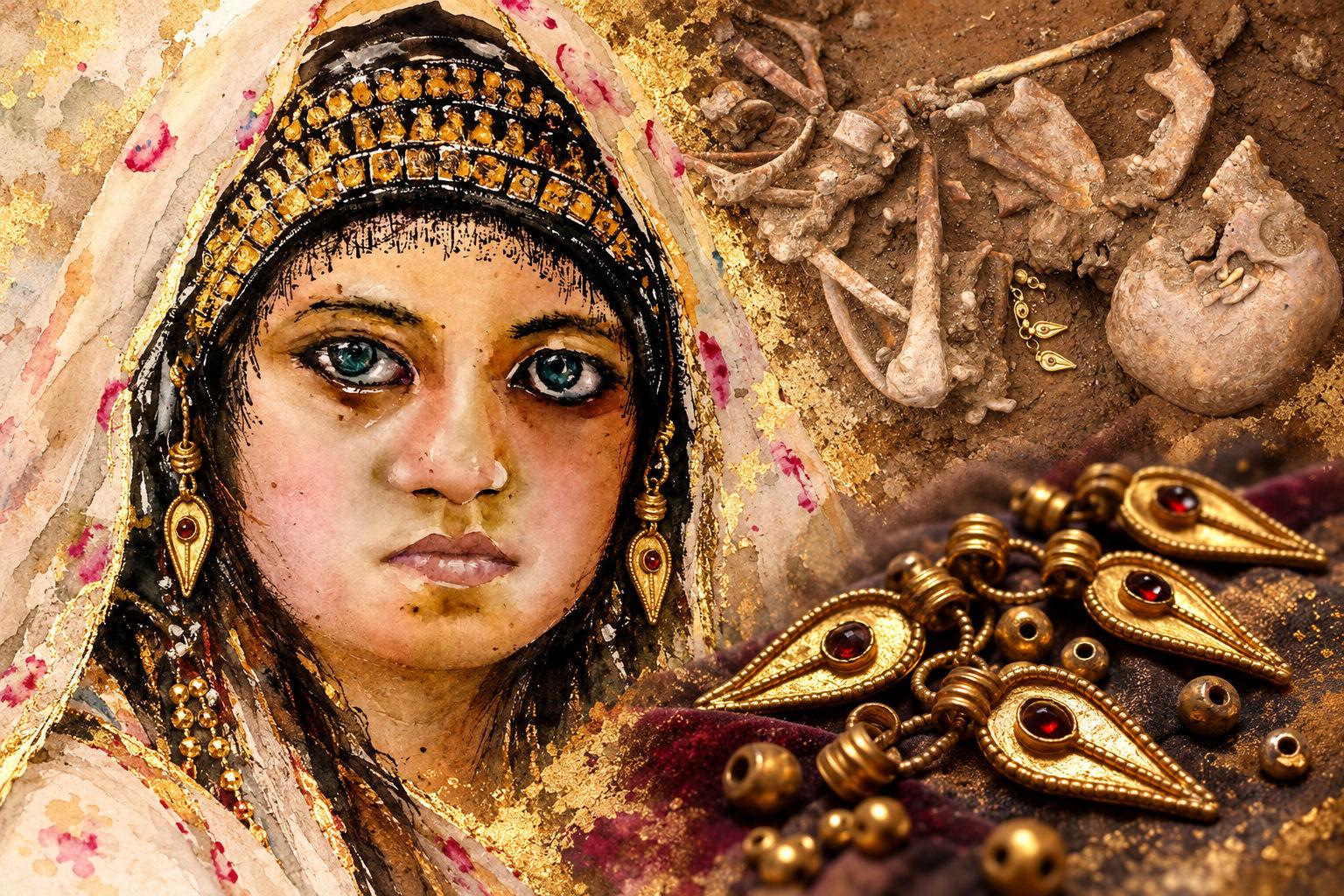
The most arresting discoveries are individuals whose ancestry points far beyond Sicily. At Castello San Pietro in Palermo, one man buried in Islamic custom had ancestry matching West African populations — groups now found in Gambia, Mali, and Sierra Leone — with no signs of recent mixing with local Sicilian ancestry. How did he reach Palermo? Merchant, soldier, enslaved man, court servant? The grave cannot say directly, but his presence forces the imagination outward across the Sahara and along the vast human circuits of the medieval Islamic world.
In the same cemetery, another man buried in Islamic fashion had ancestry pointing strongly toward northern or eastern Europe. In one Palermo cemetery, sharing a religious rite, lay one man with close West African links and another with close northern European links. Whatever else medieval Palermo was, it was not provincial.
At Monte Maranfusa, an individual buried in Islamic tradition during the Norman period showed ancestry combining European and African elements — perhaps the clearest human trace of the intimate realities behind the broad story: partnership, parenthood, and identity formed across lines of origin. At Segesta, another individual in an Islamic cemetery had ancestry linking to central or western Africa, showing that people with deep African roots were not confined to Palermo alone.
Some of these individuals may have arrived through enslavement or coercion — both African and European people were traded in the medieval Mediterranean — and it would be irresponsible to romanticize mobility without acknowledging this. Yet the burials show no obvious markers of exclusion; these people were buried according to community rites, suggesting some degree of inclusion, whether chosen or imposed.
The biggest historical lesson is not sudden replacement but layered continuity mixed with change. Sicily did not repeatedly empty and refill with each conquest. The Islamic conquest did not unleash a total biological transformation — it took place in an island already deeply tied to Europe, North Africa, and the eastern Mediterranean. The Norman period, politically dramatic, shows similar human continuity in its cemeteries: Christian and Islamic burials from this era share comparable diversity.
Only later in the medieval period does the picture shift more noticeably toward ancestry profiles closer to modern European and Sicilian populations. Even then, faith community and ancestry do not consistently match. Christian burials can resemble earlier Punic and Roman individuals; Islamic burials can include people with strikingly European or sub-Saharan ancestry. Cultural identity was real and meaningful but not reducible to biological background.
Present-day Sicilians carry ancestry linked to Anatolian farmers, western European hunter-gatherers, eastern Mediterranean groups, North Africa, and a smaller sub-Saharan element. The medieval period was one especially intense phase of an accumulation spanning millennia. Empires came and went, yet the island's people kept living in mixed, changing communities — children born, households formed, neighbours negotiating difference, cemeteries filling with evidence.
Medieval Sicily was not a borderland between separate worlds. It was one of the places where those worlds were actively made together, and its burial grounds preserve the archaeology of that human making with unusual force.
 Aurore Monnereau ,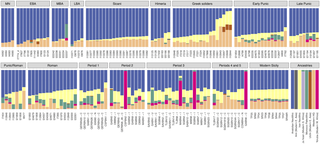
Comments