Ancient DNA reveals leprosy and long-distance migration in early medieval Germany

– 4 min read


On the wet coastal edge of northwestern Germany, a community built its settlement on an artificial mound rising above the tidal marshes of the Elbe-Weser triangle. The surrounding wetlands offered fertile soil and grazing, but also flooding and danger. The solution was ingenious: raise the ground itself and create a safe island in a shifting watery world.
Fallward became one of the most striking examples of this coastal life because it preserved evidence with extraordinary generosity. The burial ground dates from the late fourth to early fifth century, containing around two hundred cremations and several dozen intact inhumations — a reminder that even one small community could hold diverse beliefs about death.
The real miracle was preservation. Graves cut deep into damp marsh clay protected materials that normally rot away. Wood, textiles, fur, and furniture survived almost intact. Archaeologists found not just skeletons and metal objects, but beds, clothing, carved furniture, and vessels that once belonged to daily life. Fallward is unusually vivid because of it.
The inhumation graves at Fallward are astonishing because they preserve the soft, perishable things that usually vanish. Coffins survived. Bedding, plant-fibre covers, fur, and layered clothing could still be identified. These were not bodies placed in earth with token objects — they were carefully arranged, clothed, and furnished. Burial here was performance and memory.
Many grave goods showed wear and repair, meaning they had lived with the people buried alongside them. A box, a seat, a vessel, a garment fastening — these carried histories formed in life, not manufactured for death. The cemetery also reveals clear social differentiation: some graves were modest, others lavishly equipped with objects reflecting influence from the Roman world far to the south, woven seamlessly into local burial practice.
Fallward also complicates assumptions about gender. Two children whose biological sex was confirmed by genetic evidence did not match what archaeologists had previously inferred from their grave goods. It is a useful reminder that objects in graves express social identity, family wishes, and ritual convention — not simply biological facts.
Among all the graves, one towers above the rest. An adult man of around forty was buried in a wooden boat over four metres long, covered with panels forming a roof-like structure. Outside the boat stood a decorated wooden block chair interpreted as a seat of authority. At his feet sat a maple stool carved with a hunting scene and a runic inscription, alongside a gaming table, bronze basin, and ceramic vessel — all bearing signs of use and repair.
The grave combined local marshland life with signals from much further away. Fish bones, a reed mat, a water-bird-shaped box, and exceptionally developed upper-arm muscles all suggest a man deeply connected to water. Yet a Roman military belt and furniture reflecting late antique artistic styles pointed toward the wider Roman world.
Genetic analysis made him more remarkable still. While two other individuals from Fallward fit comfortably within northwestern European populations, this man's profile pointed toward east-central or southeastern Europe — the Roman frontier zone along the Danube. He may have travelled hundreds of miles, perhaps through trade, military service, or migration during a time of instability. Whatever his origin, the community buried him lavishly, surrounding him with possessions of rank. He was not marginal. He was remembered spectacularly.
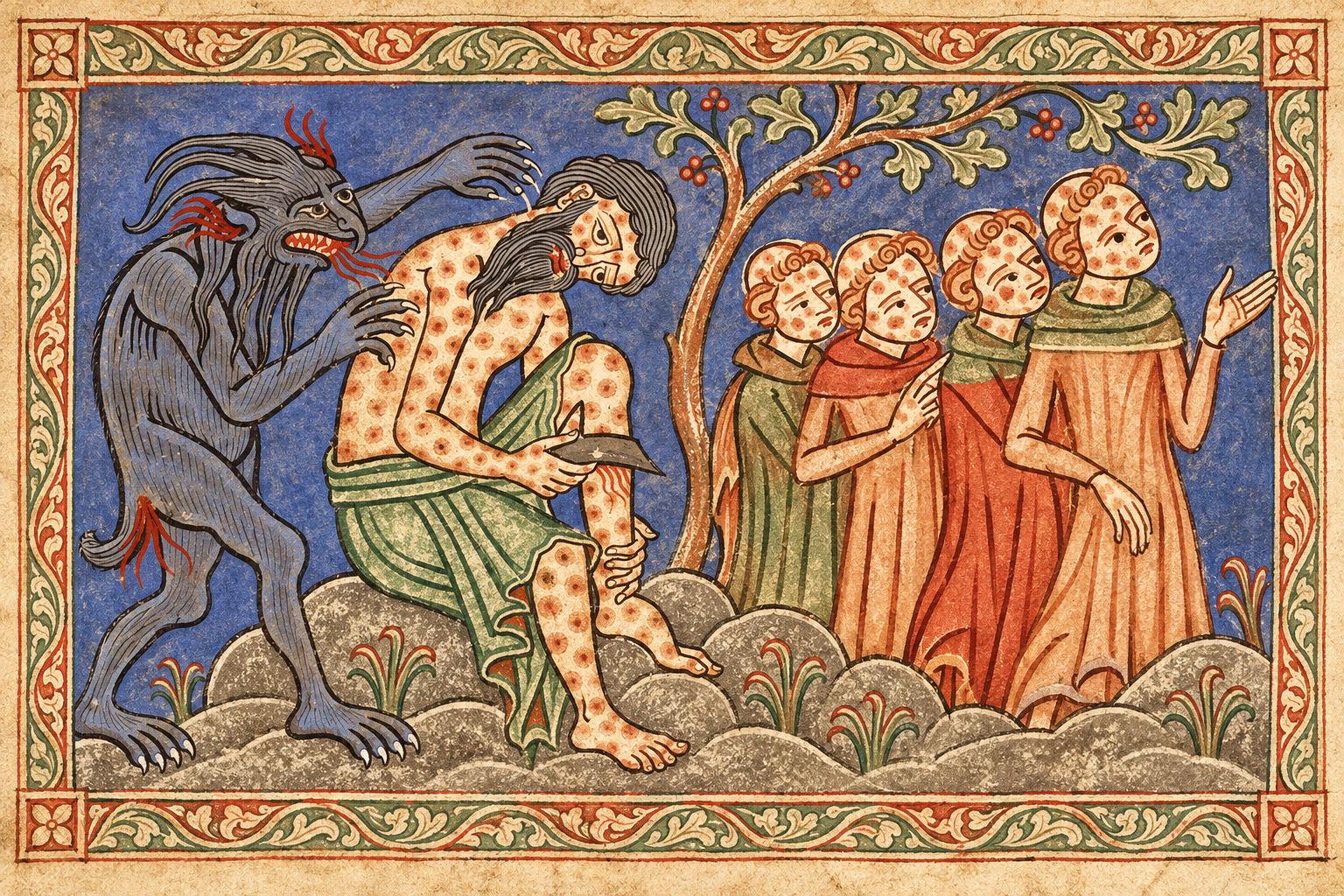
The man from the boat burial carried another secret entirely invisible to the eye. Ancient DNA recovered from his remains revealed infection with the bacterium that causes leprosy — yet his bones showed none of the classic visible damage. He may have had an early or mild form, with symptoms confined to soft tissue. He almost certainly died of something else.
This is a powerful reminder that ancient disease was not always visible to excavators. The preserved bacterium belonged to branch 3 of the leprosy family tree, an early and significant lineage, placing this burial among the most valuable early records of the disease's evolution. Remarkably, the pathogen's genetic material survived in better condition than the human DNA from the same remains, likely due to the microbe's protective cell wall.
There is no sign the community treated him differently because of illness. He received one of the grandest burials at the site. That alone warns against assuming infection automatically meant exclusion or stigma. If anything, Fallward shows that mobility carries microbes as well as people — and that disease history sits inside social history, not apart from it.
Fallward resists any simple picture of early communities as static and sealed. It shows rootedness — a coastal marsh settlement with strong local traditions — but also mobility, long-distance contact, and mixed identities. Two individuals showed strong biological affinities with North Sea populations linked to Iron Age and early medieval Britain, suggesting the sea was a corridor rather than a boundary. The man from the boat burial disrupts any sense of local uniformity entirely.
The burial goods reinforce this entanglement. Roman-influenced objects appear alongside regional craft. Styles from the Mediterranean frontier blend into local burial language. Objects moved through exchange, gift, inheritance, and imitation. People moved for equally varied reasons. Fallward was not a cosmopolitan city — it was a marshland settlement — yet even there one can glimpse the broad circulation of people, styles, and pathogens across a continent.
The site's importance lies not in confirming one grand migration theory, but in showing what large historical change looks like at ground level. It looks like a declining marsh community. It looks like varied burial customs. It looks like one man possibly from southeastern Europe buried in a boat with a Roman belt and hidden leprosy. It looks, in short, like complexity — and that complexity is the great excitement of Fallward. Even at the damp edge of the North Sea, this was not a place outside history. It was history itself, anchored in wet clay and stretched across astonishing distances.
https://www.cell.com/iscience/fulltext/S2589-0042(26)03260-8

Comments