Haplogroup G2a2a1a3

– 5 min read


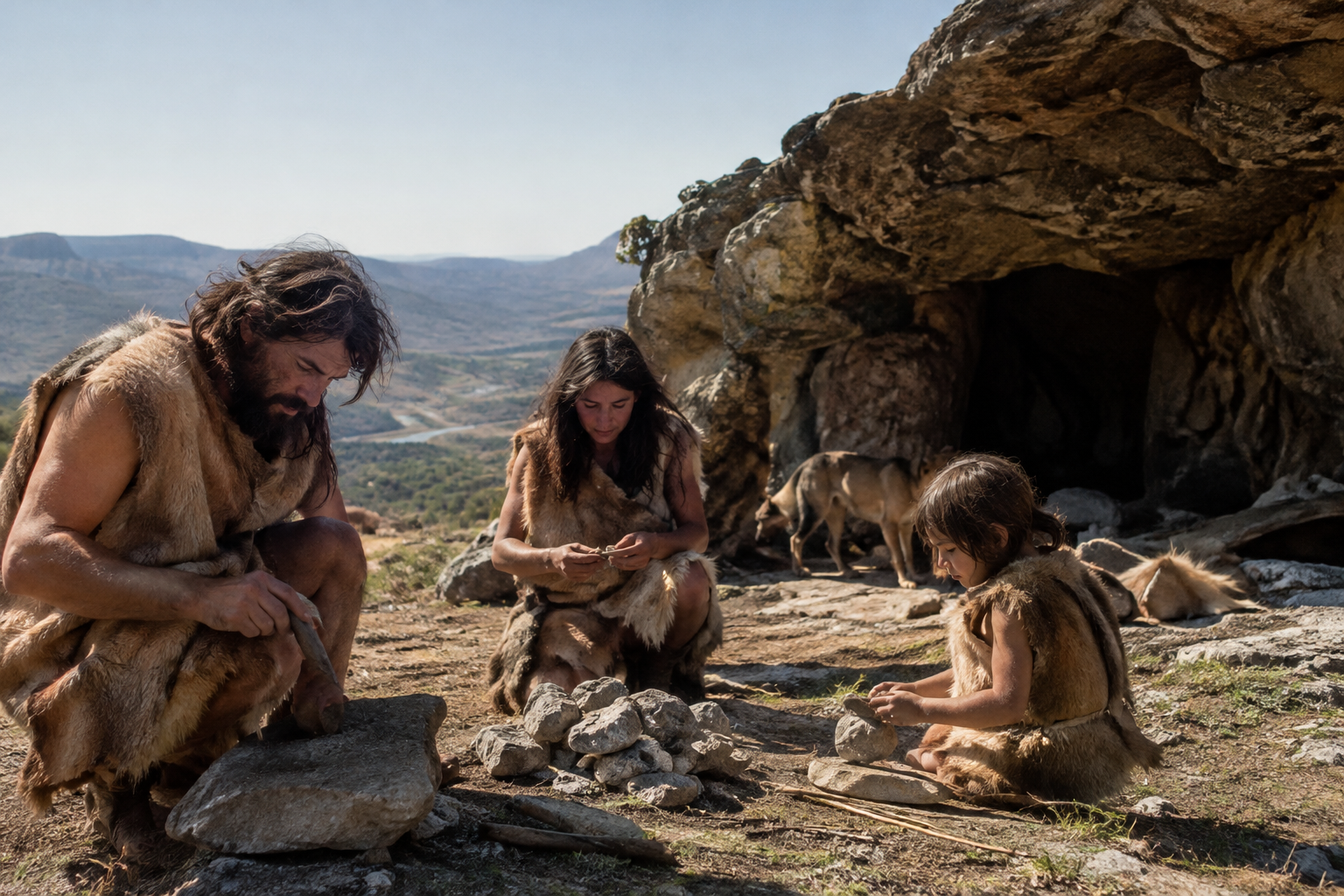
At Cova da la Guineu in Spain, one ancient male identified as I11305 offers a small but telling glimpse into the paternal history of haplogroup G2a2a1a3. He is dated to around 2950 BC, which places him late in Iberia's Neolithic world, at a time when farming communities had already been established for millennia but were still living through important regional changes in ancestry, mobility, and social life.
That matters because G2a lineages are among the best-known Y-chromosome branches linked with the spread of early farming into Europe. The narrower branch G2a2a1a3 is a much more specific point on that paternal tree, and we should be careful not to load it with every claim ever made about G2a as a whole. Still, the appearance of this lineage in a late Neolithic man from northeastern Iberia fits a larger archaeological pattern: some paternal lines associated with Europe's first farmers remained in place for a very long time, even as local populations changed in other ways.
Cova da la Guineu is in Catalonia, a region where caves were used repeatedly across prehistory. Sample I11305, dated to about 2950 BC, belongs to a period when Iberian communities were using both caves and open settlements, maintaining farming economies, and participating in cultural networks that linked different parts of the peninsula and beyond. With just one individual, we are not looking at a dynasty or a whole tribe. But we are looking at a real man whose paternal line can be set against the wider history of Neolithic Europe.
In ancient DNA, Y-DNA traces one direct male line: father to son to son. It does not stand for a person's whole ancestry, still less for language or identity on its own. Even so, paternal markers can be historically useful because they sometimes preserve long-running lineages that survive major cultural transitions.
For Iberia, that is especially interesting. By the later 4th and early 3rd millennia BC, the peninsula was not some untouched survival of the first farming frontier. It had already seen centuries of local development, regional interaction, and varying degrees of mixture between incoming farmers and earlier hunter-gatherer ancestry. A man like I11305 shows that a branch within G2a was still present there in that late Neolithic setting.
The broader haplogroup G2a appears again and again in early European farming contexts. Archaeologists and geneticists have linked it especially with the descendants of the first agricultural populations who moved westward from Anatolia into the Balkans and then across much of Europe. Research on ancient European populations, including the major synthesis published in Science, helped clarify just how important those early farming expansions were in reshaping the continent's genetic landscape.
But the narrower branch in this article, G2a2a1a3, should not be treated as if it single-handedly maps the whole Neolithic. Subclades split, contract, and survive unevenly. Some become common in one district and vanish in another. So the value of I11305 is not that he "proves" a grand migration on his own, but that he anchors this branch in a specific archaeological setting: late Neolithic Iberia.
That anchor is important because Iberia often behaves differently from central and northern Europe in prehistoric genetics. Early farmer ancestry remained especially strong there for a long time, and some lineages associated with those early farmers seem to have persisted well into later prehistoric periods. In other words, the peninsula can preserve deep farming-era signals even when other regions experienced sharper paternal turnover.
A date around 2950 BC places I11305 close to a threshold. Soon after this period, parts of western Europe would see major changes associated with Bell Beaker horizons and, in many regions, the growing impact of ancestry ultimately tied to steppe expansions. One of the most striking findings in European archaeogenetics is that these changes often affected paternal lineages very strongly, sometimes more strongly than autosomal ancestry alone would suggest.
Iberia, however, did not change everywhere and all at once. Regional variation matters. A late Neolithic Catalonian individual with G2a2a1a3 reminds us that before those later Bronze Age transformations became dominant, older farmer-linked male lines were still present on the ground. The archaeology of caves in Iberia reinforces that sense of continuity and reuse: places remained meaningful across generations, sometimes across very long spans of time.
That does not mean every cave burial represents stable, isolated local descent. Caves could be revisited, communities could move, and ancestry could mix. But in broad historical terms, I11305 belongs to a landscape where Neolithic traditions still had real weight, and where a paternal line associated with farming Europe had not yet disappeared.
Neolithic to Bronze Age Catalonia
One reason Iberian evidence is so valuable is that it often preserves long sequences of population history. Rather than a simple tale of replacement, the peninsula shows layers: early farmers, enduring local variation, later Bronze Age shifts, Roman-era mobility, and medieval mixture. Each period adds something, but not all in the same way.
For a haplogroup like G2a2a1a3, this means its ancient appearance in Iberia is best read as part of that longer memory. The branch sits within a wider paternal family that is deeply associated with the first agriculturalists of Europe. Finding it in a 3rd-millennium-BC Catalonian individual suggests that, at least in some communities, those older male lines were still part of the living population long after farming had ceased to be new.
This is also where readers should resist the temptation to jump straight from a prehistoric sample to a modern surname, kingdom, or ethnic label. The line may endure, split, migrate, or disappear many times over between 2950 BC and the present. What ancient DNA gives us is something subtler and, in its way, more impressive: a fixed point in time where one branch can be seen in a real archaeological context.
Roman Hispania's Genetic Legacy
There is a tendency in public discussions of DNA to demand either too much or too little from a sample. Too much, and one individual becomes a mascot for an entire people. Too little, and the evidence is dismissed as trivial. I11305 is neither everything nor nothing. He is one data point, but a useful one, because well-dated ancient males with identifiable Y-DNA lineages help reconstruct where branches were actually present.
For G2a2a1a3, the firm point here is late Neolithic Spain, specifically Cova da la Guineu in Catalonia. The broader interpretive frame is the long survival of farmer-associated paternal lines in Iberia. That makes this haplogroup less a story of sudden conquest and more one of persistence: a male line still present in a region where the legacy of Europe's first farmers remained unusually durable.
Later Iberian Population Shifts
If your paternal line falls under G2a2a1a3, the most responsible historical takeaway from this evidence is not a grand claim to one ancient identity, but a connection to one of Europe's old farming-associated paternal families. Sample I11305 from Cova da la Guineu shows that this branch, or a very close reported association with it, was present in northeastern Iberia around 2950 BC. That is a modest claim, but a solid and evocative one: this is a lineage with roots visible in the late Neolithic landscapes of Spain, among communities still carrying the long inheritance of Europe's first agricultural age.
Comments