Haplogroup D1b2b

– 4 min read


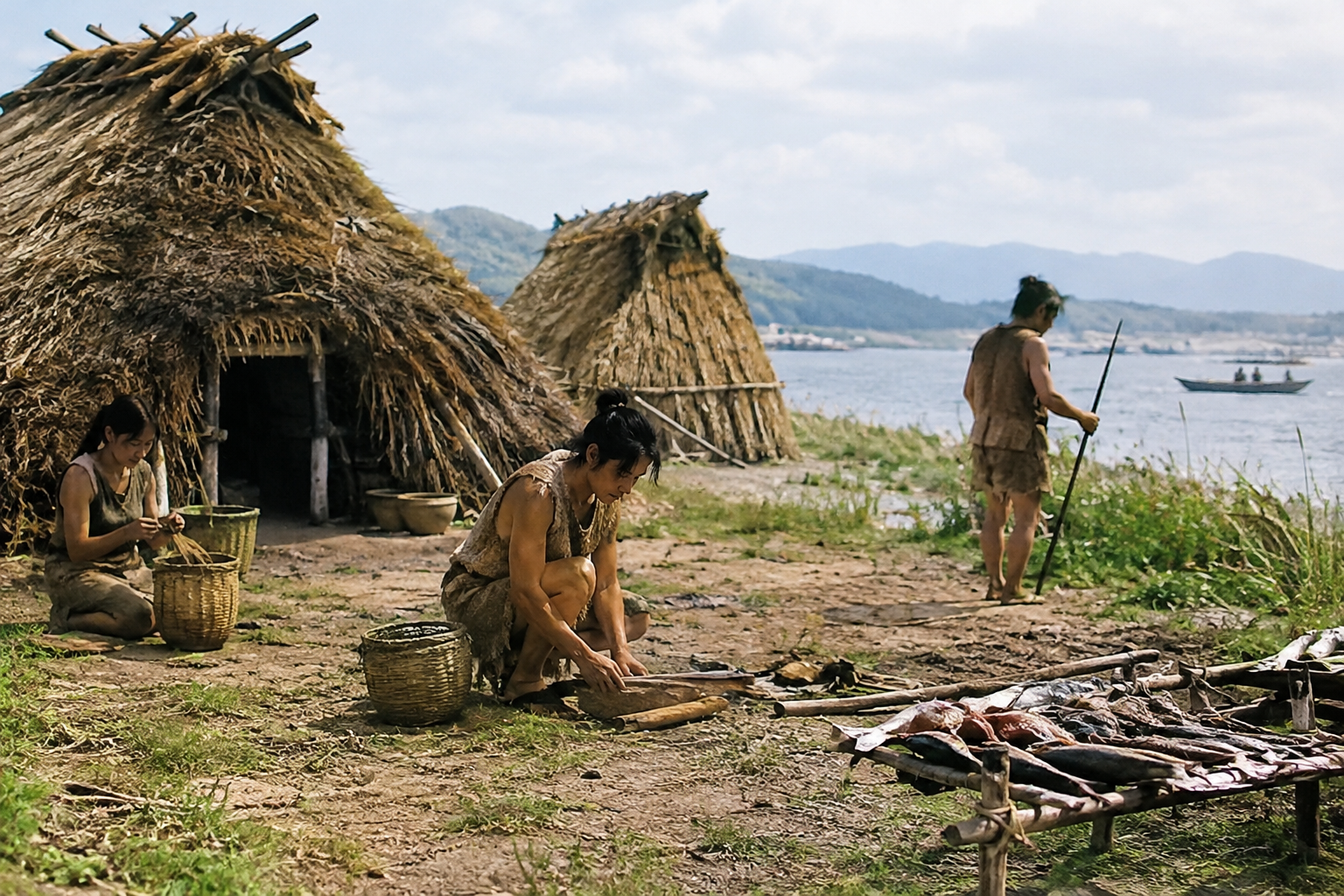
At Funadomari on Rebun Island, off the northern tip of Hokkaido, one ancient man has become unexpectedly important for the history of a rare paternal line. The sample known as Funadomari5, dated here to around 610 BC and identified as Jomon, places haplogroup D1b2b in a very specific archaeological setting: not in legend, not in court genealogy, but among the island communities of prehistoric Japan.
That matters because D1b2b is not just any Y-DNA label. It belongs within the broader Y-chromosome haplogroup D, a lineage with a strikingly uneven world distribution, found today in places such as Tibet, the Andaman Islands, and Japan. The branch discussed here, however, is the Japanese branch represented in ancient remains like Funadomari5. Y-DNA follows one direct paternal line only, but in this case that line helps illuminate a deeper question: how much of the Jomon paternal landscape survived into later Japanese history?
Funadomari is one of the key Jomon sites for ancient DNA because it anchors genetics to an actual community in northern Japan. Rebun Island sits in a maritime zone of fishing, seafaring, and regional contact, yet its prehistoric inhabitants also preserved ancestry that appears distinctive when compared with later agricultural populations from the main islands. A genetic study of these ancient northern Japanese remains, available here, helped establish just how valuable the Funadomari individuals are for understanding Jomon population history.
For D1b2b, the importance of Funadomari5 is not that he can be turned into a mascot for all of ancient Japan. Quite the opposite. His value lies in specificity. He shows that this paternal branch, or a classification associated with it, was present in a documented Jomon context in the centuries before the full historical formation of the Japanese state. That is precisely the kind of evidence archaeogenetics needs: a named individual, a real site, and a cultural setting that can be described without fantasy.
With haplogroups, it is very easy to slide from the broad to the narrow and then to overstatement. Haplogroup D is ancient and geographically unusual, but that does not mean every branch of D shares the same recent history. D1b2b is a much narrower paternal branch, and its significance has to be read from Japanese evidence, especially ancient Japanese evidence, rather than borrowed wholesale from the deep history of haplogroup D elsewhere in Asia.
In public discussion, Japanese population history is often flattened into a simple contrast between Jomon and Yayoi. Real life, as usual, was more complicated. Ancient DNA has increasingly supported the idea that the Jomon were not a mere preface to later history, but one of the ancestral layers that contributed to the peoples of Japan in different degrees. A paternal lineage such as D1b2b is therefore interesting not because it defines an ethnicity by itself, but because it may preserve one thread of that older Jomon inheritance.
One sample can never stand in for an entire population. Even so, some single individuals matter because they appear at the intersection of archaeology, chronology, and lineage. Funadomari5 does exactly that. He comes from a named Jomon context in the far north, and his Y-line points toward continuity of a paternal branch that has long been suspected to have deep roots in the Japanese archipelago.
That gives D1b2b a rather different profile from lineages that appear in Japan only after the spread of wet-rice agriculture, state formation, or later historical mobility. Instead of following the better-known routes of Bronze Age and Iron Age expansions on the Eurasian mainland, this branch is most compelling when read against the older forager-fisher world of the archipelago. The discovery does not make D1b2b uniquely "Jomon" in every case, but it does place it firmly within that ancient horizon.
East Asian Y-Chromosome Migrations
Rebun Island is useful historically because islands are never just isolated dots on a map. They can preserve older ancestry, but they also sit in networks of movement, exchange, and seasonal travel. In the Jomon period, northern island communities were part of wider maritime worlds connecting Hokkaido, nearby islands, and the coasts beyond.
That makes the presence of D1b2b in Funadomari5 especially intriguing. It suggests that this paternal branch endured in a region that was connected enough to participate in broader interaction, yet distinct enough to retain deep local ancestry. Archaeology and genetics together are doing the hard work here: not proving a romantic tale of untouched isolation, but showing continuity within a living, connected prehistoric society.
This is also where later Japanese history becomes relevant, carefully and only in outline. Modern Japanese populations are often understood as shaped by multiple ancestral streams, including substantial contributions from later migrants and farmers as well as older Jomon-derived ancestry. Ancient Jomon males carrying branches like D1b2b help explain why some paternal lines in Japan look markedly older and more locally rooted than others.
For someone researching D1b2b today, the attraction is obvious: this is a lineage that points toward one of the deepest detectable paternal layers in Japan. But the evidence is strongest when kept close to the archaeology. Funadomari5 is not a dynastic founder, not a culture hero, and not a shortcut to every question about Japanese origins. He is something better: a securely ancient person whose DNA ties a present-day paternal branch to the Jomon past.
That is a powerful kind of historical connection. Many haplogroup stories are about expansion, replacement, or empire. D1b2b, at least from the evidence represented here, tells a quieter story - one of survival. In the bones of a Jomon man from Funadomari, we can glimpse a paternal line that persisted through the enormous transformations of Japanese prehistory and later history, leaving descendants who still carry that signature today.
The best-supported insight about D1b2b is not grandeur but depth. With Funadomari5 from Jomon Funadomari as a concrete anchor, this haplogroup can be placed in ancient northern Japan before the historic states and noble houses that dominate written records. For modern testers, that makes D1b2b a paternal line with a strong claim to deep archipelago ancestry, especially within the long and complicated human story of the Jomon world.


Comments