The Imperial House of Japan
– 2 min read


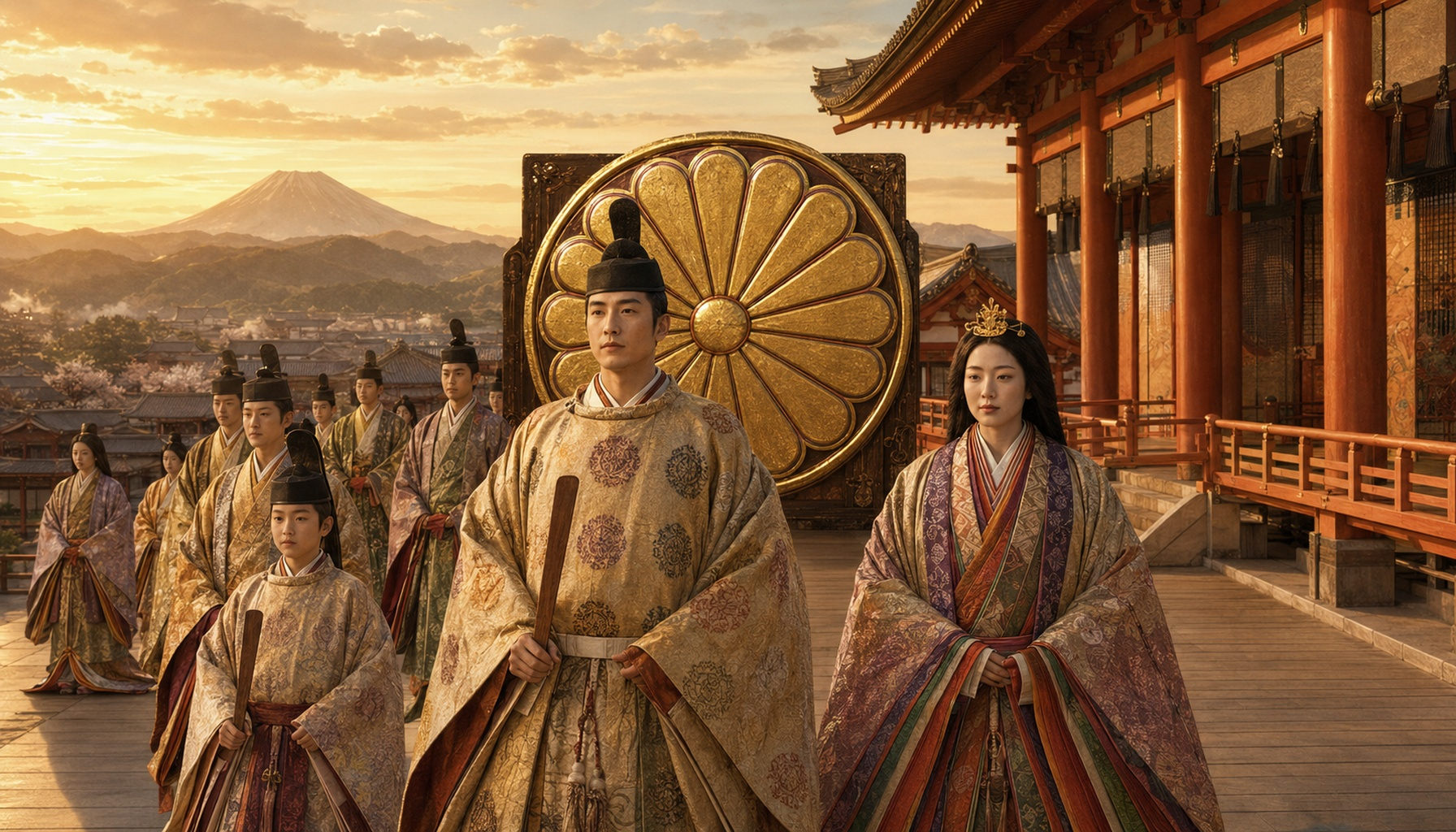
The Imperial House of Japan is the hereditary dynasty of the Japanese emperors, traditionally linked to the ancient Yamato line and often described as the oldest continuing monarchy in the world. Its historical roots lie in the early state-building world of central Japan, especially the Yamato heartland in the Kinai region around present-day Nara and Osaka, where ruling lineages, ritual authority, and emerging court institutions gradually fused into something recognisably imperial. In genetic tagging terms, the primary family haplogroup associated here is D1a2a1a2b1a1a8a, a lineage with deep East Asian and especially Japanese-linked resonance.
What makes the imperial house so fascinating is that it was never just a family sitting on a throne. It was a machine of memory, ritual, ancestry, and legitimacy. At times emperors ruled as sacral kings, at others they were overshadowed by Fujiwara regents, retired sovereigns, shoguns, or modern constitutional governments, yet the dynasty itself remained the great thread running through Japanese history. Figures such as Emperor Seiwa (850-881) remind us that this was also a genealogical powerhouse, since later warrior and aristocratic lines traced prestige back to imperial descent. The court's authority rested not only on politics, but on ceremony, Shinto tradition, and the idea that the emperor embodied the symbolic unity of the realm.
Read more about the Fujiwara Clan
A strong later location anchor for the imperial family is Edo Castle in Tokyo, the vast castle complex that became the seat of Tokugawa rule and, after the Meiji Restoration, the core of the modern Imperial Palace. Originally built in the fifteenth century and greatly expanded by the Tokugawa shogunate, Edo Castle was less a single fortress than an enormous political city of moats, gates, baileys, residences, administrative compounds, and defensive walls. Fires, warfare, and rebuilding altered it many times, and much of the old keep no longer survives, but the great earthworks, stone ramparts, guardhouses, gates, and the surrounding palace grounds still give a real sense of scale. It matters historically because it marks the shift from shogunal Edo to imperial Tokyo, when the emperor moved from Kyoto and the symbolic center of Japan was physically relocated. Parts of the wider grounds, especially the East Gardens of the Imperial Palace, can still be visited today, which makes it one of those rare places where dynastic history is not shut away in a book but laid out in moats, walls, and pathways under the modern skyline.
Explore the Imperial House of Aisin Gioro
From an ancient DNA perspective, D1a2a1a2b1a1a8a is best treated as a linked paternal signature rather than a magic stamp of direct descent. Related or linked samples include Ancient Okinawa Japan individuals NAG012 and NAG037, which are especially interesting because they connect this branch to the deep population history of the Japanese archipelago and the Ryukyu world. Other linked finds include Ancient Janghang Korea GDI008, Mongol Empire Takhiltyn Khotgor II TAH002, and even Iron Age Zeeland Veere Holland I12906, showing how some paternal branches can appear across a surprisingly wide geographic range in ancient datasets. That does not mean these individuals were ancestors of the imperial family in any simple documentary sense. It means they help sketch the broader prehistoric and historic landscape in which this lineage existed, moved, and survived.
Explore Ancient Ryukyu Jomon genomes
If your own DNA points toward Japanese, East Asian, or deeper archipelago-linked ancestry, this is exactly the sort of dynasty worth exploring. Upload your DNA to MyTrueAncestry and see whether you match the Imperial House of Japan tag, or related ancient DNA samples linked to haplogroup D1a2a1a2b1a1a8a. It is a splendid way to connect family history with the long, layered story of emperors, ritual, and the making of Japan.




Comments