The Ottonian Dynasty
– 3 min read


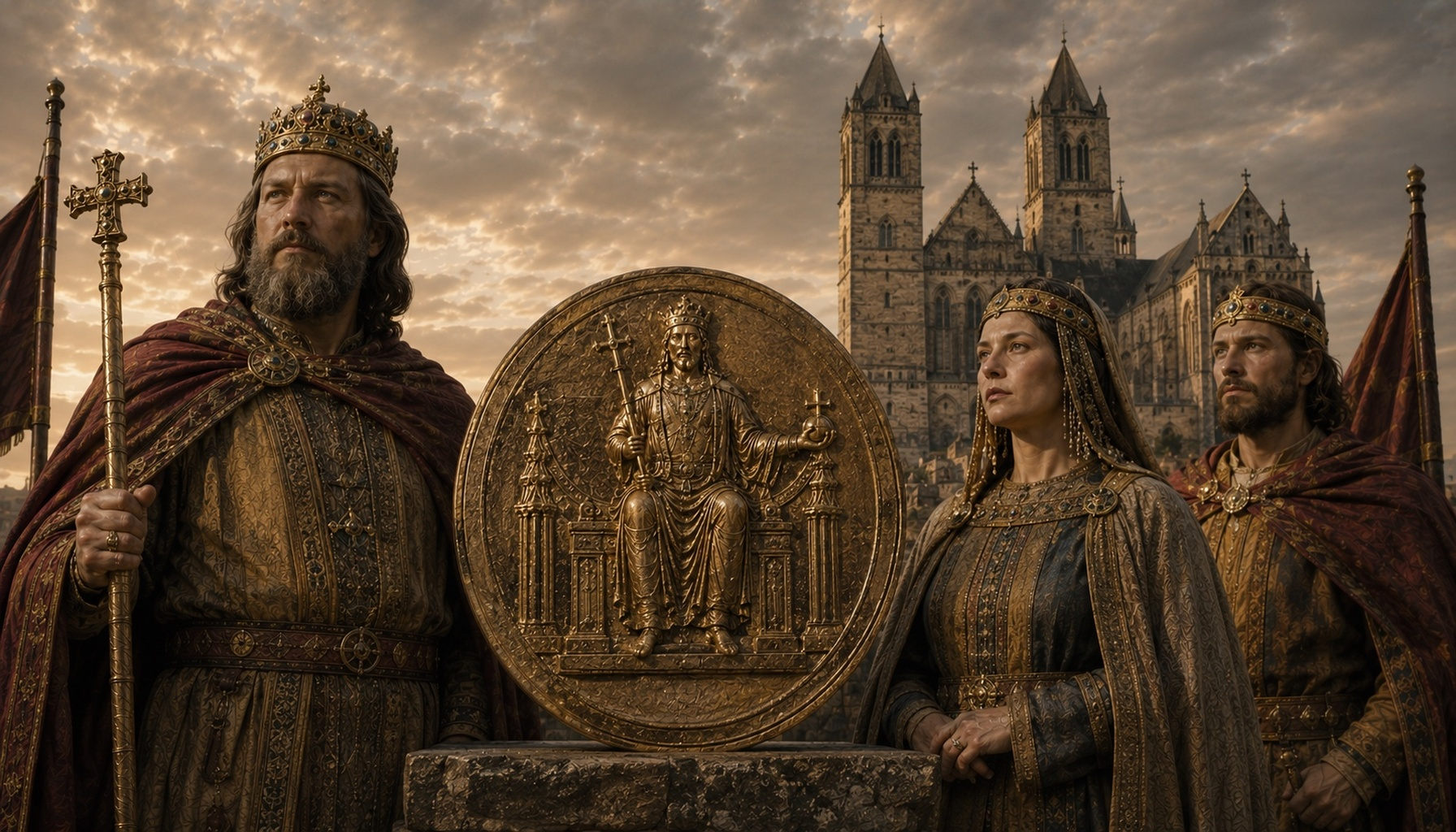
The Ottonian Dynasty was the great Saxon royal and imperial house that ruled East Francia and then the early Holy Roman Empire in the 10th and early 11th centuries, and it is linked here with the primary paternal haplogroup R1b1a1b1a1a2e1. This was not a family that simply inherited a throne and sat on it. The Ottonians emerged from the power politics of northern Germany, from the old duchy of Saxony, in a world still being rebuilt after the breakup of the Carolingian order. Their rise tells us a great deal about how early medieval Europe actually worked: not as neat nation-states, but as a web of war leadership, church alliances, dynastic marriage, frontier management, and the careful staging of sacred kingship.
From that Saxon base, the family turned regional authority into imperial power. Henry I the Fowler (876-936) steadied the kingdom and confronted external threats, especially the Magyars. His son Otto I the Great (912-973) became the dynasty's defining ruler, defeating rivals, strengthening royal control, and reviving the imperial title in 962 in a way that tied German kingship to Roman imperial tradition. Later, Heinrich II (973-1024) carried that Ottonian model into the 11th century, combining piety, political calculation, and close work with bishops and abbots. The dynasty's legacy was immense: it helped shape the political architecture of medieval Central Europe and laid essential foundations for what became the Holy Roman Empire.
A key location for understanding the family is Magdeburg Cathedral in Saxony-Anhalt, one of the most important Ottonian memory sites in Europe. Otto I favored Magdeburg strongly and turned it into a major political and ecclesiastical center. The cathedral standing there now, dedicated to Saints Catherine and Maurice, is the first Gothic cathedral built on German soil, begun in 1209 after a fire destroyed the earlier church complex. That earlier church, however, was deeply bound up with Otto's own world. The building preserves the long afterlife of Ottonian prestige, above all through the tomb of Otto I, whose burial there makes the site far more than just an impressive church: it is a dynastic landmark, a place where medieval rulership, liturgy, architecture, and memory all meet. It remains a major historic monument and can still be visited today, which gives modern visitors a very direct route into the Ottonian past.
Explore Otto I's tomb at Magdeburg
From an ancient-DNA perspective, the Ottonian haplogroup tag R1b1a1b1a1a2e1 sits within a broad and very old western and central European pattern rather than something confined to one court or one kingdom. Related or linked samples with this haplogroup appear across a striking range of times and places, including Medieval Northern Spain Las Gobas individuals such as ldo066, ldo037, ldo046, ldo048, ldo062, and ldo040; elite Celtic burials in Germany such as Asperg-Grafenbuehl APG001 and APG003 and Ludwigsburg Roemerhuegel LWB001 and related entries; Bronze Age Unetice samples from Thuringia at Leubingen including LEU040, LEU024, and LEU065; Migration Period and early medieval individuals from Hungary and Germany such as RKO001, RKF253, Bur6, BRC055x, DRH046, and DRH017; and medieval and later samples from Belgium, England, Scandinavia, and beyond. There are even deeper links into Bell Beaker, Corded Ware, Bronze Age France, Bohemia, the Low Countries, and Britain. None of that proves direct descent from those named individuals to the Ottonians, of course. What it does show is that the dynasty's paternal line belonged to a lineage with a long and well-attested archaeological footprint across western and central Europe.
Explore the Royal Premyslid Dynasty
If the Ottonians catch your imagination, the next step is the fun one: compare your own DNA against dynasties, noble lines, and related ancient samples from medieval and prehistoric Europe. Upload your DNA to MyTrueAncestry and see whether you match the Ottonian Dynasty or populations linked to haplogroup R1b1a1b1a1a2e1.

Comments