Fujiwara Clan
– 2 min read


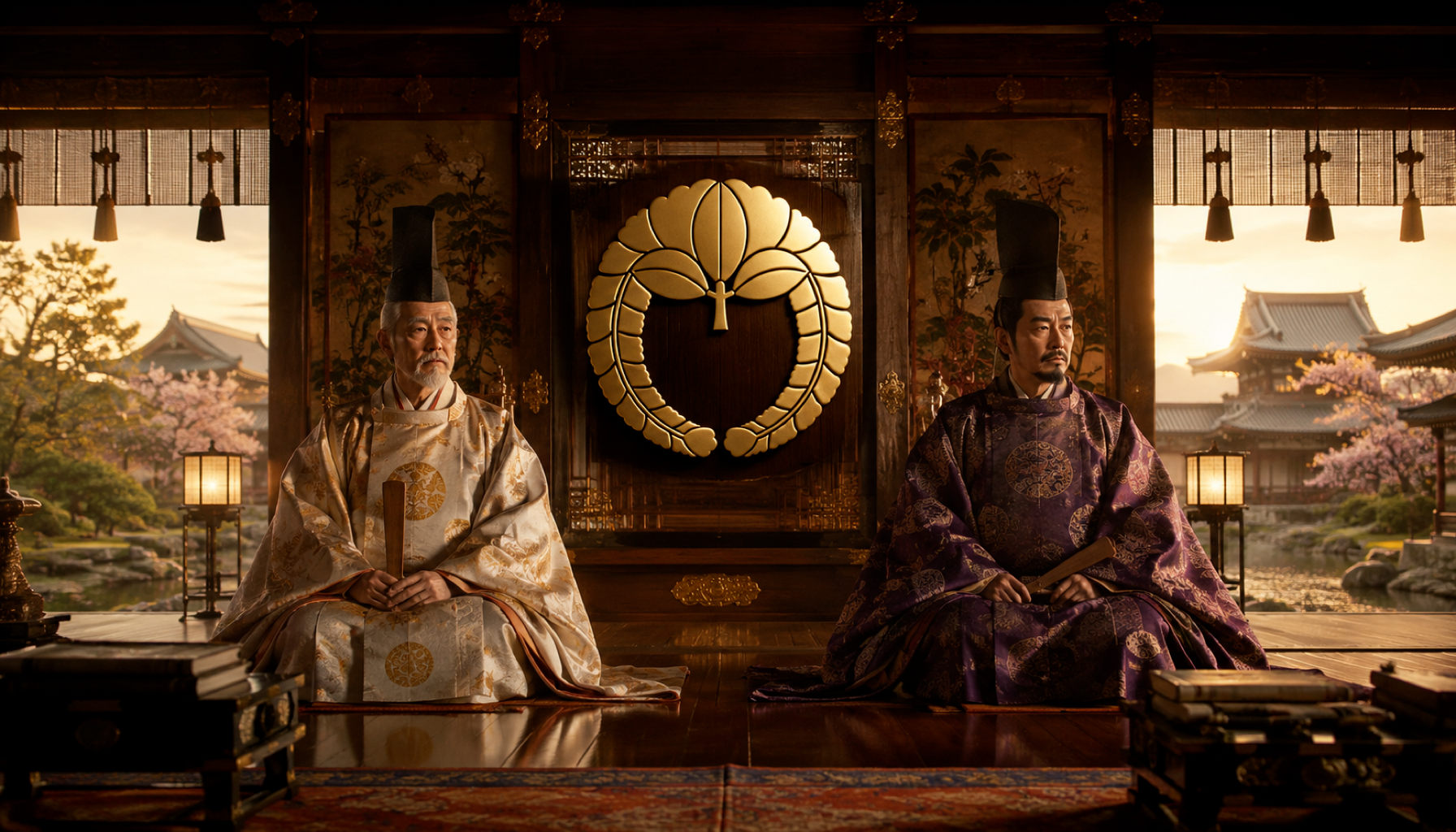
The Fujiwara Clan was one of the great aristocratic houses of imperial Japan, a family whose real genius was not seizing the throne but standing just beside it and quietly deciding who got access to power. Emerging from the older Nakatomi tradition in the Yamato heartland, they rose in the 7th century as the Japanese court was being reshaped by reform, centralization, and fierce political rivalry. Their primary linked haplogroup here is O1b2a1a1, a lineage associated with parts of the wider Japanese historical landscape.
The family story begins with Nakatomi no Kamatari, later known as Fujiwara no Kamatari, who died in 668 and was posthumously honored as the founding figure of the clan. From that point the Fujiwara became masters of court politics, especially in the Heian period, when they built influence through regencies, marriage alliances with the imperial family, and control of high office. This was power in a very Heian style: elegant, ceremonial, literate, and deeply strategic. Names such as Fujiwara no Fuhito, Fujiwara no Michinaga, and Fujiwara no Yorimichi belong to a lineage that helped shape government, court rank, literary culture, and the very idea of aristocratic refinement in classical Japan.
Read more about the Nakatomi Clan
A key place for understanding their world is Fujiwara Palace in Kashihara, Nara Prefecture, in the old Asuka region where the early Japanese state was taking form. This was the imperial palace complex of Fujiwarakyo, Japan's first full-scale planned capital laid out on a Chinese-style grid, used from 694 to 710 before the court moved to Nara. Today the site is an archaeological park rather than a standing palace, which is rather lovely in its own way: wide open ground, excavated remains, reconstructed markers, and the surrounding landscape of the ancient Yamato basin still giving a sense of political center and ritual space. According to the Kashihara city visitor information, it remains a major historic destination and can still be visited, especially in seasons when the flower fields around the site are in bloom, making it one of those rare places where early state history and present-day public access meet quite gracefully.
Explore more on the Fujiwara Clan
From a DNA perspective, O1b2a1a1 is the primary haplogroup linked here to the family tradition. Ancient and historic samples that are related or linked to this broader haplogroup background include Historic Okinawa Japan NAG007, Tokugawa Shogunate Okinawa Japan NAG036, and Tokugawa Shogunate Okinawa Japan NAG039. These are not evidence of direct descent from the Fujiwara themselves, and it is important not to pretend otherwise. What they do offer is a useful genetic window into lineages connected to the wider historical populations of Japan, helping place aristocratic families like the Fujiwara into a broader human story that stretches beyond court diaries and into the bones of the past.
Explore ancient DNA from Japan
If the Fujiwara story catches your imagination, with its mix of lineage, politics, marriage strategy, literature, and courtly brilliance, you can take the next step with your own DNA. Upload your results to MyTrueAncestry and see whether you match the Fujiwara Clan or related ancient DNA samples from Japan's historical past.






Comments