The Royal House of Nassau

– 3 min read


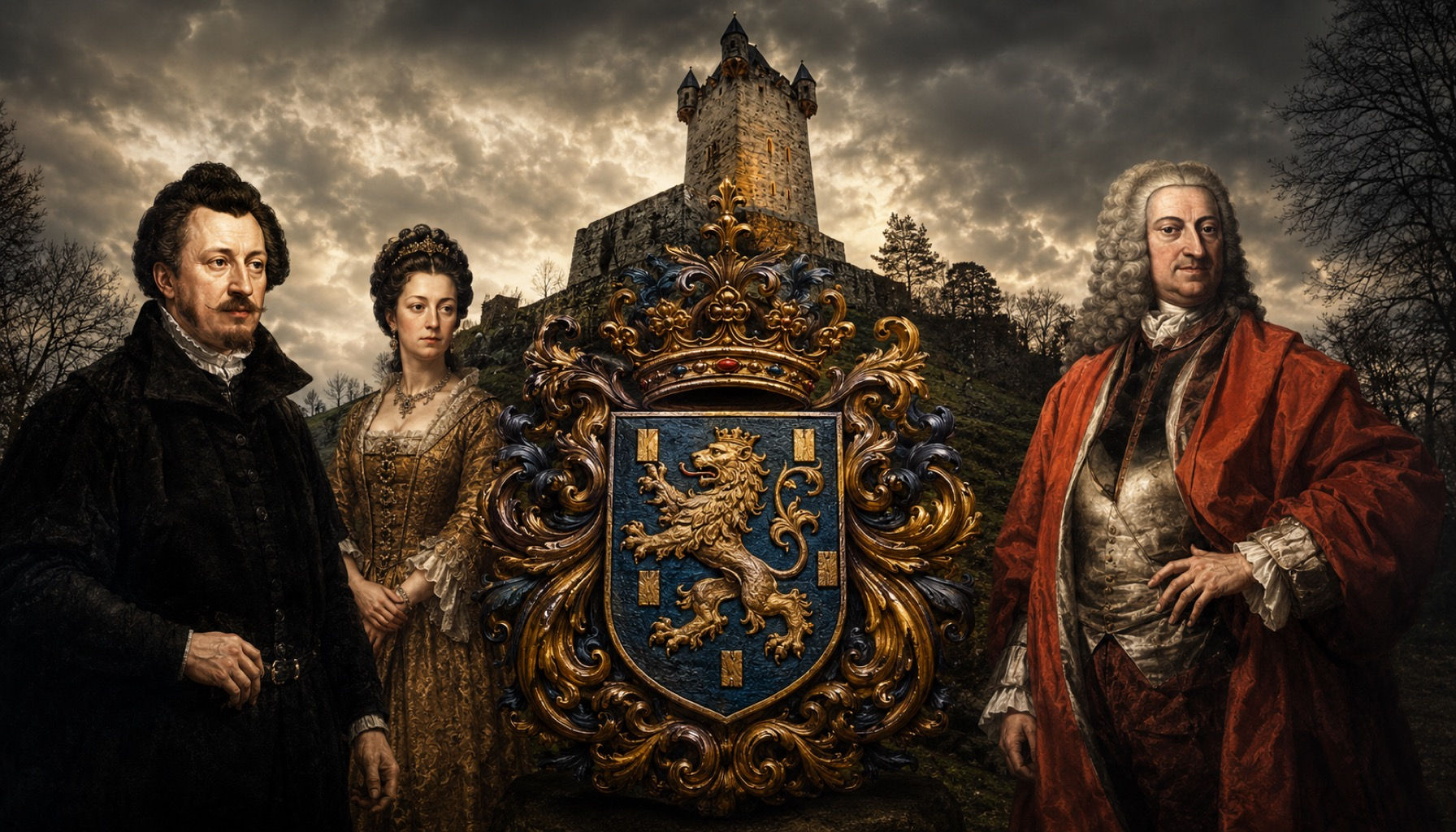
The Royal House of Nassau was one of Europe's great ruling dynasties: a family that began as medieval lords in the German lands around Nassau and went on to shape the histories of the Netherlands, Luxembourg, and the wider Low Countries. Its story is the classic western European princely pattern in action: castles, counties, marriages, feuds, military service, patient inheritance, and eventually crowns. In haplogroup terms, the primary family line is linked here with R1b1a1b1a1a1c1a1, a branch within the wider R1b family so often seen across western Europe.
The earliest well-known ancestor usually named is Dudo of Laurenburg, attested in 1125, a figure planted firmly in the world of the High Middle Ages, when local counts and fortress lords along the Rhine and its tributaries could slowly turn stone walls and river influence into dynastic power. From those beginnings came the counts of Nassau, and from them the later branches that would produce the Orange-Nassaus, Dutch stadtholders, kings of the Netherlands, and grand dukes of Luxembourg. Figures such as William the Silent gave the dynasty its most famous political role, but the family's deeper significance lies in continuity: Nassau managed, over centuries, to remain relevant as the map of Europe was repeatedly torn up and redrawn.
Explore the Royal House of Wittelsbach
The family's location anchor is Nassau Castle, the Burg Nassau above the Lahn near the town of Nassau in present-day Rhineland-Palatinate, Germany. This was the stronghold from which the dynasty took its name, and that matters more than it may first appear. Medieval dynasties were often, quite literally, landscapes turned into family identity. A castle was not just a residence; it was a statement of control over roads, river movement, tolls, farmland, and lordship. Nassau Castle emerged in the 12th century and became the symbolic cradle of the house, even as the family later spread into multiple branches and territories far beyond this original hilltop seat. Though much altered by time, warfare, and ruin, the site remains a powerful marker of where the Nassau story began, and yes, it can still be visited today as a historic ruin and heritage destination.
From an ancient-DNA point of view, the Nassau-associated haplogroup R1b1a1b1a1a1c1a1 sits within a deeply rooted western and central European paternal landscape. Related or linked samples appear across a striking spread of times and places: Lombard warrior elite burials at Collegno in northern Italy such as COL_069, COL_069b, and COL_069x; Hungarian knightly burials including Elek Bathory at Pericei (PER01) and Ferenc Bathory (PER03-1); medieval Denmark at Vor Frue Kirkegard Aalborg (CGG100493); several medieval Sint-Truiden church burials in Belgium including ST0052, ST1232, ST0632, and ST3006; Iron Age Belgic Suessiones samples from Bucy-le-Long in France such as CGG022456, CGG022463, CGG022431, CGG022425, CGG022438, and CGG022419; Batavi-associated samples from Valkenburg Marktveld in the Netherlands including CGG107745 and CGG107754; the medieval Polish Piast-related sample PCA0193; early Anglo-Saxon burials from West Heslerton and Buckland Dover; Lower Saxony's DUN010; Longobard HVN005; Norman-era Lincoln Castle S3044; and even deeper-time examples from the Netherlands, Bohemia, Britain, Bavaria, and Bell Beaker contexts such as I4070. None of this proves direct descent to Nassau from any one individual, of course. What it does show is that the haplogroup sits in a long-lived northwestern and central European continuum, entirely at home in the kinds of population histories that later produced medieval noble houses like Nassau.
Explore medieval royal DNA links
If the House of Nassau catches your imagination, that is really the point: family history is not just a list of names but a way into the making of Europe itself, from hilltop castles in the German west to the royal courts of The Hague and Luxembourg. Upload your DNA to MyTrueAncestry to see whether you match the House of Nassau, its haplogroup R1b1a1b1a1a1c1a1, or any of the related ancient DNA samples from medieval and Iron Age Europe.






Comments