The Paston Family
– 3 min read


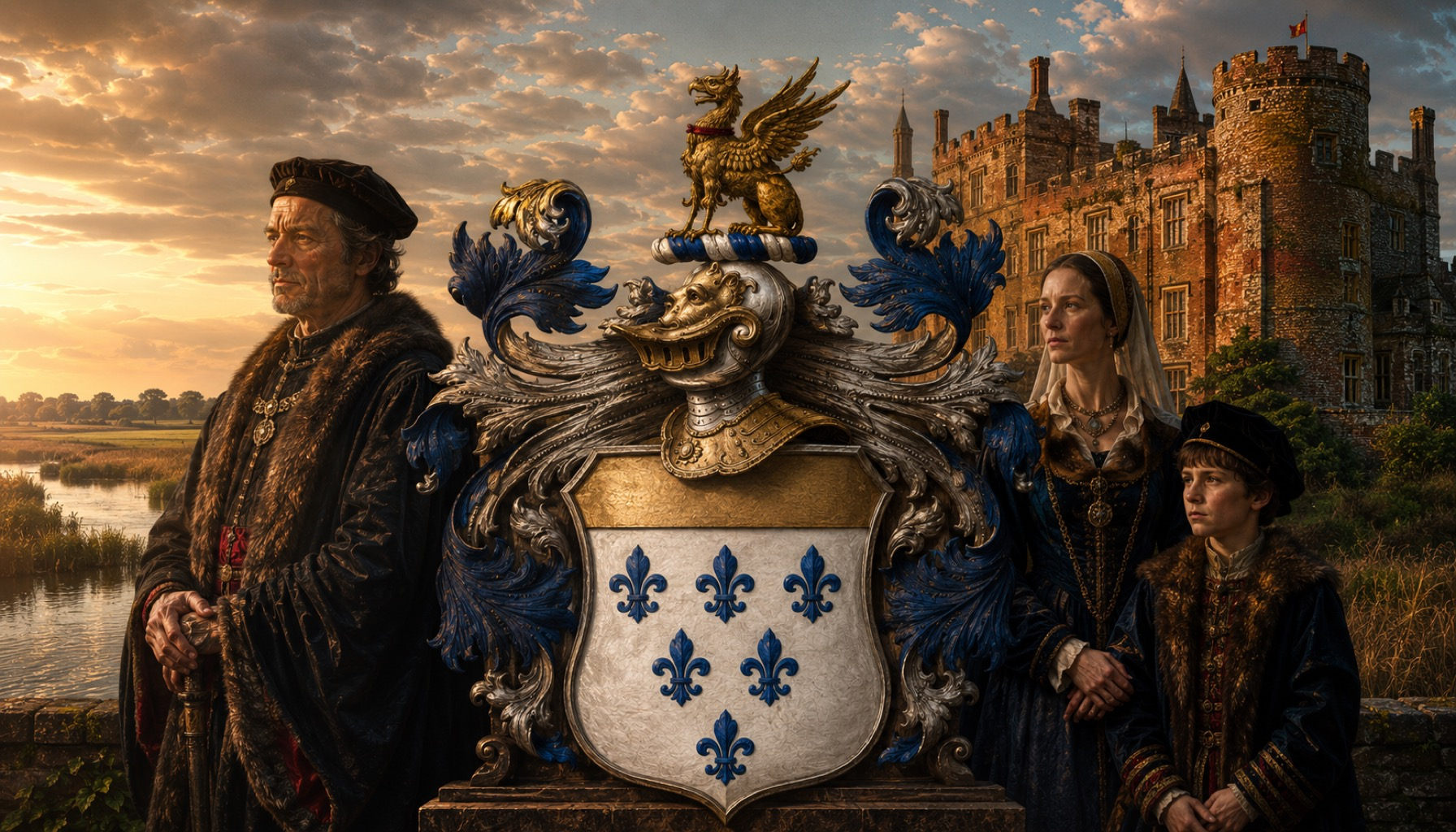
The Paston family were one of the most famous gentry houses of late medieval England, rooted in Norfolk and remembered above all because they left behind something most families did not: their voices. Linked here with the primary family haplogroup I2a1b2a2a2b, the Pastons rose not from the oldest feudal aristocracy but from the energetic, literate, legally skilled world of the fifteenth-century English gentry. Their name is associated with land deals, lawsuits, marriage planning, household anxieties, and social climbing carried out with determination and remarkable documentary precision.
They came originally from Paston in north Norfolk, a village that gave the family its surname, in a region shaped by prosperous agriculture, parish life, coastal trade, and the long aftershocks of the Black Death and the Hundred Years War. This was a world in which old noble power still mattered greatly, but newer families could advance through law, service, education, and careful estate strategy. William Paston (1378-1444), a distinguished judge, laid much of the groundwork for the family fortune. His descendants, especially John Paston I (1421-1466), fought doggedly to hold and expand that inheritance. Later, Sir Clement Paston (1515-1597) carried the name into Tudor England, showing how the family adapted beyond the medieval age that made them famous.
Read more about the House of Pelham
What makes the Pastons so irresistible to historians is the Paston Letters. They are not polished chronicles written after the fact, but living correspondence: complaints, instructions, warnings, affection, bargaining, gossip, panic, and pragmatism. Through them we see a household under pressure, trying to turn legal rights into actual control on the ground. Servants must be managed, tenants negotiated with, daughters married, sons advanced, rivals watched, and castles defended. The letters remind us that "family strategy" in fifteenth-century England was not an abstraction. It was daily work, often fraught, often exhausting, and occasionally rather dramatic.
The great location anchor of the family is Oxnead, near Aylsham in Norfolk, where the Pastons established Oxnead Hall as a principal seat. The medieval manor at Oxnead became closely associated with the family's rise and later prestige, and the church there also preserves important Paston memorials. In historical terms, Oxnead mattered because it translated paper ambition into visible status. A family that had advanced through the law and relentless property acquisition needed a house that announced permanence, authority, and gentility. The hall later saw rebuilding and alteration, and while the grand house itself does not survive as a fully standing country house in the way some later estates do, Oxnead remains a real and visitable historic place through the parish church of St Michael and the wider village setting, where the Paston story still clings to the landscape. It is exactly the sort of East Anglian site where one can feel how documentary history and physical place lock together.
For those interested in deeper paternal-line context, the Paston family is tagged here with haplogroup I2a1b2a2a2b. That does not mean every historical bearer of the surname can be genetically reduced to one line, nor does it imply direct descent from any excavated ancient individual. What it does offer is a way of placing the family within a much older map of related Y-chromosome branches. Ancient and historic samples linked to this broader line include MBG008 from the Elite Celtic burial at Magdalenenberg in Germany, ATP_PSN_522 from the Augustinian Friars in medieval England, I7959 from Early Bronze Age Praha-Stodulky-Mal-Ohrada in Czechia, BRC039x from Migration Period Saxony-Anhalt, poz498 from Bronze Age Karczyn in Lower Silesia, poz720 from Pielgrzymowice Grave 669 in Silesia, I11590 and I20641 from the early Anglo-Saxon cemetery at West Heslerton in Yorkshire, I17327 from Iron Age Prague, ELW030 from a post-medieval plague victim at Ellwangen, SRA62 from Mesolithic Sramore in Ireland, and even the celebrated Cheddar Man from Somerset, England. These are best understood as related or linked points in the long history of I2-associated paternal ancestry across prehistoric and historic Europe, not as a neat single-family chain.
Explore Roman and Early Medieval Britain DNA
If the Pastons interest you, it is probably because they feel so recognizably human: ambitious, worried, practical, proud, and forever writing letters because something has gone wrong with land, money, marriage, or inheritance. Uploading your DNA can let you explore whether you match the Paston family group or any of the related ancient DNA samples linked to haplogroup I2a1b2a2a2b, and place your own story into the longer human past.
Comments