The House of de Lacy

– 3 min read


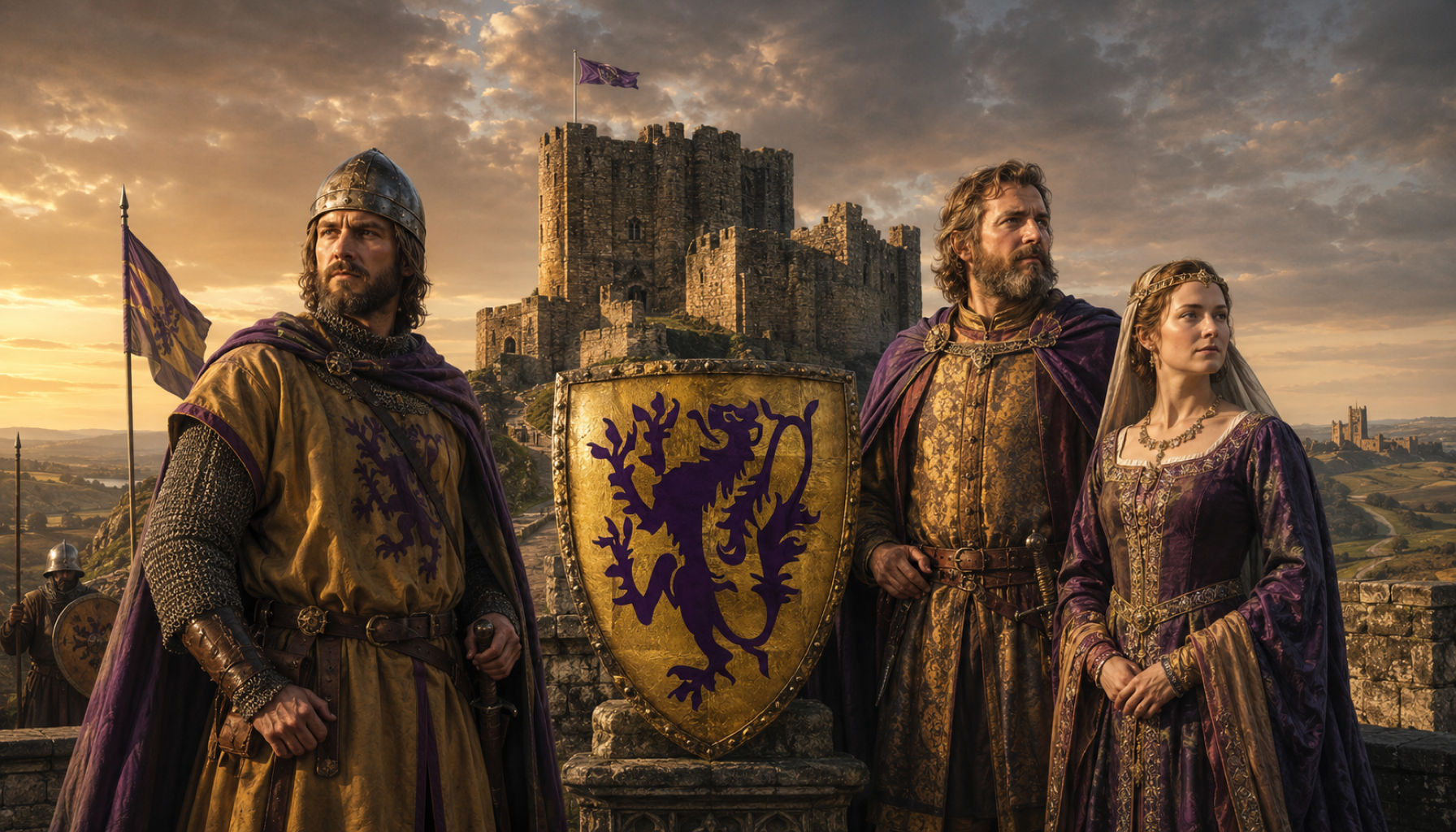
The House of de Lacy was a formidable Norman and later Anglo-Norman noble family whose story runs through medieval England, the Welsh Marches, and Ireland. Their name came from Lassy, in Normandy, and from that northern French base they were drawn into the great aristocratic reshaping of Britain after 1066. In family DNA terms, the primary haplogroup linked here is R1b1a1b1a1a2c1a3a2a1a1, a branch within the wider R1b world so often associated with long continuities across western Europe. Haplogroups linked with the family: R1b1a1b1a1a2c1a3a2a1a1.
The de Lacys were not simply landowners with a smart surname. They were frontier magnates, castle builders, military organisers, royal servants, and at times royal headaches. Their rise depended on exactly the sort of hard medieval currency that mattered most: loyal service in war, possession of strategic estates, and the ability to hold unstable border zones. In England they became associated with baronial authority and marcher lordship; in Ireland branches of the family helped drive conquest and administration. Figures such as Hugh de Lacy, Lord of Lassy (1020-1085), Robert de Lacy (1130), and Roger de Lacy (1170-1211) sit within a wider family history marked by inheritance struggles, rebellion, alliance, and the practical business of ruling from castles in difficult country.
Read more about the House of de Courcy
The family origin points back to Lassy in Normandy, in a landscape of local lordships, fortified sites, and ambitious warrior elites emerging from the 10th and 11th centuries. That matters, because the de Lacys belonged to the world that produced the Norman expansion itself: men who could convert local seigneurial power into something much larger through conquest abroad. Once established across the Channel, the family became classic examples of the Anglo-Norman frontier aristocracy. Their authority rested not only on title, but on occupation, defence, and display. Castles were their calling card, and lordship in places such as the Welsh borderlands or Ireland was never abstract. It meant men, rents, roads, feuds, justice, and the constant risk that a king, a rival baron, or a local uprising might upset the whole arrangement.
The great location anchor for the family is Chateau de Lassay, at Lassay-les-Chateaux in Mayenne, France, tied to the old seigneurial landscape from which the de Lacy name emerged. The site is particularly evocative because it still preserves the feel of a fortified medieval lordly centre rather than merely a vanished place-name in a charter. The present castle has important late medieval rebuilding, with towers, curtain walls, gateworks, and a commanding silhouette that makes it very easy to see how such places advertised power as much as they provided defence. It stands in a region full of contested medieval history, where noble families, local lordship, and wider royal authority all collided. In other words, this was precisely the kind of place from which a family like the de Lacys could step onto the larger stage of Norman expansion. Better still, Chateau de Lassay is a known heritage site and can still be visited, which gives modern visitors a rare chance to stand in the landscape that gave the dynasty its name.
Explore the House of de Warenne
There is, of course, an important caution with medieval noble families and genetics: we should not claim direct descent from archaeological individuals unless there is specific evidence. What we can say is that the de Lacy family is here tagged with the primary haplogroup R1b1a1b1a1a2c1a3a2a1a1, and that related or linked ancient DNA samples carrying this branch or close connections appear across a strikingly broad time depth and geography. These include Celtic Durotriges individuals from Duropolis, Winterborne Kingston in England such as WBK12, WBK20, WBK29, WBK41, WBK05, WBK30, WBK43, WBK06, WBK08, WBK18, and WBK191; Migration Period Hungary Rakoczifalva RKF217; Imperial Roman Era Zadar Croatia I26776; Bronze Age Orkney KD061; Bronze Age Calabria GMO015; Early Medieval Belgium ST2025; Medieval Belgium outsider ST1308; Gallic France CGG023699; Post Roman Dorset I11580; Merovingian Germany IND013; Late Roman Austria R10656; Late Roman Portugal R10488; Iron Age Somerset I11991; Iron Age Battlesbury Bowl I21309; Bronze Age Trumpington Meadows I3256; Bronze Age Amesbury Down I2417; Bell Beaker Upavon I4950; Bronze Age Bedfordshire I7576 and I7577; Bronze Age South Lanarkshire I5473; Iron Age Hinxton HI2; Early Bronze Age Thames I5377; Scotland Late Bronze Age I2859; and Ireland Copper Age Rathlin2B. Taken together, these linked samples do not prove a de Lacy pedigree stretching back into prehistory, but they do place the family's tagged paternal line within a deep and very recognisable west European genetic landscape.
If your family story touches Norman, Anglo-Norman, English, Welsh Marcher, or Irish medieval heritage, the de Lacy story is a fascinating one to explore. Upload your DNA to MyTrueAncestry to see whether you match the House of de Lacy, its tagged haplogroup R1b1a1b1a1a2c1a3a2a1a1, or related ancient DNA samples from Britain and Europe.
Comments