The House of de Courcy
– 2 min read


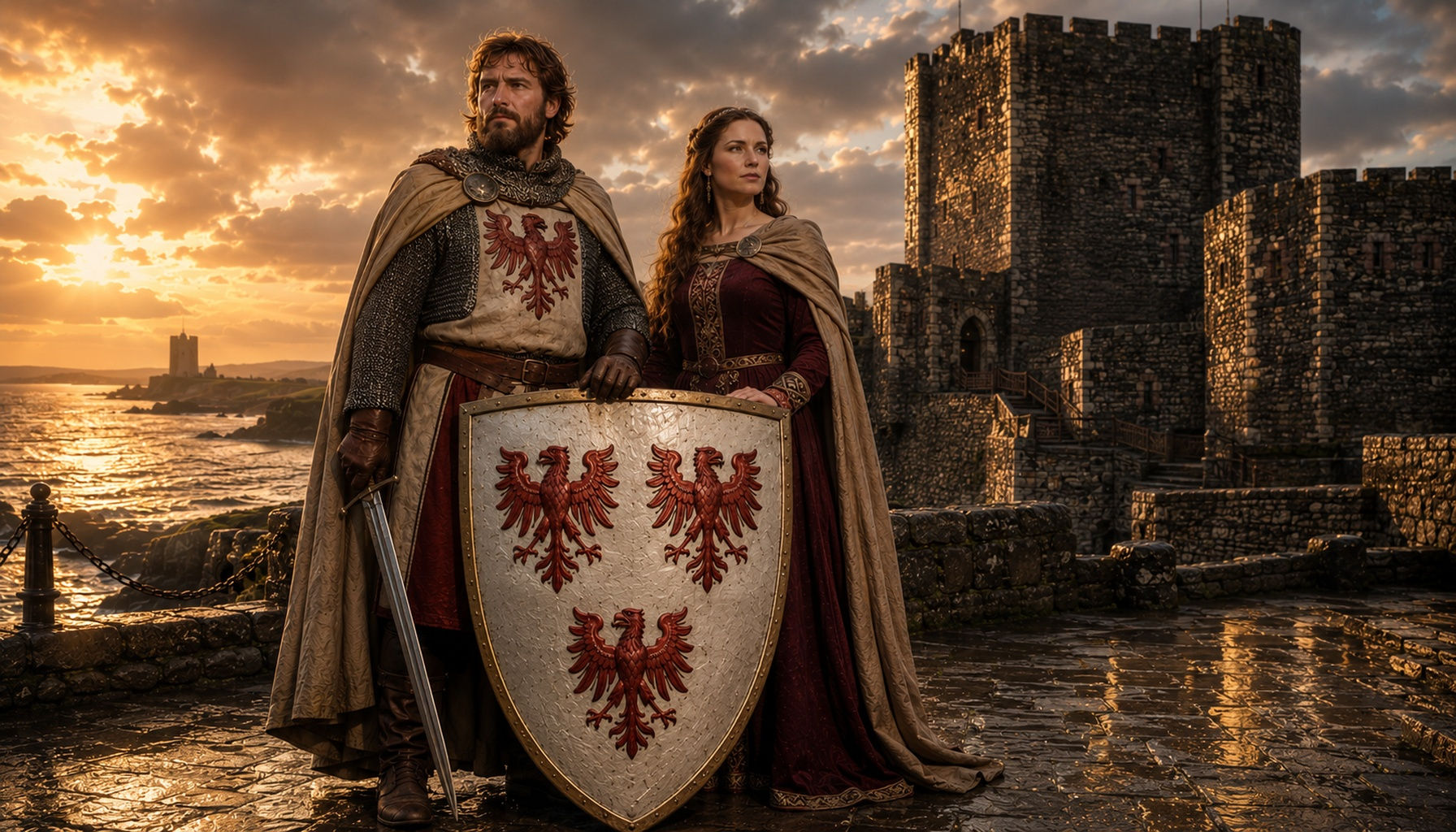
The House of de Courcy was an Anglo-Norman noble family whose name came from Courcy in Normandy, and whose later story stretched across England and deep into medieval Ireland. Their primary family haplogroup is linked here as I1a1b1a1d2b, a paternal line that adds an intriguing genetic tag to a house better known in history for swords, charters, castles, and hard frontier politics. Like so many Norman families, the de Courcys began as lords rooted in a named place, then expanded through conquest, royal favour, marriage, and relentless opportunism.
What makes the de Courcys especially vivid is that they stand right on the fault line of the Anglo-Norman world. They were not merely grand landowners sitting comfortably behind stone walls. They belonged to that mobile, ambitious aristocratic class that crossed the Channel, served kings, fought rivals, and carved out new power in contested regions. John de Courcy, born around 1150 and dying in 1219, became the most famous member of the family through his dramatic conquest of Ulster. Robert de Courcy is another important early figure tied to the family's Norman and English standing. Taken together, the de Courcys embody the classic frontier pattern of the age: continental origin, military expansion, castle lordship, Irish settlement, and an enduring noble identity shaped as much by danger as by prestige.
The family's location anchor is Chateau de Courcy in Calvados, Normandy, near the commune of Courcy. This was the sort of place from which a noble name could become a political brand. The site preserves the memory of the seigneurial world that produced families like the de Courcys: a landscape of fortified residence, local authority, and strategic positioning in a region transformed by ducal power and then by the wider Norman adventure abroad. The present remains are later and layered, as such places often are, but that is part of the fascination. A Norman stronghold was rarely a frozen monument; it was rebuilt, adapted, damaged, and reused across centuries. Chateau de Courcy still stands as a visible reminder of the family's geographic origin, and it can be visited, which gives modern visitors the rare pleasure of standing in the very landscape that launched one branch of the Anglo-Norman world toward England and Ireland.
Read about Norman Conquest DNA
From a DNA perspective, the de Courcy haplogroup tag I1a1b1a1d2b sits within a wider northern European story, and a number of ancient samples are linked or related to that broader lineage without implying direct descent from the family itself. These include individuals from Migration Period Hungary at Rakoczifalva (RKF183), Longobard Period Pannonia at Savaria Szeleste Barbaricum in Hungary (SZL026), Merovingian Bavaria at Altheim in Germany (Alh_141), Iron Age Pommerania at Gdansk Wielbark (PCA0480), and post-Roman and early medieval Britain including Cornwall Widemouth Bay (I16383) and Wolverton in Buckinghamshire (I16509). The same linked pattern also appears across Denmark, Sweden, the Netherlands, Germany, Russia, Saaremaa, and medieval Hungary, with samples such as CGG107443, CGG107762, CGG105926, AHS29, To_Lav_T2US16, Bal_111, Bal_111m, Bal_111x, als007, kro016, DUN005, VK315, VK223, VK549, and VK507. In plain English, this is the sort of genetic trail that fits a world of North Sea movement, Scandinavian connections, continental mobility, and the shifting military societies from which Norman and related medieval elites ultimately emerged.
Explore Anglo-Saxon migration DNA
If the de Courcys catch your imagination, it is probably because they belong to that wonderfully untidy medieval world where family, warfare, land, and identity were all knotted together. Upload your DNA to MyTrueAncestry to see whether you match the House of de Courcy or any of the related ancient DNA samples linked with haplogroup I1a1b1a1d2b.
Comments