Ancient Leprosy Genomes and the Origins of Branch 0

– 4 min read


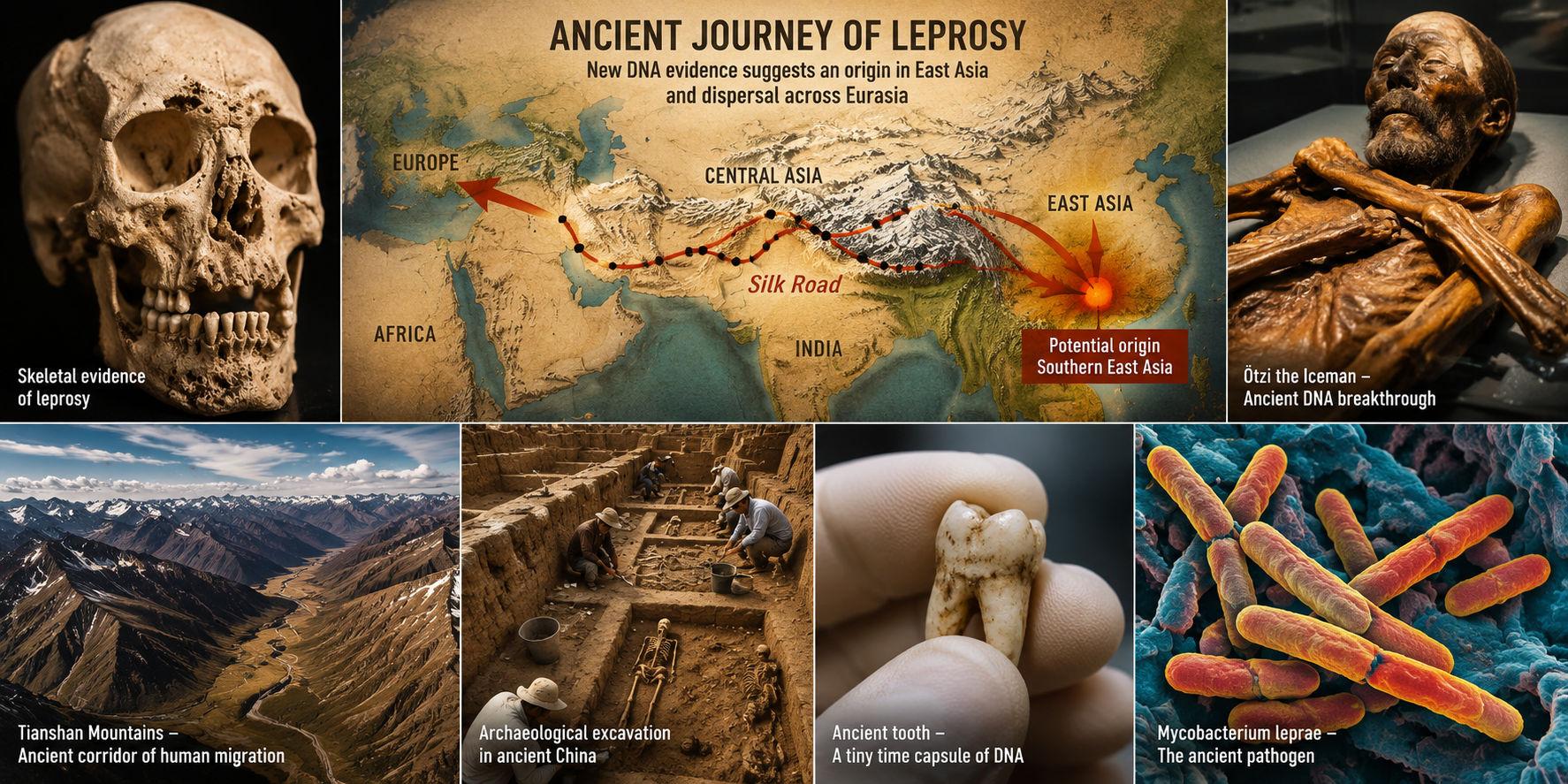
For a long time, the story of ancient leprosy seemed written mainly in Europe. Medieval cemeteries and hospital burial grounds gave scholars a dramatic archive of suffering and exclusion. But that picture was incomplete. Vast eastern lands had yielded almost no ancient genetic evidence for the disease — not proof of absence, but the silence of preservation and chance.
That silence breaks with two striking discoveries from China. Among 1,800 human skeletal remains screened from sites across the country, two individuals carried ancient traces of the bacterium that causes leprosy. The first came from Shihuyao in Xinjiang, a great corridorland of the northwest. The second came from Dangliuzhuangcun in Shanxi, a region tied into the long history of farming communities along the Yellow River. Together they offer a vivid reminder that disease moved through real communities in landscapes shaped by migration, exchange, and local tradition.
The Shihuyao site lies in the Manas River Basin — a meeting point between worlds, part of the broad Tianshan zone where caravans, herders, and armies crossed paths over generations. The individual known as XSSIM2B dated to roughly 1,711–1,550 years before present, placing them in a time of vigorous interaction across Inner Asia. At Dangliuzhuangcun near Datong, individual DLZCM04 dated to around 2,340–2,157 years before present — making this one of the earliest securely dated examples of the disease.
Evidence came not from dramatic mummies but mostly from dental pulp, a hidden chamber sealed within teeth that can preserve molecular evidence remarkably well. Researchers had to search 1,800 skeletons to find just two positive cases. The genetic material recovered was strong enough to reconstruct two ancient bacterial genomes at high quality: strain A533 from Xinjiang and D318 from Shanxi. Both belonged to Branch 0 — a very early lineage in the family tree of leprosy, previously known only from European ancient examples. With A533 and D318, the eastern half of Eurasia is no longer blank.
Once reconstructed, the genomes were compared with dozens of ancient strains and over 150 modern ones. Both belonged to Branch 0, the most basal major lineage in leprosy's known history. Branch 0 divides into two sister lines: 0A, containing ancient and modern strains from Eurasia, and 0B, found today in Pacific Island populations — opening a vast geographical drama stretching from East Asia to the Pacific and westward across Eurasia.
The Shanxi genome D318 occupies a basal position within a modern East Asian line, suggesting long-term persistence in the region. The Xinjiang genome A533 tells a more startling tale: it clusters with five medieval European genomes, sitting near the root of that group. This creates a direct genetic connection between the Tianshan region and medieval Europe — suggesting the flow may have been east to west, with a pathogen in the Tianshan world standing near the origin of strains later found in European graves.
The analysis estimated the common ancestor of all sampled leprosy strains at roughly 4,199 years before present. The Tianshan region was not a blank wilderness — it was an active corridor where people moved with animals, textiles, ideas, and infections. D318 points toward eastern persistence; A533 points toward western linkage. Together they suggest Branch 0A was a dynamic set of lineages, some remaining in East Asia, some spreading outward.
Diseases do not travel by themselves. The study examined the ancestry of both infected individuals, revealing a deeper human story. XSSIM2B from Xinjiang showed mixed western and eastern Eurasian ancestry — a human embodiment of the corridor itself, reflecting generations of contact. DLZCM04 from Shanxi fit more closely with ancient Yellow River farming populations, showing that leprosy had also found a place within settled regional societies, not merely carried by passing strangers.
The evidence further suggests Branch 0 may have first circulated in southern East Asia, with one branch moving southward to eventually reach Pacific Islands, and another spreading northward through farming expansions and population integration. This places leprosy within some of the biggest demographic processes in Asian prehistory — the spread of rice-farming groups and the Austronesian expansion into the Pacific.
Leprosy was never only a medical condition. It attracted fear because it could disfigure the body slowly and visibly, and sufferers were often marked socially as well as medically. Genetic evidence now confirms the disease was present in ancient East Asia well before medieval Europe's documented epidemic waves. Yet eastern historical records describe no equivalent institutional response. The bacterium remained genetically stable, but human reactions to it were never neutral — illness became social identity across cultures separated by thousands of miles.
These two ancient individuals from Chinese graves confirm that leprosy belonged within East Asian history as surely as within European history. Their buried remains connect a cemetery in Shanxi and a burial ground in Xinjiang to medieval Europe, Pacific islands, and ancient southern East Asia — one woven account of human migration, frontier mobility, and social stigma. The pathogen moved because people moved. Through the graves of Shihuyao and Dangliuzhuangcun, that history becomes at once more global and more intimate.
 Shuang Fu





Comments