Viking Age Lady Kata of Varnhem
– 5 min read
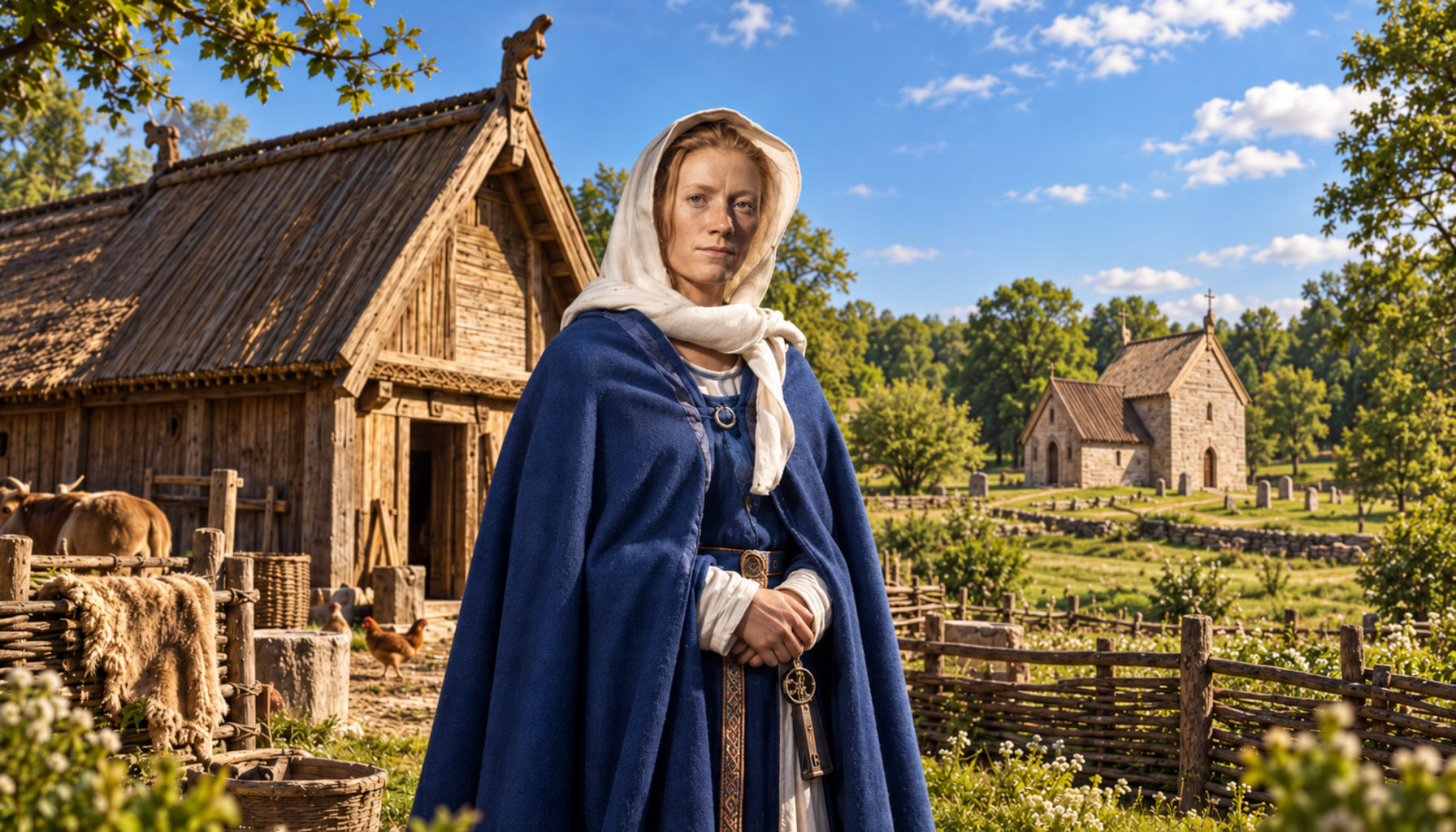
Kata of Varnhem was an elite woman of 11th-century Sweden, living at a moment when the Viking Age was shading into a Christian Middle Ages. She belonged to the powerful milieu surrounding the wealthy estate at Varnhem in Västergötland, a place that was far more than an ordinary farm. It was one of those nodal points where land, family, religion, and prestige came together, and where the conversion of Scandinavia was not simply preached but materially built into the landscape.
What makes Kata so arresting is that she is not just an anonymous skeleton from a famous site. Her name survives. So do glimpses of her family. A runic memorial associated with her grave names her husband Kattel and her brother Torgils, while her burial beside an early private church in an impressive limestone coffin marks her out as a woman of exceptional standing. In a period when written records for Scandinavian women are often painfully thin, Kata steps forward with unusual clarity.
Varnhem itself deserves a pause. In the 11th century, private churches were serious statements of power. To found one meant wealth, influence, and confidence in a new religious order that was reshaping society across Sweden, Denmark, and Norway. This was the age when old cult places, inherited estates, and new Christian institutions overlapped in fascinating and sometimes uneasy ways. Kata appears to have belonged to the family controlling this estate, and archaeology strongly suggests that she may have exercised real authority within its household and landed world. Her life sits exactly at that hinge-point in Scandinavian history: not the saga-age caricature of helmets and raids, but a more complex world of estate management, kinship, piety, commemoration, and social rank.
Kata died at around 30 to 35 years of age, according to examination of her skeleton. The burial itself is one of the strongest clues to her status. She was laid to rest beside the early church at Varnhem, in a prominent and privileged setting reserved for people at the top of local society. The limestone coffin is not just a nice archaeological detail; it is social language in stone. It tells us that her family commanded resources and wished to display rank, memory, and Christian identity in a durable form.
The identification of the remains as Kata is strongly supported rather than mathematically certain in the modern forensic sense. The case rests on the close association between the grave, the commemorative runic inscription, and the elite churchyard context at Varnhem. In other words, this is not a wild guess, nor is it an unchallengeable proof stamped from a laboratory. It is a historically grounded identification built from archaeology, inscription, and burial setting. That is often how real ancient history works: several kinds of evidence converging on a compelling conclusion.
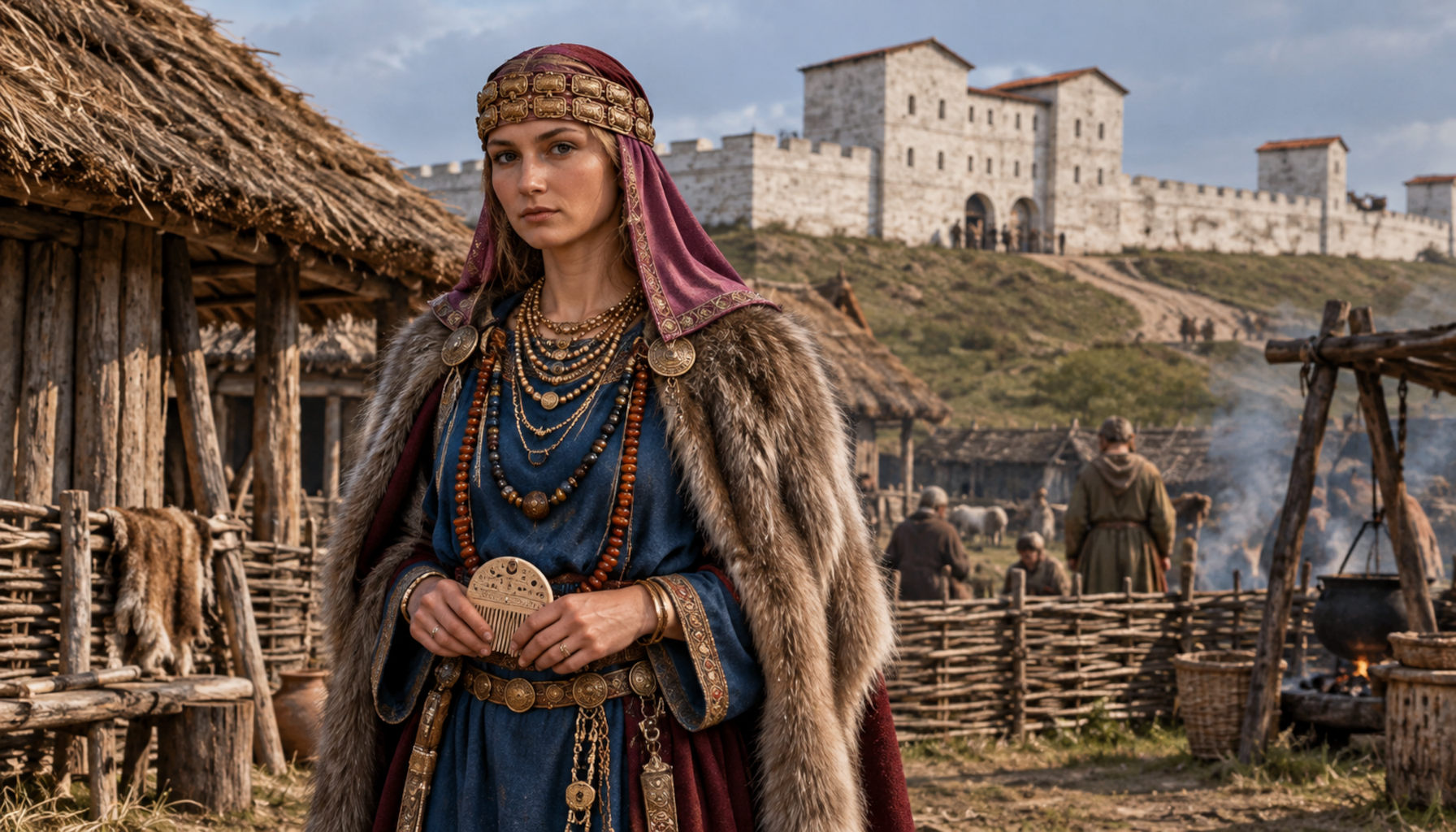
Modern research has given her an afterlife of a rather extraordinary sort. Scientific study of her remains has been used to investigate aspects of her origins and appearance, and forensic artist Oscar Nilsson created a lifelike facial reconstruction from her skull and associated evidence. There is something wonderfully unsettling about it. Suddenly this 11th-century woman ceases to be merely a name in a museum label or a data point in a burial catalogue. She looks back at us.
The ancient DNA sample associated with her is listed as Viking Age Kata of Varnhem Skara Sweden, sample VK303, dated to about 1050 AD. That places her very neatly in the late Viking Age, precisely when Christian burial customs were becoming established among high-status Scandinavian families. The sampled material comes from her excavated remains at Varnhem, although the supplied material does not specify here which exact skeletal element was used for sequencing. As ever in ancient DNA, the sample is not interesting in isolation; it matters because it is tied to a well-contextualized burial with rare historical associations.
This is one reason Kata is such a valuable figure for archaeogenetics. Many ancient genomes come from unnamed people. Kata’s sample, by contrast, belongs to a woman whose grave, family connections, elite status, and historical setting are unusually visible. That allows researchers to ask richer questions. Not “what was the DNA of some Viking Age individual?” but “what does the DNA of this particular woman, from this powerful Christianizing estate, add to the picture?” The study context provided by the reference article at biorxiv.org belongs to the larger wave of genomic work that has transformed our view of Viking Age populations, showing them to be historically connected, mobile, and regionally varied rather than genetically uniform.
Discover Viking Age Christian Tomb DNA
Kata’s direct maternal lineage, traced through mitochondrial DNA inherited through the mother’s line, belongs to mtDNA haplogroup T2a1b1a1. Her direct paternal lineage, which would be traced by Y-DNA, is not available here because Y-DNA is carried only by biological males. So in Kata’s case there is no Y-haplogroup to report, and there is no need to invent one.
What does T2a1b1a1 mean in plain terms? It places Kata within one branch of a much older maternal lineage found across parts of Eurasia over long stretches of time. A mitochondrial haplogroup is best understood as a deep maternal ancestry marker, not as an ethnic badge. It does not tell us that Kata was “more” or “less” Viking, Swedish, Christian, noble, or anything else of that sort. Culture, language, status, and religion are not reducible to a mitochondrial label. What it does offer is one clean line of descent through her mother, her mother’s mother, and so on back into the deep past.
There are broader ancient-DNA links worth noting around Kata’s maternal branch. Related T-line samples have appeared in quite varied contexts, including Viking Age Sigtuna in Sweden and much earlier individuals from Bronze Age Austria such as DSH008 and DSH023, as well as more distant examples like KNE002 from Early Bronze Age Czechia, I18213 from Early Iron Age Hungary, I5516 from Food Vessel period Doune, and Estonian Bronze Age samples such as X05 and V7. One must be careful here: these are not “Kata’s people” in any simple familial sense. Rather, they show that parts of the wider maternal T network turn up across Europe over millennia, a reminder that the genetic threads visible in a Viking Age woman may have very deep prehistoric roots.
More narrowly, the most directly relevant T2a1b1a1-linked sample in the supplied material is Kata herself, VK303. That may sound almost comically circular, but it is actually important. Sometimes an ancient lineage is known from a broad cloud of loosely related samples; sometimes the key point is simply that a historically meaningful, well-contextualized person has now been securely placed within that lineage. In Kata’s case, the value lies less in building a long list of exact maternal matches than in anchoring one specific haplogroup to one unusually well-documented Viking Age woman.
So what can her DNA tell us? It can help place her within the genetic diversity of late Viking Age Scandinavia and preserve one direct maternal lineage from an elite Christianizing estate. It can also contribute to future kinship and population comparisons if more individuals from Varnhem and similar sites are studied. But it cannot, on its own, reveal her personality, prove specific ethnic identity, or demonstrate direct descent for modern people who happen to share the same mtDNA branch. Shared haplogroups usually point to much older common ancestors, often far earlier than the Viking Age itself.
Kata matters because she stands at the meeting point of four kinds of evidence that seldom align so neatly: archaeology, runic commemoration, osteology, and ancient DNA. She lets us see how an influential woman in 11th-century Sweden was situated within a transforming world of estates and churches, old kin structures and new Christian identities. Her DNA does not solve every historical question, but it enriches a life already visible in stone, bone, and inscription. With Kata, genetics is not replacing history. It is joining the conversation.
Read about Early Christian DNA in Scandinavia
If stories like Kata’s intrigue you, MyTrueAncestry lets you compare your DNA with ancient populations and archaeological samples from worlds like Viking Age Scandinavia. It cannot prove direct descent from Kata herself, but it can help you explore whether your ancestry shows connections to the populations and lineages that shaped her age.

Comments