Swedish Warship Kronan Sailor

– 4 min read
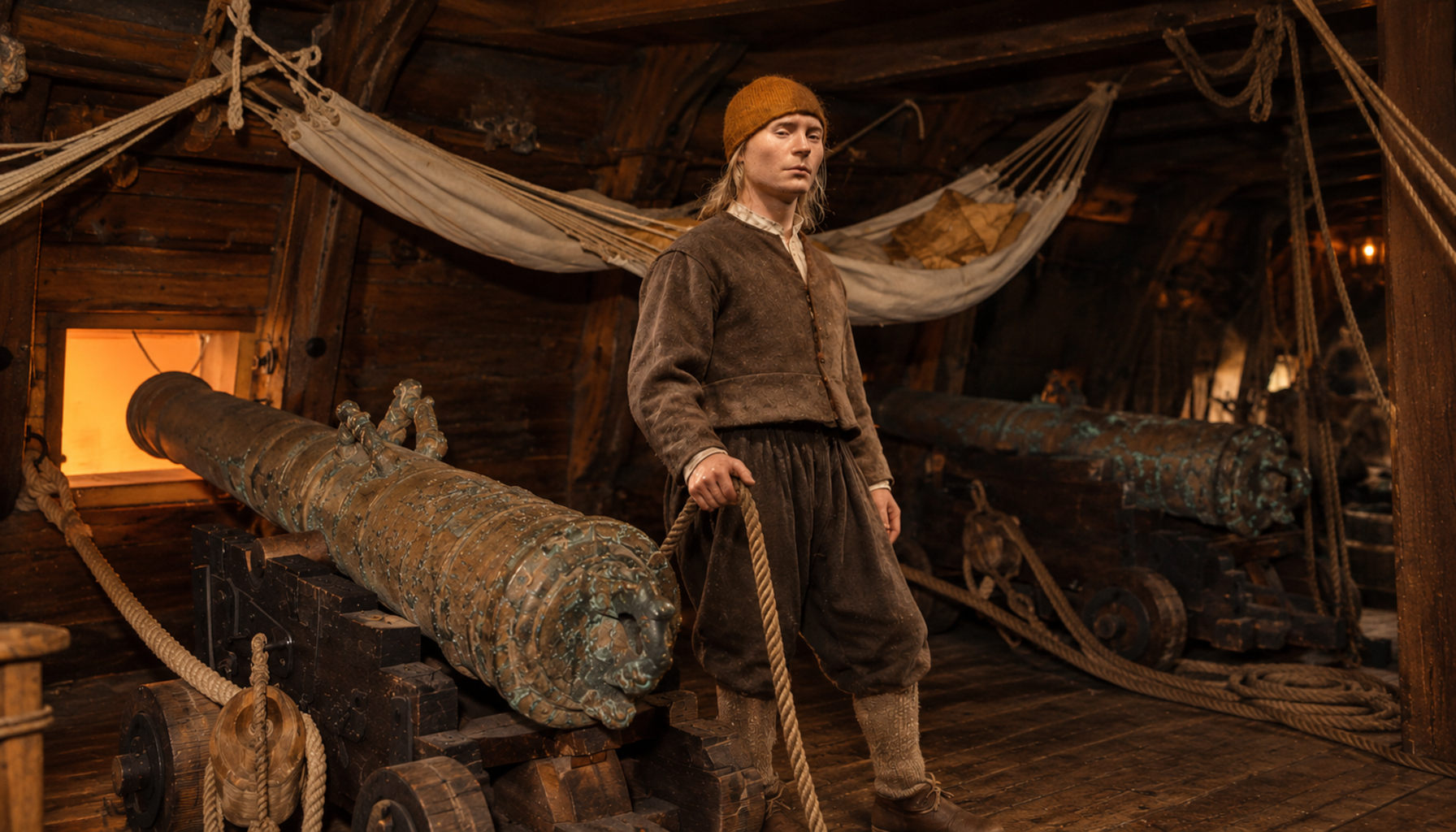
The man represented by sample kro016 was one of the crewmen lost aboard Kronan, the giant flagship of the Swedish navy, when she went down at the Battle of Öland in 1676. We do not know his personal name, birthplace, or rank from the information supplied, and that uncertainty matters. But we do know the world he served in: a Sweden of imperial ambition, naval competition, and constant pressure across the Baltic, where warships were not simply floating gun platforms but statements of royal power.
Launched in 1668, Kronan was among the great warships of seventeenth-century Europe, carrying more than 100 cannons and embodying the confidence of the Swedish Empire under the later Vasa era and its military establishment. On 1 June 1676, during battle against a combined Danish and Dutch fleet off Öland, the ship made a hazardous turn in heavy wind, heeled over, capsized, and then exploded when the gunpowder magazine ignited. The loss was catastrophic. Admiral Lorentz Creutz and hundreds of sailors and soldiers died with the flagship. For centuries the wreck lay on the Baltic seabed, until its rediscovery in 1980 turned a famous naval disaster into an archaeological site of extraordinary richness.
This sailor lived at a time when Sweden was a major northern power, its rulers seeking to dominate the Baltic through armies, fortresses, and fleets. Service aboard Kronan placed him at the sharp end of that project. Life on such a ship would have been crowded, disciplined, noisy, and dangerous even before battle began: guns, rigging, stores, powder, officers, marines, and ordinary seamen packed into a floating machine of war. When Kronan sank, the event was not merely a naval mishap. It was a political and military shock, because so much command structure and so many men vanished at once. Sample kro016 reminds us that behind the grand language of empire stood individual bodies, individual deaths, and individual histories.
The sample is described as Stora Kronan Shipwreck Battle of Oland Sweden, dated to about 1676 AD. In this case, we are not dealing with a securely named historical person, but with a probable identification at the level of context: the remains are associated with one of the men who died in the sinking of Kronan. That is a strong archaeological identification of circumstance, not a personal identification by name. The wreck has yielded cannons, coins, weapons, clothing, tools, and personal belongings, alongside human remains, allowing researchers to place kro016 firmly within the material world of the ship and its final battle.
That context is what makes the sample so compelling. A seventeenth-century shipwreck is almost a sealed time capsule, though never a perfect one. In the case of Kronan, underwater archaeology gives us not only the drama of the sinking but the texture of shipboard life: what men wore, handled, spent, repaired, and carried. DNA analysis then adds one more layer, not replacing archaeology but sitting beside it.
The sailor’s Y-DNA haplogroup was I1a1b1. Y-DNA follows the direct paternal line, passed from father to son. His mtDNA haplogroup was J1c8a. Mitochondrial DNA follows the direct maternal line, passed from mothers to their children. These are lineages, not ethnic labels, and they do not by themselves tell us the man’s language, profession, loyalties, or precise homeland.
The paternal lineage I1a1b1 is historically interesting because related ancient samples appear across a wide sweep of European contexts linked to northern and central Europe. Among the examples often cited are the same Stora Kronan shipwreck sample kro016, Migration Period Hungary Rakoczifalva (RKF183), Longobard-period Hungary at Szeleste (SZL026), Merovingian Bavaria (Alh_141), Gothic-associated Wielbark samples from Poland such as PL048 and PL074, early medieval and Viking-age Scandinavians including Denmark samples CGG107443, CGG107459, and CGG106720, Viking Age Sweden Uppland Alsike (als007), Vendel Age Saaremaa Salme I (VK507), Viking Age Funen (VK315), Iron Age Finland Levanluhta (CGG019338), and even earlier finds such as Neolithic Sweden Albacksbacken Maglarp (CGG105926). One should be careful here: this does not mean our sailor belonged to any one ancient tribe named in those site labels. It means that his direct paternal line sits within a lineage seen in a range of northern European and Germanic-period contexts over a long time span.
The maternal lineage J1c8a is, in the supplied material, directly attested for kro016 itself. That is more limited, but still valuable. mtDNA often receives less public attention than Y-DNA, yet it preserves an equally real family story: an unbroken chain of mothers stretching back through time. In this case, the securely relevant J1c8a-linked ancient sample named here is the Kronan sailor himself, which means the maternal result is informative for this individual even if broader comparison remains sparse in the supplied dataset.
The wider scientific backdrop comes from large-scale ancient DNA research such as the 2022 Cell study on the genomic history of Europe, which helps place lineages like these within long-term population history rather than treating them as isolated curiosities. That kind of work shows how deeply mixed and mobile European populations have been over millennia. For a man on a Baltic warship in 1676, that is exactly the point: even before the modern age, the human background to states and armies was already layered, mobile, and complex.
The DNA from kro016 is historically interesting because it brings individuality back into a disaster usually told at fleet level. It can help place this sailor within broader paternal and maternal lineages known in European ancient DNA, and it confirms that the men aboard Kronan can be studied not only as casualties but as biological individuals. What it cannot do, on its own, is name him, assign him a precise ethnicity, or prove descent for modern people who happen to share one of his haplogroups. Shared haplogroups point to ancient lineage connections, often far older than the seventeenth century.
That is perhaps the most moving thing about this case. A vast ship, a great explosion, an imperial defeat: history loves the big scene. But ancient DNA and archaeology allow us to pause over one sailor from that wreck and see him not as a statistic, but as a person with a paternal line, a maternal line, a place in a crew, and a body recovered from one of Scandinavia’s most famous maritime catastrophes.
MyTrueAncestry lets you compare your DNA with ancient populations and archaeological samples, helping you explore possible genetic connections to the Baltic world, Scandinavian history, and the deeper lineages found in ancient DNA research.
Comments