Dame von Pförring Roman Frontier
– 5 min read
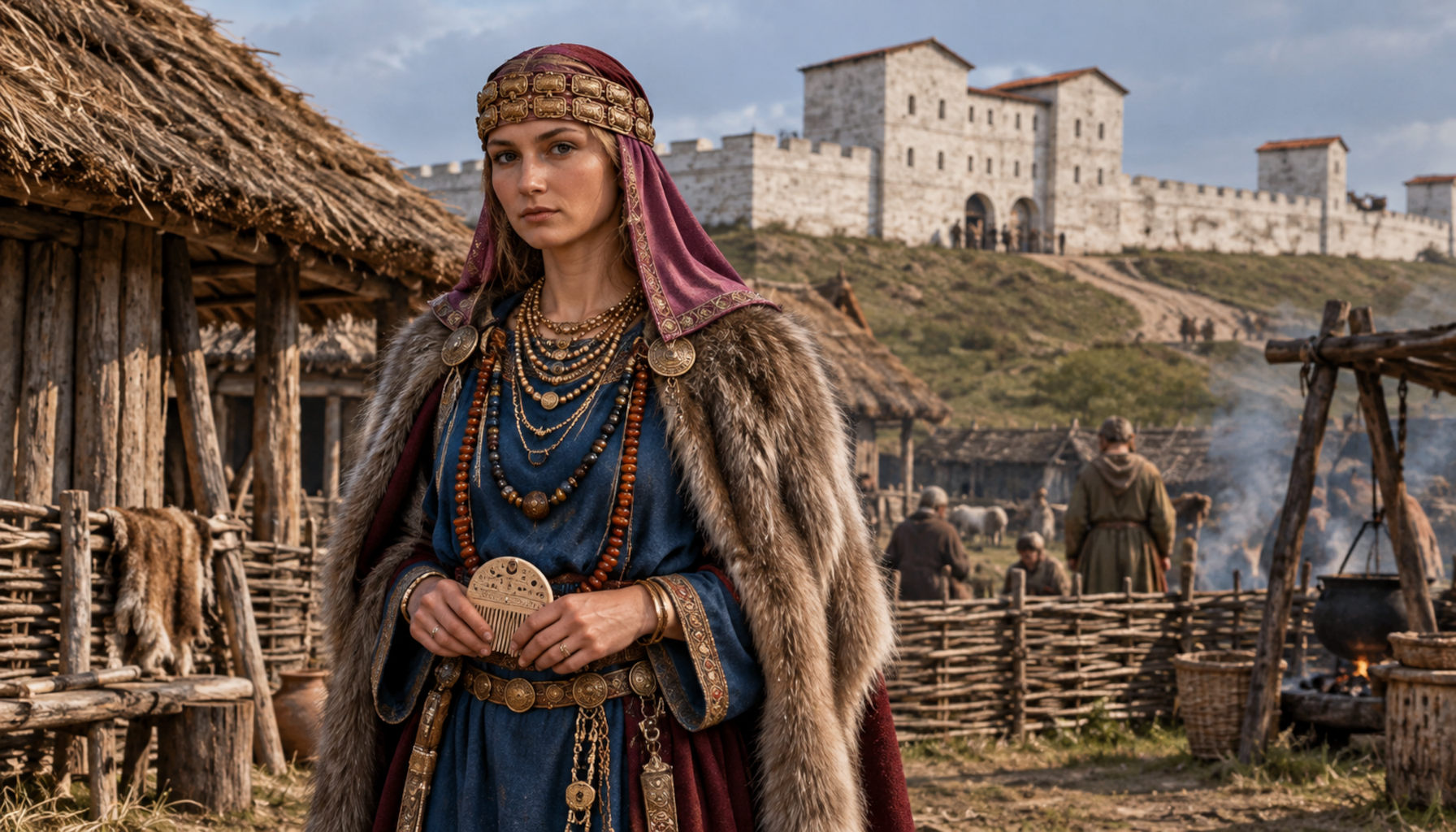
The woman conventionally known as the Dame von Pförring lived at a most awkward and interesting moment in European history: around 400 AD, when Roman power on the Raetian frontier was thinning, but Roman habits, objects, and prestige still mattered enormously. Buried near Pförring in Bavaria, close to the former Roman cavalry fort of Celeusum, she stands before us not as a name from a chronicle but as a person made vivid by archaeology, stature, dress, and now ancient DNA.
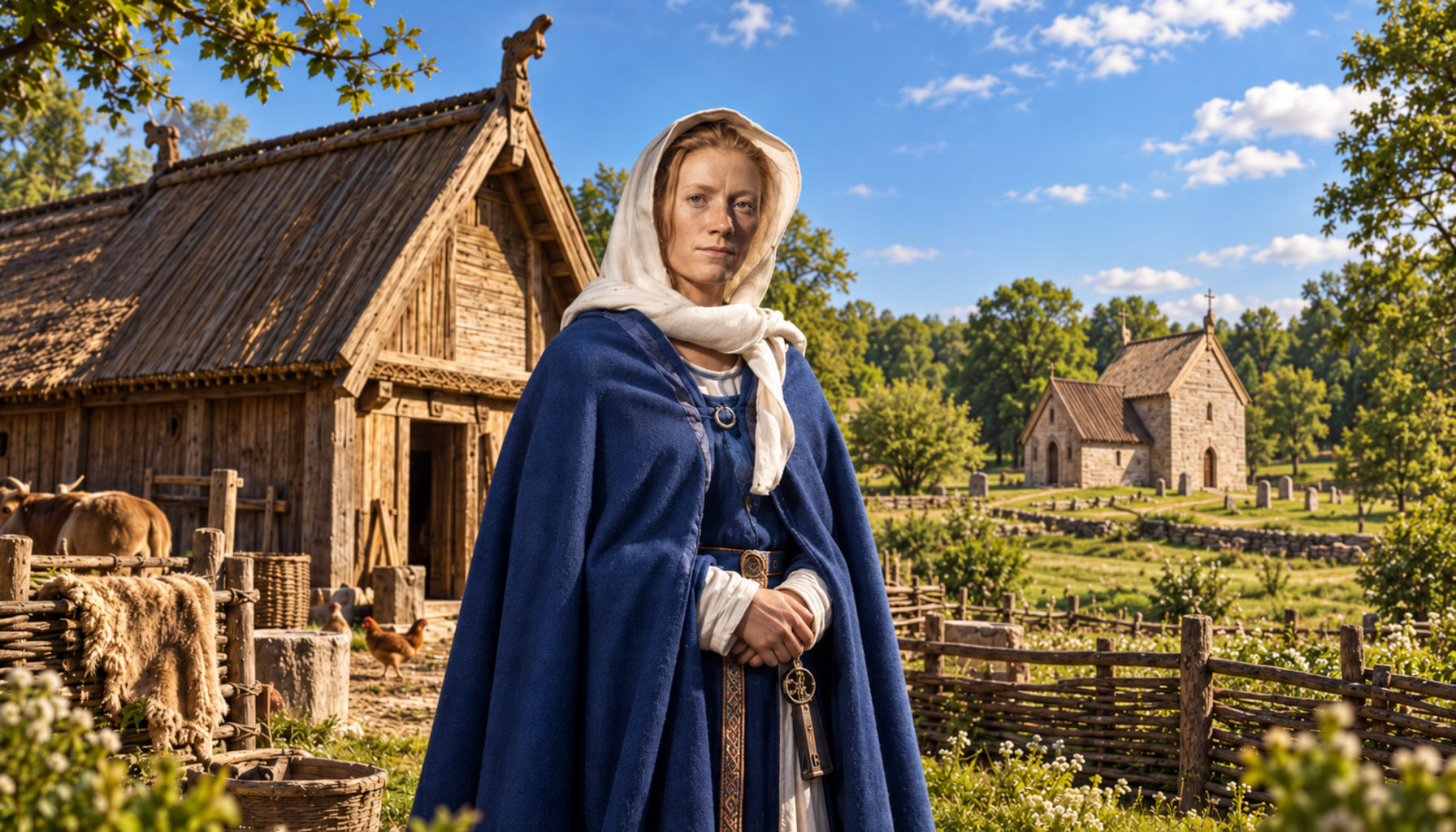
She was young, about 20 years old, and remarkably tall for her time at more than 170 centimeters. That alone would have made an impression. But what truly marks her out is the extraordinary care of her burial: a richly furnished wooden chamber grave filled with ornaments and objects that speak of rank, identity, and a frontier society where Germanic and Roman worlds were not neatly separated but thoroughly entangled.
The Dame von Pförring belongs to that late Roman and post-Roman world in which frontier elites could be culturally Germanic, materially Roman, and politically adaptive all at once. Her grave included hundreds of amber, coral, and glass beads, brooches, silver fittings, an elaborate decorated head covering, a hairpin, a gold ring, a bracelet, and a particularly intricate belt-hanging assemblage. That last collection is wonderfully revealing: keys, tweezers, small containers, a cowrie shell, a needle case, pierced Roman coins, and other suspended items that were both practical and performative. Such things were not random clutter. They were costume, status, and social language.
Inside the chamber were also ceramic vessels, a glass cup, a comb, and other household items. Altogether the burial suggests not merely wealth, but a carefully staged presentation of womanhood, household authority, and elite identity. She was rooted in the Germanic population north of the Roman frontier, yet the Roman military and economic world was still very much in the room, so to speak. Celeusum and the Raetian limes were no longer the hard imperial barrier they had once been, but their legacy persisted in trade, ornament, habits of display, and the aspirations of local leading families. Her burial captures that transformation with unusual clarity.
In genetic research, the Dame von Pförring is represented by sample Pfoe1, described as Elite Germanic Grave Dame von Pfoerring near Celeusum Raetian Frontier Germany, dated to about 400 AD. This is not a case where DNA was used to identify a famous named ruler from written sources. Rather, the individual is archaeologically secure as the woman buried in this exceptional grave, while her historical identity in the sense of personal name or family pedigree remains unknown. In other words, we are dealing with a real and well-contextualized person, but not a named figure from texts.
The value of Pfoe1 lies precisely there. The sample comes from an excavated burial whose context is unusually rich, allowing researchers to connect biological evidence with grave goods, chronology, frontier geography, and the social world of late Roman Raetia. The associated study published in Nature helps place individuals like her within broader patterns of mobility and interaction around the fading Roman frontier, though one should be careful not to claim more than the evidence allows. DNA can illuminate ancestry and population links; it cannot tell us her language, her legal status, or what she thought about Rome.
No Y-DNA haplogroup is available for this individual, which is entirely normal because Y-DNA traces the direct paternal line and is present only in males. For the Dame von Pförring, the reported maternal lineage is mtDNA haplogroup H49a. Mitochondrial DNA, inherited through the direct maternal line, follows a different route through ancestry from the rest of the genome. It tells us about one maternal thread among many, not the whole fabric of a person’s background.
Haplogroup H belongs to a broad maternal lineage that has been widespread in Europe for a long time, and H49a is one smaller branch within that larger tree. That is useful for lineage classification, but it should not be mistaken for an ethnic badge. H49a does not prove that the Dame von Pförring was “Roman,” “Germanic,” “Gothic,” or anything else of that kind. Those are historical and cultural categories, not mitochondrial ones. What the mtDNA result does provide is a securely documented maternal-line marker that can be compared with other ancient individuals and populations.
Among H49a-linked material mentioned here, the directly relevant sample is Pfoe1 herself, the elite woman from Pförring. At present, that makes the maternal lineage evidence more precise at the level of her own record than as a broad network of close archaeological matches. That is still valuable. Even a single mtDNA assignment helps anchor this burial within the growing ancient-DNA map of late antique Europe, especially in a frontier region where identities were layered and shifting.
More broadly, related comparative samples from late Iron Age and medieval Europe, including individuals such as Gothic Tribe Poland Maslomecz Wielbark (PL079), Iron Age Denmark Sjaelland Mosede Mose (CGG107486), Belgic Suessiones Iron Age France Bucy-le-Long (CGG022433 and CGG022429), Pre-Vendel Iron Age Sweden Skane Trelleborg (CGG105934), Post Viking Age Denmark Ribe Lindegarden Esbjerg (LP120), and Medieval Age Faroe Islands Sandoy Church (VK248), can be useful as population context rather than as close family evidence. They remind us that maternal lineages and wider ancestry patterns circulated across a very interconnected northern European world over many centuries. But similarity to such samples does not mean the Dame von Pförring belonged to the same tribe, shared the same language, or had any recent genealogical tie to them.
The Dame von Pförring is historically interesting because her DNA sits alongside one of the most eloquent female burials from the transformation of Roman Raetia into early medieval Bavaria. Her grave already tells a story of status, adornment, and frontier negotiation. The genetic data add another layer by placing a real biological person into that historical landscape. Not as a stereotype, not as a textbook “barbarian” or “Romanized” figure, but as an individual whose life was shaped by a borderland where armies, fashions, trade goods, and people moved in complicated ways.
That is the proper strength of ancient DNA here. It helps us study ancestry and population connection, and it can sometimes reveal whether communities were more locally continuous or more mixed than older narratives assumed. What it cannot do on its own is resolve every question of identity. The Dame von Pförring remains most powerful when archaeology and genetics are read together: the beads, the keys, the coins, the chamber grave, the frontier fort nearby, and the maternal lineage H49a all combining to show a young woman living at the edge of an empire that was ending, though not yet gone.
With MyTrueAncestry, you can compare your DNA with ancient populations and archaeological samples from worlds like late Roman Raetia and the early medieval frontier. It is a way to explore possible genetic connections to the peoples and regions that shaped history, without claiming that a shared match or haplogroup proves direct descent from this remarkable woman of Pförring.
Comments