Cosmopolitan Goths: Archaeogenomic Evidence for a Genetically Diverse Masłomęcz Community in Late Iron Age Barbaricum

– 8 min read


Goths on the Move: The Masłomęcz Group and Gothic Origins
The migration route of the Goths sweeps from the chilly shores of the Baltic Sea down towards the Black Sea, but pauses for a fascinating examination of one remarkable community: the Masłomęcz group in today's eastern Poland. Here, in the Hrubieszów Basin, between the 2nd and 4th centuries CE, archaeologists have uncovered a world-class Gothic "barbarian" centre, and geneticists have now revealed its extraordinary biological history.
The Masłomęcz group belongs to the wider Wielbark cultural complex, a cluster of archaeological cultures linked to the Goths as they expanded from the Baltic region. For decades archaeologists debated which part of the Wielbark world served as the starting point for the Masłomęcz community. Was it Central Pomerania on the Baltic coast, or the Elbląg Upland further east? Ancient DNA evidence now weighs in strongly towards the Elbląg Upland, specifically the cemetery at Weklice, rather than the traditionally favoured Pomeranian heartlands.
Named after the village of Masłomęcz, about 50 km east of Zamość, this group has left traces across the Hrubieszów Basin. Archaeologists have found evidence of around 70 settlements and 10 cemeteries, together with spectacular finds: the hoard of gold coins from Metelin, a sword from the Bug River near Gródek, and rich clusters of brooches and ornaments scattered over dozens of sites. This was no poor, marginal frontier society, but an opulent regional hub.
Over 800 graves from Masłomęcz-group cemeteries have been excavated to date. This study draws on 37 newly sequenced individuals from these cemeteries, combined with previously published data, to assemble a comprehensive genetic portrait of the community. The key burial grounds include Masłomęcz 15, Gródek 1C, Moroczyn 25, Strzyżów, and Werbkowice-Kotorów II.
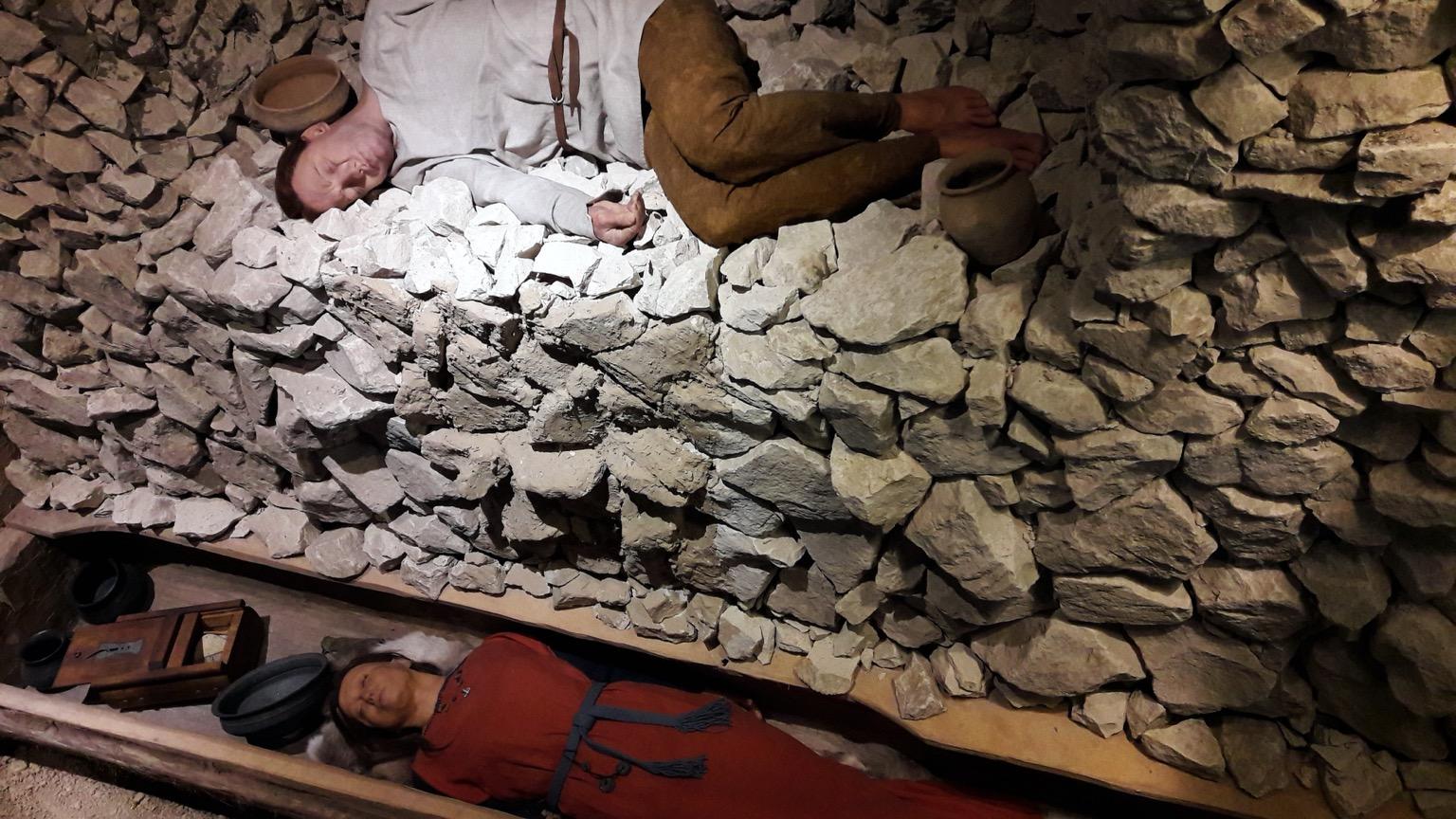
The graves of the Masłomęcz group are remarkable not just for their richness, but for their peculiarities. Burial customs appear almost theatrical: graves were frequently reopened and rearranged, skeletons were sometimes partly dismembered with only selected bones deposited, children were buried with single adult bones, and multiple individuals were interred together with detached skulls from other people.
The excellent soil conditions have preserved even the tiniest infants' skeletons almost intact, providing geneticists with unusually good material to work with – a rarity for Iron Age northern Europe, where cremation often destroys all trace of DNA.
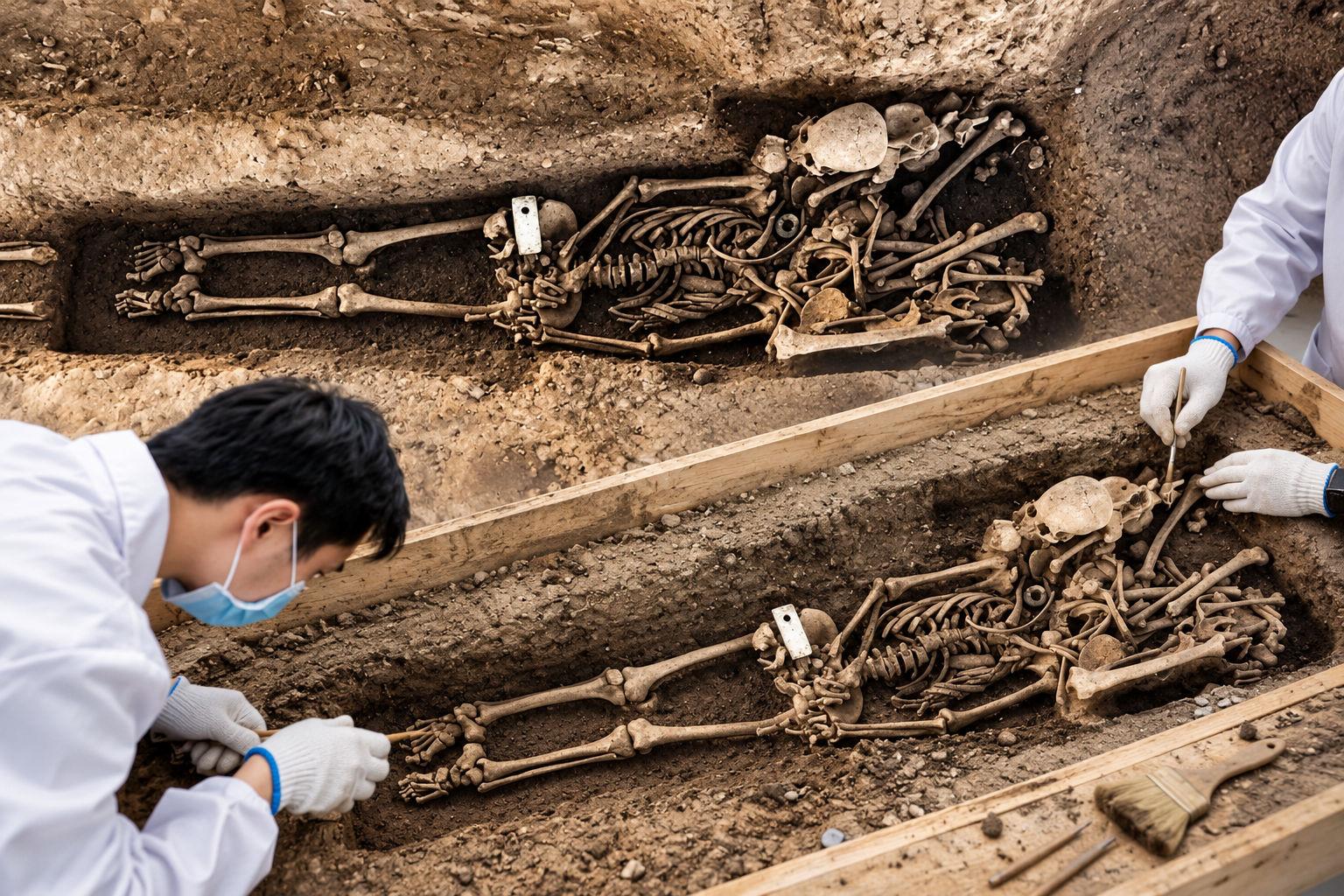
One grave receives special attention: grave 20 at Masłomęcz 15. Here, a young woman (PL040) was buried with three detached skulls. Two of them (PL041 and PL042) were successfully sampled for DNA analysis.
Initially, one might assume a family tomb with mothers, sisters, or daughters united in death. Yet the DNA tells a different story. All three sampled women carry different maternal lineages, and no close kinship can be detected between those whose genomes can be compared in detail. Only faint echoes of distant cousinhood may connect them, but they are certainly not mothers, daughters, or sisters.
This grave illustrates a broader pattern: in Masłomęcz cemeteries, sharing a grave or being buried with someone's skull does not necessarily indicate close biological family relationships. The social rules governing these dramatic burials were clearly more complex than simple blood ties.
Another evocative burial from Masłomęcz 15 involved a man (PL062) seated in a casket, with a woman (PL063) lying beside it, seemingly "nestling" against the coffin. Their genes reveal they were probably quite distant relatives – no closer than fourth-degree kin – from different maternal lines. The grave appears intimate, but represents no straightforward parent-child or sibling relationship. Again, burial choices seem shaped by social or ritual roles rather than tight family units.
At Strzyżów, a rich grave has long fascinated archaeologists because of an object closely paralleling finds from the Balkans and nowhere else. DNA analysis confirms that the man buried there (PL046) carries ancestry pointing firmly towards western and south-eastern Europe, including the Balkans. Here, artefact and genome align beautifully: a stranger from the south, or the descendant of such a stranger, settling among the Goths of the Hrubieszów Basin.
The male-line ancestry of Masłomęcz men reveals where the Scandinavian connection speaks loudest. Of 22 genetically male individuals in the dataset, 12 carry the Y-chromosome haplogroup I1. Today this lineage is especially frequent in Scandinavia, appearing in Scandinavian remains dating back to the Bronze Age. Sub-branches identified in Masłomęcz (such as I-Y2245 and I-FGC41265) are particularly characteristic of the Baltic Sea region and northern Europe.
One boy from Masłomęcz (PL067) belongs to a sub-branch of R1a called Z284, found almost exclusively in Scandinavia among modern populations and in ancient Scandinavian and Viking-age individuals. Genetically speaking, he is clearly a northerner or the descendant of one. Other R1a lineages link some Masłomęcz males to the wider Balto-Slavic and Baltic world, suggesting either local recruitment along the migration route or marriages into nearby populations. One man (PL085) carries Y-haplogroup J2b-L283, most common today in the Balkans, and his autosomal DNA also shows strong southern European affinities.
Overall, roughly three-quarters of the Masłomęcz men have male lines pointing to the Baltic Sea basin with closest ties to Scandinavia. A smaller fraction show Balto-Slavic, Baltic, or Balkan affinities. The male population appears diverse but with a clear Scandinavian backbone.
The maternal lines, traced through mitochondrial DNA, present an even more varied picture. Among 38 individuals with sufficient mitochondrial data, at least 30 different maternal lineages are identified, dominated by typical European groups such as H and U, but otherwise highly diverse.
This wide spread of maternal lineages suggests a large, open population with substantial movement of women into the group from Scandinavia, the Baltic region, the south, and probably from local communities as well. The Masłomęcz cemeteries were not the resting place of a single, tight-knit clan, but of a bustling, multi-sourced community.
One central aim is to locate the Masłomęcz group within the wider web of Wielbark culture, and to identify which Wielbark community may have served as the main source of people for the move into the Hrubieszów Basin. The Wielbark culture spread along the southern Baltic coast in the first centuries CE, with several well-studied cemeteries in northern Poland including Weklice, Kowalewko, Pruszcz Gdański, and Czarnówko.
Earlier archaeological interpretations often favoured Central Pomerania as the staging area for Gothic expansion inland. However, using statistical comparisons, researchers demonstrate that among all published Wielbark sites, Weklice in the Elbląg Upland is consistently the closest genetic match to Masłomęcz. When compared with other Iron Age groups, Masłomęcz aligns more tightly with Weklice than with other sites.
If one seeks the "parent" Wielbark community most similar to Masłomęcz genetically, Weklice stands out, not Pomerania. This suggests that Masłomęcz settlers were more likely to have branched off from Wielbark communities in the Elbląg Upland rather than from the central Pomeranian coast.
When Masłomęcz genomes are placed among thousands of ancient and modern individuals from across Eurasia, most cluster with Iron Age and Late Antiquity northern and central Europeans. Many can be modelled genetically as if drawn almost entirely from Early Iron Age Scandinavia.
Yet the story extends beyond this core. For a significant minority, a single Scandinavian origin is insufficient. Several individuals (PL072, PL052, PL066, PL067) are noticeably closer to Iron Age populations from Lithuania and the eastern Baltic region than to Weklice or other Wielbark sites. Their ancestry profiles echo the Baltic-style artefacts appearing in Masłomęcz graves from the 3rd century CE, tying material culture and genes together.
The previously mentioned PL046 from Strzyżów and PL085 from Masłomęcz stand out because their genomes show clear pulls towards south-eastern and southern Europe. One individual from an earlier study (PCA0110) falls among Mediterranean samples on genetic plots, consistent with ancestry patterns seen in Thracian-linked individuals from the Ukrainian steppe.
Others show affinities to Iron Age and Roman-period western and central Europeans – people genetically similar to ancient populations in Germany, Czechia, or even Britain. Two Masłomęcz individuals (PL078 and PL080) can be described as having majority British Iron Age-like ancestry mixed with a smaller Scandinavian component.
Despite sampling 50 individuals, only one clear pair of first-degree relatives emerges: a man (PL076) and a woman from a previous study (PCA0105). Their DNA shows he was most likely her father; they do not share a maternal line, ruling out a mother-child link.
Interestingly, PL076 has strongly local, Scandinavian-derived ancestry, while his probable daughter PCA0105 is a genetic outlier with a genome pulling towards the south-west. She is not a fresh immigrant but still resembles the Masłomęcz population more than any external group, probably representing second or later-generation mixture between Goths and non-local people.
A scattering of distant kin at the cousin level can be detected, but close-kin marriages seem rare. Only one man (PL083) shows high levels of long stretches of identical DNA suggesting his parents were close relatives (first or second cousins). Another (PL046 from Strzyżów) may also be the child of second cousins. Overall, the community appears to have been large and diverse enough to avoid extensive inbreeding.
The central message is that the Masłomęcz group was both deeply rooted in Scandinavian-derived ancestry and remarkably open to newcomers. Far from being a closed, uniform "tribe," this Gothic community in the Hrubieszów Basin was genetically heterogeneous from its very beginnings in the late 2nd century CE.
Some of the most striking genetic outsiders – the Balkan and Mediterranean-linked individuals – appear in the earliest Masłomęcz phases, when Gothic groups are thought to have been engaged in great wars along the Roman frontier, including the Marcomannic Wars. Others, with Baltic and western European traits, enter the picture later, corresponding with the expansion of Gothic power and widening contact networks.
The graves, with their reopened pits, curated skulls and complex multiperson burials, show that these newcomers were not kept at arm's length. Their bodies were treated according to the same ritual rules as everyone else. Their descendants blended into the local genetic pool, so that even the most extreme "outliers" are, by and large, already part of a shared Masłomęcz genetic world.
This research gently overturns the old image of Goths and other "barbarians" as inward-looking, ethnically rigid groups. In the cemeteries of Masłomęcz, Gródek, Strzyżów and the rest of the Hrubieszów Basin, we see instead a mobile, multi-origin population built around a strong Scandinavian-derived core but enriched by people from the Baltics, the Balkans, central and western Europe, and beyond – a cosmopolitan community at the very heart of "barbarian" Europe.
The Masłomęcz group emerges as both a Gothic community with clear Scandinavian roots and a remarkable crossroads where people from across Europe settled, married, and were buried together according to shared customs that transcended biological kinship. Their story reveals the dynamic, interconnected nature of Iron Age European societies, challenging traditional notions of rigid tribal boundaries and highlighting the cosmopolitan character of communities far beyond the Roman frontier.
Comments