Ancient DNA Shows Social Hierarchy in Late Shang Xisima Was Not Based on Genetic Differences
– 7 min read


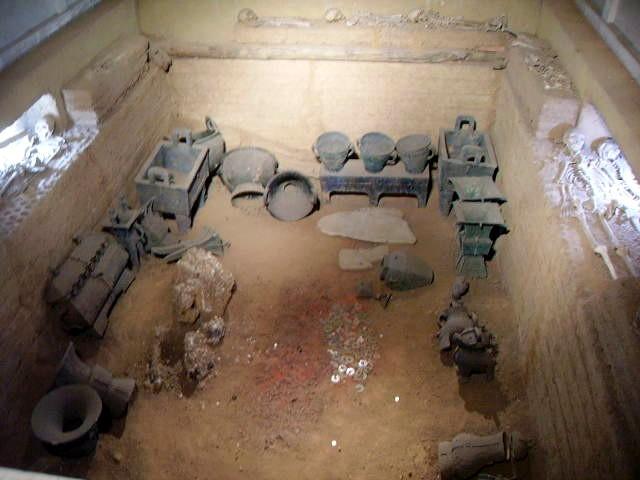
The Xisima cemetery, near today's Xingyang City in Henan Province, offers a vivid snapshot of life and death in the waning centuries of the Shang dynasty, roughly 1300–1046 BCE. Excavated in 2005, the site preserves the burials of people thought to be Shang elites and commoners who were forcibly moved from the royal heartland after the Zhou conquest around 1046 BCE. In other words, Xisima is a community of political exiles – a defeated court and its followers, re-planted in new soil.
Archaeologists quickly noticed that the cemetery was neatly divided by the direction of the graves. This was not a random choice of compass points. In Bronze Age China, how a body was laid out, and which way the head pointed, was a deeply coded social signal. At the great royal cemetery of Yinxu, the late Shang capital at Anyang, clusters of tombs sharing the same orientation often also shared the same clan emblem. There, direction, grave structure, and inscribed family symbols all marched together to spell out identity and status.
Xisima looks strikingly similar in plan. That resemblance led archaeologists to argue that the two burial directions at Xisima marked two different ethnic or social groups living side by side – perhaps even distinct Shang lineages or allied communities, each keeping its own mortuary traditions after relocation.
The team working at Xisima had more than grave orientation to go on. The tombs also differed in scale and richness – details that would have been obvious to any Late Shang visitor walking through the cemetery. The pattern matches what would be expected in a stratified Bronze Age society: elites in grander tombs with richer diets, followers and dependants in humbler graves, and the contrast literally mapped into the landscape by the way bodies were aligned.
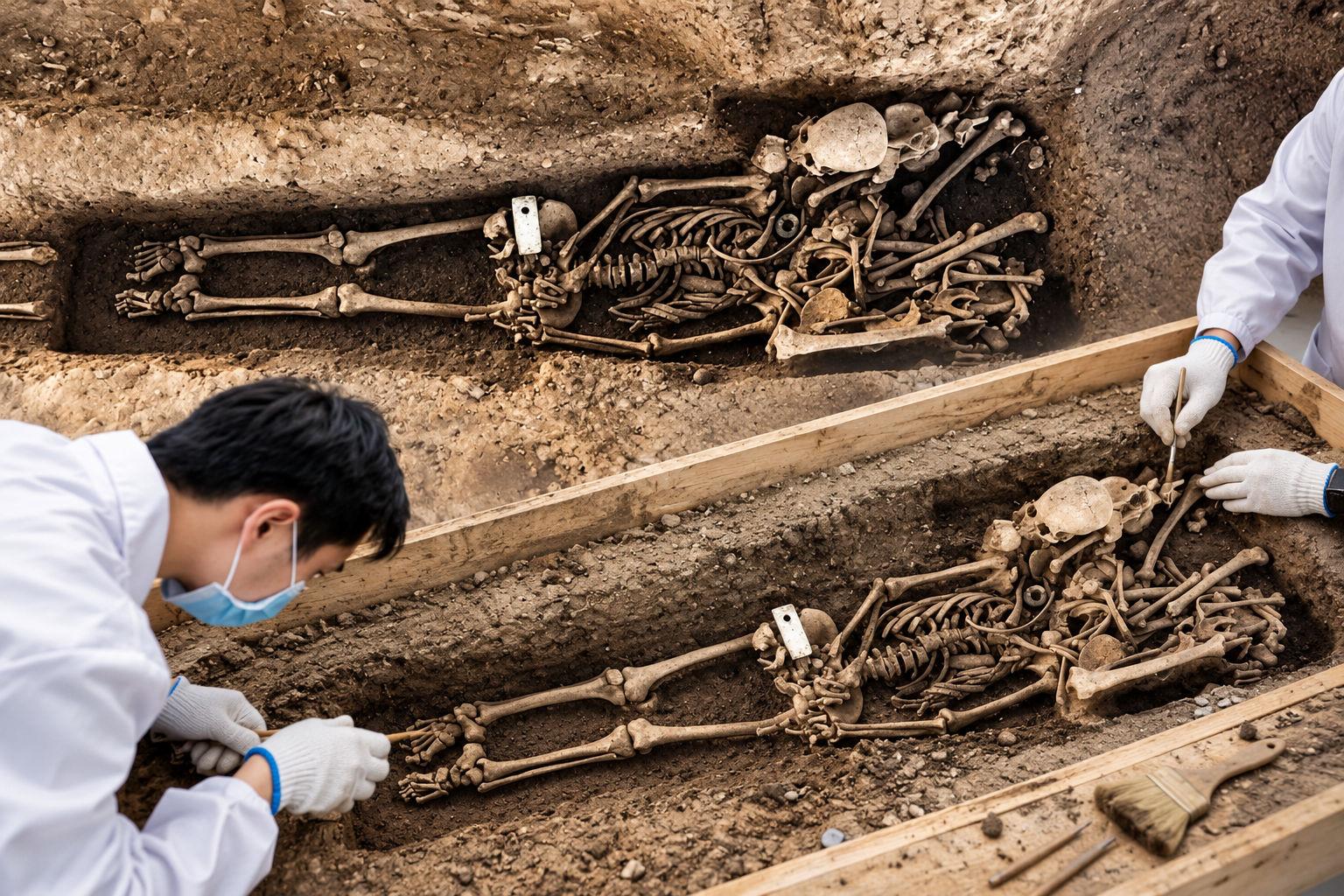
The study focused on 11 individuals from the Xisima cemetery whose bones preserved enough ancient DNA for analysis. Each one comes to us under a technical label, but the archaeology lets us glimpse a little of their human stories. One individual, XSM-M128-1, stands slightly apart in time: radiocarbon dating shows that this person lived during the Warring States period, about a thousand years after most of the others. Yet they were buried in a high-grade tomb that mimics the older Shang pattern, suggesting that local people were still echoing ancient burial traditions many centuries later.
Traditionally, archaeologists assumed that such clear differences in burial practice – especially the neat block of high-grade tombs versus low-grade tombs – meant different ethnic groups, or at least distinctly separate lineages. The new genetic work from Xisima challenges that comfortable assumption. When researchers compared the genomes of people from high-grade and low-grade tombs, they found remarkable similarities rather than differences.
In other words, at Xisima social rank was not enforced or defined by distinct ancestry. High-status and low-status people shared the same genetic background. They were part of one local population whose members could end up on very different rungs of the social ladder. The tombs, with their orientations and grave goods, are shouting about hierarchy. The DNA, by contrast, is whispering: these people are fundamentally the same stock.
Earlier archaeological work at Xisima had suggested that groups of tombs with the same orientation and close spacing might represent nuclear families or extended households. It is a sensible idea: one can imagine grandparents, parents, and children arranged in neat rows, all facing the same way in death. The genetic study, however, looked specifically for close kin relationships and did not find evidence for parents and children or siblings among the tested individuals. Even two people who shared the same maternal lineage, XSM-M87 and XSM-M114-1, turned out not to be close biological relatives in the autosomal DNA.
This does not mean families were absent from Xisima. It may reflect the limited sample size and the fragmentary survival of DNA. Many graves were not sampled or did not yield usable genetic material. But the available evidence does indicate that, at least among the individuals we can study, status and tomb type were not simply a matter of being born into a tight, biologically defined clan buried together.
While the genetic evidence flattens the picture of ancestry, the archaeology restores the sharp edges of inequality. Isotope studies reveal that those in high-grade tombs ate more animal protein, probably from domesticated animals and perhaps even from ritual feasts, while those in low-grade tombs had more restricted access to meat. Taken together, the cemetery reads like a frozen social map: a community of shared ancestry, divided by food, grave construction, and post-mortem honours, not by deep biological separation.
Written sources describe how King Wu of Zhou overthrew the Shang around 1046 BCE, bringing down a dynasty that had dominated the Central Plain for centuries. The people buried at Xisima are widely interpreted as Shang survivors forcibly moved from the old capital area and replanted near what is now Xingyang. Their cemetery shows that they carried their social system with them. Even in exile, they maintained their established burial practices, social hierarchies, and cultural traditions.
Xisima thus captures a poignant moment: a displaced Shang community maintaining old burial codes and social divides, even as political power slips away. Beneath the soil, the cemetery preserves their world in miniature – shared blood, sharply unequal lives, and graves that still speak of who mattered more.
Long before bronze ritual vessels and royal sacrifices, the Central Plain was already a densely settled farming zone. The article builds on earlier work showing that people of the Middle Neolithic Yangshao culture, living about 5,000 years ago, left a very strong genetic legacy in this region. Later Late Neolithic communities in the Yellow River middle reaches – such as those at Yuzhuang, Wadian, and Yangshaocun – show subtle genetic differences, but all are firmly rooted in those earlier Yangshao farmers.
These Late Neolithic groups already form a patchwork of slightly different ancestries. By the time we reach the Shang Dynasty around 1600–1046 BCE, the Central Plain is a political powerhouse, with walled cities, bronze foundries, and the earliest Chinese writing carved on oracle bones. The key question this article asks is: did all that political and cultural change bring in new people, or did it sit on top of long-established local lineages?
The Central Plain was not just one cradle of farming – it was a demographic engine, sending out farmer-descended lineages in many directions, even as its own core population remained strikingly continuous through time. Earlier Neolithic sites in this region, such as those linked with the Yangshao culture, already show a characteristic Central Plain ancestry. By around 4000 years ago, at Late Neolithic sites, the region is already a mosaic of closely related, but subtly different, communities.
These Late Neolithic groups helped form the genetic foundations not only of later Central Plain populations, but also of people living in the upper Yellow River, the lower Yellow River, the Tibetan Plateau, and Southwest China. The Central Plain was thus both culturally influential and genetically foundational for much of East Asia.
When the authors projected the Xisima genomes onto a broader genetic map of East Asia, all eleven individuals clustered tightly together. They did not fan out into separate groups; no one stood off to one side as a foreigner or migrant. Nor did high-grade and low-grade tomb occupants fall into different clusters. On the genetic map, they are essentially one group.
Multiple lines of analysis – shared genetic drift, formal four-population tests, and mixture modeling – all point in the same direction: the Xisima individuals can be explained as direct descendants of those Late Neolithic Central Plain people, with no need to invoke a new, external population. In plain terms, if one imagines a family tree of the Central Plain, the Shang people at Xisima sit on a straight branch grown from the trunks of Yangshao and Late Neolithic villagers.
The authors also examined the ancestors traced through the Y chromosome from father to son and mitochondrial DNA from mother to child. Among the Xisima people, they identified diverse lineages. These Y and mitochondrial lineages are diverse, which fits a long and complex history of marriages, movements, and family mixing over generations. Crucially, this diversity does not contradict the finding of overall genetic similarity: the bulk of each person's ancestry – the autosomal DNA – still places them firmly in the same Central Plain population.
An especially evocative pair are M87 and M114, who share the same maternal lineage called D4b2b. This hints that, if one walked back far enough up their family trees, they would reach a common maternal ancestor – perhaps some centuries earlier – even though they are not closely related within the timeframe that the study can test.
By weaving together ancient DNA, tomb orientation, grave richness, and dietary evidence, this research invites a more careful understanding of social organization in early Chinese archaeology. The Xisima material demonstrates that elaborate burial differences and clear social hierarchies do not necessarily reflect separate ethnic groups or distinct ancestral populations. Instead, what looked like the material trace of separate peoples turns out, under the lens of DNA, to be a single community managing status, power, and identity within one shared biological population.
At Xisima, inequality is carved into the cemetery's layout and into the bones' chemistry, but not into the underlying ancestry. The living community may well have understood these burial groups as socially separate, but they were not separate in genetic origin. This challenges older archaeological assumptions and suggests that early Chinese states were not mosaics of neatly bounded biological ethnic groups, but complex, historically layered societies in which identity, power, and ancestry do not always move in step.
The research transforms our understanding of how social hierarchies operated in Bronze Age China, showing that status systems could be maintained and transmitted across generations without requiring genetic separation between social classes. This finding has implications for how we interpret similar archaeological patterns throughout early Chinese history and beyond.
Original source article: https://doi.org/10.1093/molbev/msaf316
Comments