Leifur of Viking Age Sigtuna
– 5 min read


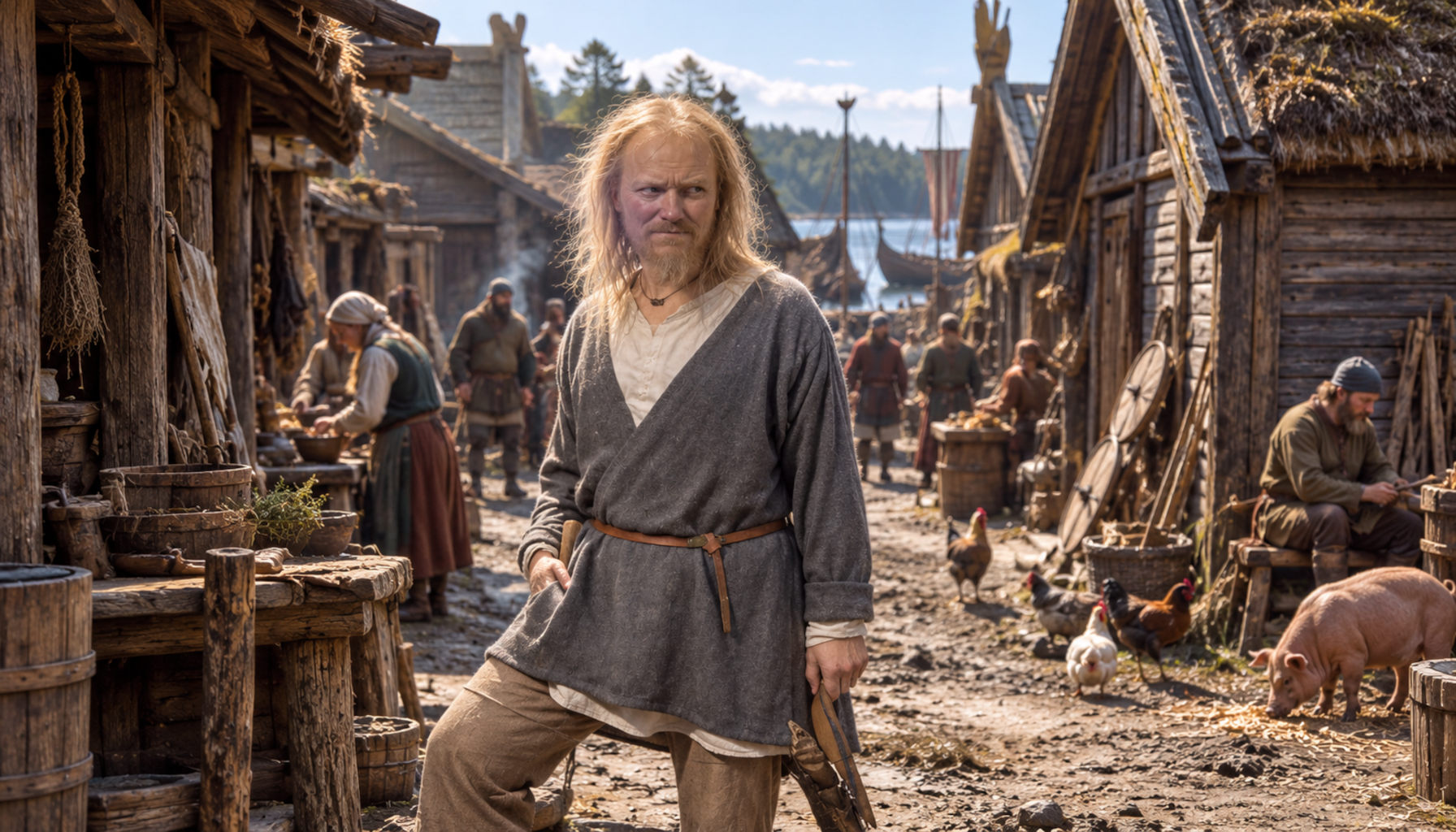
Leifur of Viking Age Sigtuna was not a king, not a saga hero, and not a named chieftain preserved in chronicles. He was, instead, something in some ways more precious: an ordinary man whose bones, burial, isotopes, and DNA allow us to glimpse the human reality of Sweden around the year 1100. He lived at the moment when Sigtuna, founded around 980, was becoming one of the most important royal and commercial towns in Scandinavia, a place where older Viking habits met Christian burial customs, royal power, imported goods, and new ideas from abroad.
The man we call Leifur was buried in the Nunnan cemetery at Sigtuna. His real name is lost to history; “Leifur” is a modern name given during a museum reconstruction project. Yet archaeology has restored a surprising amount. He seems to have died between about 45 and 60 years old, stood around 179 centimeters tall, and was laid to rest without weapons or grave goods. That plain burial matters. It places him in the Christianizing town world of late Viking Age Sweden, where identity was no longer always displayed in the grave through swords, brooches, and rich offerings.
To understand Leifur, one must understand Sigtuna. This was not an isolated settlement of farmers and raiders straight out of popular Viking cliché. It was a planned royal town emerging under the Swedish kings as political authority tightened and long-distance exchange intensified. Coins were minted there. Craftsmen worked there. Traders and travelers passed through from the Baltic, the North Sea world, and lands further east and south. Christianity was increasingly visible in burial practice and public life, even while older Scandinavian customs and social habits did not simply vanish overnight. Leifur belonged to this transitional world. Isotope analysis suggests that he likely spent his childhood outside Sigtuna before settling there later, which fits neatly with what we know of a growing town drawing in people from elsewhere. In other words, he was probably part of the human movement that made Sigtuna what it was.
His significance lies precisely in his ordinariness. We often meet the Viking Age through exceptional people: raiders, rulers, saints, and saga protagonists. Leifur shows the other side of history, the townsman whose life unfolded amid profound change but left no written biography. Thanks to the facial reconstruction created by Oscar Nilsson, he has also become strikingly visible to modern audiences: not a mythic Viking with theatrical furs and horned nonsense, but a real middle-aged man with a particular face, the sort of person one might have passed in a Sigtuna street.
The biological sample associated with Leifur is identified as Sigtuna sample 84001, from Viking Age Sigtuna in Sweden, dated approximately to 1100 AD. This is not a case of a securely named historical individual identified from inscriptions or documentary evidence. Rather, it is a secure archaeological individual whose modern nickname was assigned for reconstruction and public interpretation. That distinction matters. We can speak confidently about the excavated man and his scientific sample, but not about his original historical name.
His remains were recovered from the Nunnan cemetery, a burial ground reflecting the Christian practices increasingly adopted in urban Sweden by the final Viking generations. The lack of weapons, jewelry, and other grave offerings is consistent with that setting. Skeletal study revealed his age at death and unusual height for the period. Isotope work further suggested childhood origins elsewhere, reminding us that medieval towns were made by migration as much as by local continuity. Leifur was not simply “a Viking from Sigtuna” in the narrow sense; he was probably someone who came into Sigtuna’s orbit as the town expanded.
The wider scientific backdrop includes the major Viking Age paleogenetic work published in Current Biology, which helped show that Viking Age Scandinavia was genetically varied and deeply connected to wider networks across Europe. That research did not reduce Viking identity to a single genetic type; quite the reverse. It demonstrated mobility, mixture, and regional complexity. Leifur fits that broader picture very well.
Leifur’s Y-DNA haplogroup, representing his direct paternal line, is N1a1a1a1a1a1a7a. His mtDNA haplogroup, representing his direct maternal line, is H2a2a1g. These are lineages, not ethnic labels. They tell us about one paternal line and one maternal line among thousands of ancestors, not the whole of his identity, language, or culture.
The paternal lineage is especially interesting because branches of haplogroup N are historically found across northern Eurasia and parts of northeastern Europe, including regions linked in different periods to Finno-Ugric-, Baltic-, and Scandinavian-speaking populations. That does not mean Leifur was “defined” by that lineage. It does mean that his direct male line adds one more piece to the picture of how interconnected the Baltic and northern European world could be in the late Viking Age.
Among ancient samples linked to Leifur’s Y-lineage branch or near it are individuals from a strikingly wide arc of time and geography: Grand Prince Dmitry Alexandrovich of the Rurik dynasty (Nev2), Late Roman Arrabona in Hungary (GYS037), Longobard-period Pannonia (KMU009), Iron Age Denmark at Mosede Mose (CGG107492), Germanic Iron Age Sweden at Fullero near Uppsala (ful001), Iron Age West Lothian in Scotland (I27384), and the Vendel Age Salme I context in Saaremaa (VK508). One must be cautious here. These are not “relatives” in the everyday sense. Sharing such a haplogroup means belonging to a broader paternal lineage that may connect through a common ancestor far back in time. Still, the distribution is historically suggestive: Leifur’s paternal line sits comfortably within the mobile and entangled northern European world that linked Scandinavia, the Baltic, and farther regions long before and during the Viking Age.
Leifur’s maternal lineage, H2a2a1g, is harder to dramatize and perhaps more interesting for that very reason. Mitochondrial lineages often cut across many regions and communities, and without a supplied list of directly comparable ancient H2a2a1g samples, it is best not to overstate the matter. What we can say is that his maternal line belonged to a branch of the wider H family, one of the many maternal lineages long present across Europe. In Leifur’s case, the mtDNA result is valuable not because it magically reveals a named ancestry, but because it anchors one part of his biological inheritance within the real diversity of Viking Age Scandinavia.
Genetic analysis has also been used to suggest aspects of Leifur’s appearance, including reddish-blond hair and blue eyes. Those predictions are plausible and evocative, but they should be treated as informed scientific estimates rather than a perfect color photograph from the year 1100. DNA can contribute to facial and pigmentation reconstruction, yet it does not give us his voice, beliefs, trade, or the language spoken in his childhood home.
Leifur’s DNA is historically interesting because it helps put flesh on a period too often flattened into stereotype. Here is a man from a formative Swedish town, buried in Christian fashion, likely born elsewhere, and carrying lineages that fit a broad northern Eurasian story of movement and mixture. His genome does not tell us his profession, nor does it prove a neat modern identity. It cannot certify that he was Swedish in the way a modern passport does, and it certainly cannot by itself assign him to a saga, clan, or tribe. What it can do is show that the people inhabiting Viking Age towns were as mobile, layered, and historically entangled as the trade routes and political transformations around them.
MyTrueAncestry lets you compare your DNA with ancient populations and archaeological samples from worlds like Viking Age Scandinavia. It cannot prove direct descent from Leifur, but it can help you explore whether your genetic profile shows connections to the populations, lineages, and historical landscapes that shaped people like him.
Comments