Celtic Charioteer of Pocklington
– 4 min read
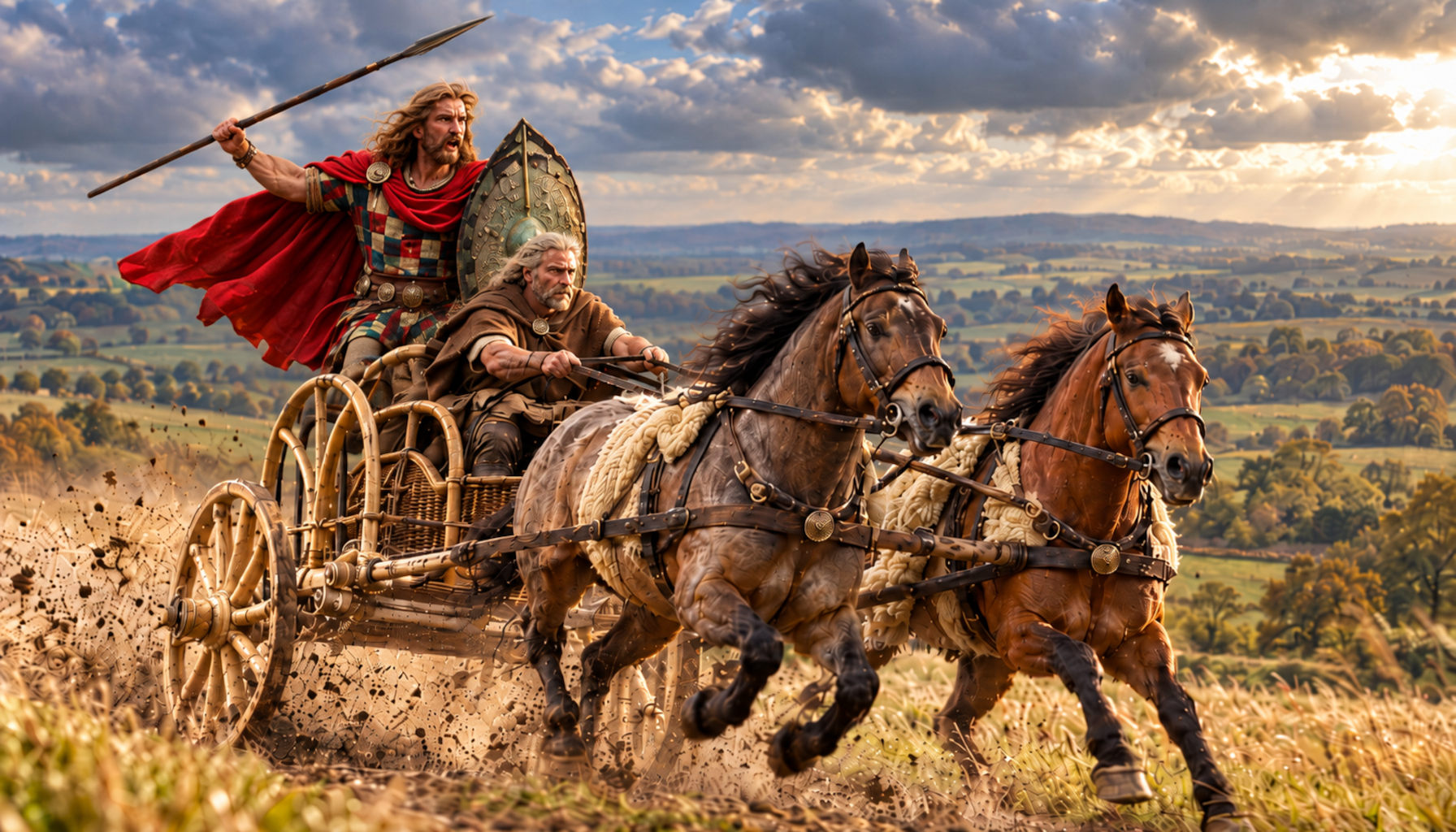
The Celtic Charioteer of Pocklington was an elite Iron Age Briton buried in East Yorkshire around 225 BC, in the centuries before Rome reached Britain. Known in ancient-DNA research as sample I5511, he belongs to that rare and fascinating archaeological world in which power was displayed not only in life but in burial: a man laid to rest with a chariot, the sort of funerary theatre that instantly tells us we are dealing with someone of rank.
He came from the distinctive Arras culture of Yorkshire, one of the few Iron Age societies in Britain to practise chariot burial for selected high-status individuals. These graves, sometimes accompanied by two ponies and vehicle fittings, speak of mobility, prestige, warfare and spectacle. In other words, this was not just a farmer with a cart. He was part of a warrior aristocracy whose status was proclaimed in metal, horseflesh and ceremony.
The Pocklington cemeteries have produced some of the most remarkable Iron Age burials in Britain, and they matter because they illuminate a society that left no native written history of its own. Classical authors, writing from the Mediterranean world, described British chariots as battlefield machines crewed by a driver and a fighting warrior, with the latter dismounting to engage in combat before being picked up again. Archaeology cannot simply be made to fit every classical flourish, but the combination of chariot burials, horse remains and weapon-related equipment shows that chariots were indeed bound up with elite identity in Britain. The Charioteer of Pocklington stands in that exact tradition: an aristocratic Briton from East Yorkshire, living in a landscape of tribal territories, local power and long-distance connections across Iron Age Europe. He is historically important not because we know his personal name, but because his burial and genome together provide a rare human link to the chariot-riding elites of pre-Roman Britain.
Explore Celtic origins in ancient DNA
The associated biological sample is described as Elite Charioteer Briton Pocklington Yorkshire England, dated approximately to 225 BC. This is not a securely named historical individual in the way a king in a tomb inscription might be; rather, it is a strongly supported archaeological identity. We can say with confidence that the sample represents an elite man buried at Pocklington within the Arras cultural sphere, and that his social importance is inferred from the chariot-burial context itself. What we cannot do is supply a personal name, a tribal office or a detailed life story beyond what the grave and its wider setting justify.
That distinction matters. Ancient DNA works best when tied to careful archaeology, and here the archaeology is exceptionally eloquent. A chariot burial in Iron Age Yorkshire is already unusual; at Pocklington it becomes part of a broader cemetery tradition that marks out a narrow upper tier of society. The grave tells us that this man was commemorated as someone whose status was inseparable from horses, movement and martial display. The genome does not create that interpretation, but it lets us place this individual biologically within the wider populations of Iron Age Britain and beyond.
The Charioteer’s Y-DNA haplogroup, which traces his direct paternal line, was R1b1a1b1a1a2c1b. His mtDNA haplogroup, which traces his direct maternal line, was J1c9. These are lineages, not ethnic badges. They do not prove that he was “Celtic” in some simple genetic sense, because cultural identity in Iron Age Britain was shaped by language, kinship, politics, territory and custom as much as by ancestry. What the lineages do provide is a way of comparing him with other ancient individuals who shared parts of the same paternal or maternal descent lines.
A short ancient-DNA view of his paternal lineage is especially interesting. The same Y-DNA branch, R1b1a1b1a1a2c1b, appears in several other Iron Age individuals from East Yorkshire, including burials from Wetwang Slack and Pocklington such as I36888, I39729, I36994, I36863, I36864, I31507, I31006, I21952, I14100, I36913, I21697, I21703, I21860, I21865, I21643, I21696, I21263, I21625, as well as other Pocklington-associated individuals like I12415, I5508 and I13752. That clustering suggests that this paternal lineage was well represented among the Iron Age communities of the East Yorkshire Parisi region. The same broader lineage also turns up farther afield in later individuals such as RKF032 and RKF041 from Migration Period Hungary, mbs141 from medieval Sigtuna, and still other later European contexts. That does not mean these people belonged to one continuous political group, still less one “tribe” preserved unchanged across a millennium. It means only that paternal lineages can persist, spread and reappear across very different societies.
His maternal lineage is more narrowly attested in the material supplied here. For J1c9, the directly relevant linked sample named is I5511 himself. That makes the maternal line less useful for broad comparison in this particular case, but still valuable. mtDNA reminds us that every elite male burial also carried a maternal inheritance, passed from mother to child across many generations. Even when the public imagination rushes to warriors and fathers, the genome quietly preserves both lines.
The wider study published in Nature at https://www.nature.com/articles/s41586-021-04287-4 helped place Iron Age Britons into a larger map of population history across Britain and Europe. Its relevance here is not that it gives us a complete biography of the Pocklington charioteer, but that it situates him within a real, sampled ancient population rather than leaving him as a purely romantic archaeological figure.
Read about Iron Age Britain kinship
The DNA of the Celtic Charioteer of Pocklington is historically interesting because it attaches a genetic profile to a very particular social role: an elite man buried in one of Britain’s best-known chariot traditions. That allows us to ask better questions about continuity, relatedness and local population structure in Iron Age Yorkshire. It does not, however, reveal his personal exploits, the language he spoke on a given day, or whether he ever fought from a chariot himself. Genetics can illuminate ancestry and biological connections; archaeology explains status and ritual; history supplies the broader frame. The real power comes when all three are read together.
Discover Iron Age Europe in DNA
If this world of Iron Age Britain, elite burials and ancient genomes intrigues you, MyTrueAncestry lets you compare your DNA with ancient populations and archaeological samples from across history. You may discover genetic connections to the wider populations and lineages associated with pre-Roman Britain and other ancient worlds.
Comments