Ancient DNA and matrilineal kinship in Iron Age Britain
– 8 min read


In Iron Age Britain, one burial tradition stands out with unusual clarity: the cemeteries of East Yorkshire, spread across the Yorkshire Wolds. Here, the dead were laid beneath square barrows, small ditched monuments that from the air appear like geometric marks cut into the land. Across rolling chalk uplands, hundreds of graves formed enduring places of memory, built up generation after generation.
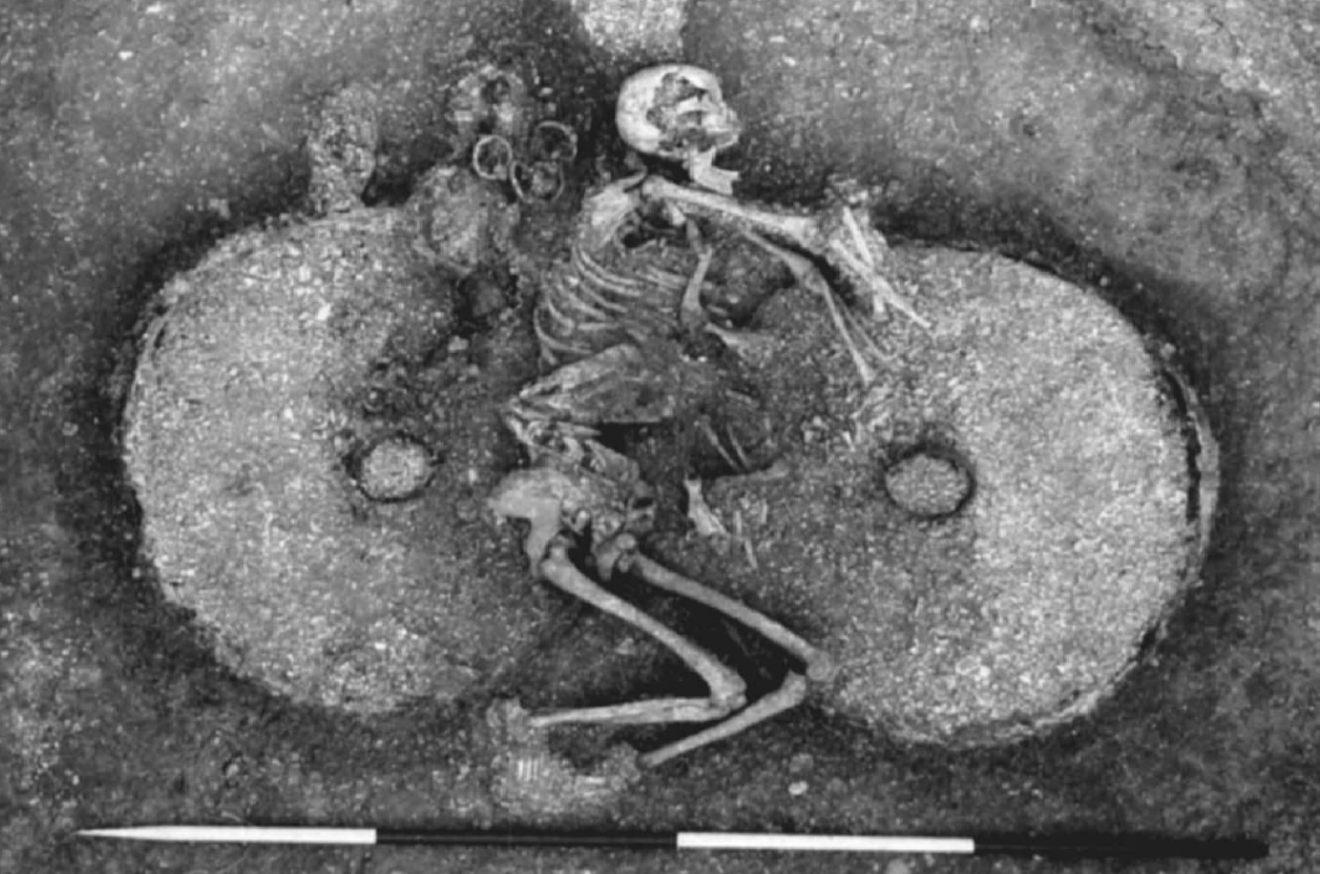
The Yorkshire Wolds preserve bone exceptionally well, allowing ancient people to emerge with unusual vividness. Most were buried crouched, often on a north-south line, in graves modest in form yet intensely meaningful. A mound was not simply built and abandoned. It remained active, revisited, and reused.
Many graves had nothing at all. Where objects survived, they were dress items, pottery, or food offerings. Yet apparent modesty should not be mistaken for poverty of ritual. A cemetery where most people were buried with little makes the richer burials blaze all the brighter.
A small number of graves contained dismantled two-wheeled chariots alongside weapons, decorated metalwork, horse gear, and mirrors. These are among the most famous Iron Age burials in Britain. Their material style resembles continental La Tène art, yet the funerary rite remains deeply local. This was not a copy of continental custom. It was a local tradition with its own grammar, borrowing and reshaping what it wished.
The cemeteries sit inside busy working landscapes. The dead remained embedded in the rhythms of the community. To tend the fields or walk the droveways was also to pass among ancestors. The burial grounds endured from the fifth to the first centuries BCE, accumulating into dense ancestral crowds rather than orderly rows.
The archaeological picture is now richly populated by specific individuals: women with mirrors, men with weapons, children, and infants. One newborn at Wetwang Slack had Down syndrome, a reminder that ancient communities included people with a wide range of lives and bodies. These sites reveal not just rank, but vulnerability, affection, and how communities decided who belonged.
Wetwang Slack is the largest excavated Iron Age cemetery in Britain. Set in a dry valley in the Yorkshire Wolds, around 240 square barrows and 446 burials were recorded, excavated mainly during rescue work in the late 1970s. The chalkland preserved remains exceptionally well, producing an unusually detailed picture of the community.
The cemetery stretched along a ditched droveway for roughly half a kilometre, its barrows clustered tightly, often touching or cutting into one another. It grew and changed over generations, becoming a layered ancestral field.
Most of the dead had little or no grave goods. That makes the exceptional graves electrifying. A separate cluster of five barrows held three chariot burials: two male, one female. The female chariot burial is famous for good reason. This woman was accompanied by a dismantled chariot, an iron mirror, horse-bits, pig forequarters, and most remarkably a closed bronze canister decorated with flowing curvilinear motifs of high artistic sophistication. Whatever its exact use, it was a powerful object buried with a woman of obvious importance.
These extraordinary graves were not isolated marvels. They were entangled in family history, connected through kinship to the wider cemetery community. Genetic analysis revealed that a very large portion of sampled individuals were linked through close biological relationships, making Wetwang Slack not merely a cemetery but the outline of a long-lasting social formation.
Some individuals stand out with special poignancy. The newborn with Down syndrome brings into focus a real infant, not an abstract data point. Dietary studies suggest a community eating substantial animal protein with little difference between richer and poorer graves. Childhood evidence reveals unexpectedly early weaning patterns, sketching family life behind the graves.
Wetwang Village, a separate chariot burial discovered in 2001 about 1.5 kilometres away, held an adult woman with extensive signs of disease or injury. She was buried with an iron mirror placed in what appears to have been a fur-lined bag closed with string threaded through blue glass beads: not just a mirror, but a mirror wrapped and dressed for burial. This woman was also genetically tied to the Wetwang Slack community, confirming that the cemetery formed part of a wider web of remembered relations.
Spatial memory was also at work. Close biological relatives were buried nearer to one another. Certain women acted as anchors, with descendants clustering around them over several generations. Burial location itself carried genealogical force.
Pocklington and the Melton cemeteries show how rich and varied the Arras burial tradition could be. Excavated between 2014 and 2017 ahead of housing development, Pocklington proved to be a classic Arras cemetery with 82 barrows and 119 individuals. Most were buried crouched, with heads to the north, and grave goods survived in only about a fifth of burials.
Yet Pocklington contains one of the most spectacular burials of all. Barrow 85 held a man with sword, shield, and spears, accompanied by two ponies and an intact chariot. Not dismantled. Intact. That is highly unusual and gives the grave a frozen ceremonial immediacy. Scientific work adds further depth: sulfur evidence suggests around a third of those studied had moved across different geological zones during their lives, making movement visible in the bones.
Melton 1, south-west of Melton, is smaller but deeply revealing. Its age range spans adults, adolescents, juveniles, infants, newborns, and foetuses. This is a community cemetery in the fullest sense. One burial stands out for its elaborate ritual composition: three goats and three piglets were placed north of the human body, goats above piglets, two of the goats decapitated, all carefully aligned in opposing directions. That is not casual disposal. It is symbolic choreography now partly lost but once perfectly intelligible to those conducting the funeral.
Melton 2 offers yet another unforgettable individual: an adult woman buried flexed, arthritic in shoulders, wrists, and knees, whose right thigh bone bore ancient cut marks running diagonally across the shaft. Whether linked to injury, ritual treatment, or post-mortem manipulation, the evidence gives this woman an unmistakable individuality.
Together, Pocklington and Melton broaden the cast of characters and confirm that the Arras tradition was not confined to chalk uplands. It travelled across different terrains while retaining recognisable core features: a world not of uniformity but of shared custom expressed in many voices.
The graves of East Yorkshire do not just hold individuals. They hold family history. At Wetwang Slack, the cemetery can be read as a vast web of kinship stretching over many generations, transforming how we understand the site entirely.
Two women are especially memorable. One had descendants buried across ten generations and was the individual with the most relatives in the cemetery. Another had descendants spread across seven generations. Their burial spots became fixed points around which later funerary decisions were made. Generations later, children, grandchildren, and further descendants continued to be placed near their lines, implying sustained memory of where significant kin lay and who belonged to whom.
The role of women is especially important. Adult women at Wetwang Slack tended to be more closely related to one another than men were to one another, suggesting the burial community was strongly anchored by maternal lines. Most couples were not both present in the cemetery; when only one partner appeared, it was far more often the woman. The cemetery was selectively drawing in women of certain lineages while many male partners were buried elsewhere.
The chariot graves fit this family picture in fascinating ways. The female chariot burial at Wetwang Slack was the mother of a man in another chariot burial. The prestigious vehicle burials were not isolated symbols. They were embedded in family networks where prestige and kinship intersected.
Monument type also reflected lineage. Primary barrow burials tended to contain individuals with more relatives in the cemetery than ditch burials or flat graves. Close relatives were consistently buried nearer each other. The cemetery was not an open field but a structured map of belonging, with the arrangement of graves actively keeping genealogy in view.
The East Yorkshire cemeteries were not closed islands. Wetwang Slack, Wetwang Village, Pocklington, and Melton formed a network in which the dead of one cemetery often had relations in another, making these burial places nodes in a regional social world rather than isolated communities.
The strongest links run between Wetwang Slack and Pocklington, where many individuals had multiple relatives at the other site across generations. Specific cases are vivid: one woman at Wetwang Slack appears to have belonged to a maternal line common at Pocklington, suggesting she may have moved from that community. Yet the closest cross-cemetery links often run through men, consistent with the broader pattern of women remaining rooted in local burial grounds while men moved between communities.
A remarkable pattern deepens this picture. Two dominant maternal lines at Wetwang Slack were united by reproductive partnerships far more often than chance would predict, sustained across multiple generations and branches of the family tree. One branch shows six consecutive generations of unions linking the same two lines. To sustain such a pattern required active genealogical memory used as a social instrument.
The biological evidence also addresses a longstanding question. Because the Arras tradition includes square barrows and chariot burials resembling continental styles, it has often been linked to communities across the Channel. But the genetic evidence does not support a recent migration from there. People in the Yorkshire cemeteries appear largely continuous with broader prehistoric Britain. Local communities adopted, adapted, and transformed prestigious ideas without ceasing to be local.
What emerges is a landscape of mobility without uprooting, alliance without sameness, and memory stretched across place. Men moved, families linked separate cemeteries, prestigious graves belonged to wider genealogies, and local maternal lines remained powerful anchors. Every barrow carried a message not merely about who had died, but to whom they belonged, from which line they came, and how the living wished those relationships to be remembered.
 View ORCID Profile
Comments