Late Iron Age Mobility and Burial Practices in Celtic Switzerland
– 5 min read


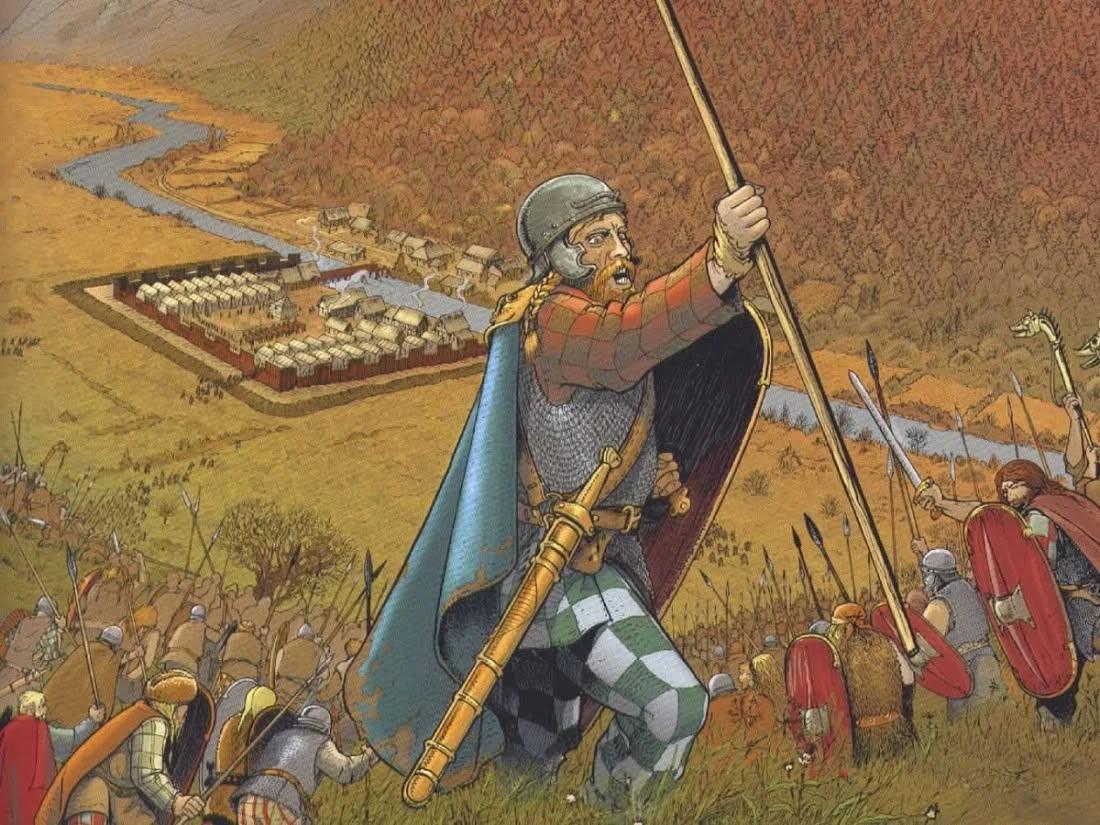
Late Iron Age Switzerland was a world in motion. People moved across valleys, plateaus, and mountain corridors — sometimes locally, sometimes across remarkable distances. Hilltop strongholds, busy settlements, and busy trade routes linked Central Europe to the Mediterranean. Rather than imagining mass migrations, the evidence reveals something more human: individuals changing residence, joining new communities, and carrying distant worlds with them.
Switzerland occupied a critical position between northern Europe and the lands south of the Alps. The Swiss Plateau was a hinge zone where traders, craft workers, and families passed through or settled. The Alps themselves were difficult but threaded with paths and contacts.
The most striking evidence comes from burial grounds. At Münsingen-Rain, the dead were laid out with ornaments, brooches, weapons, and vessels. At Bern Engehalbinsel, graves suggest a place that drew people into its orbit. At Cornaux/Les Sauges, a cluster of bodies linked to a bridge collapse seems to capture a moment of movement itself — archaeology freezing a journey in mid-step.
Scientific analysis of teeth and bones makes that movement visible. Teeth preserve childhood signals; bones reflect later years. Comparing these chemical traces with the local environment reveals who grew up elsewhere. Results show that larger, economically lively centres like Bern Engehalbinsel and Münsingen-Rain attracted the most newcomers. Some came from neighbouring valleys; others from as far as central France. Long-distance travel was not myth — it happened, person by person.
Cornaux/Les Sauges gives this idea unusual force. Many of the bridge victims showed non-local chemical signatures — perhaps traders, a travelling group, or men on escort duty. The site offers not a formal cemetery but a disaster scene, preserving movement in action. Equally haunting is an isolated cranium from Avenches, found in a gate setting suggesting display. The individual was young, with origins pointing to the southern Alpine zone — a possible trophy head or curated relic, once mounted above an entrance, marking power, memory, or violence.
Late Iron Age cemeteries in Switzerland reveal a society where community belonging mattered as much as displays of rank. These burial grounds were carefully staged acts of memory, identity, and shared custom.
Münsingen-Rain is one of the standout sites. Its rich spread of grave goods — brooches, jewellery, rings, vessels — varies from elaborate to plain, yet the whole cemetery shows disciplined burial traditions. Objects were both intimate and social: a brooch fastened clothing; a ring sat on a finger. Once placed in a grave, they became public statements about gender, taste, and social standing.
Bern Engehalbinsel was not merely a cemetery but part of a significant centre, its burial record linking the dead to regional networks of movement and material culture. Brooch styles shift across time with enough precision that a single ornament can place a burial within a narrow date range, turning the graveyard into a timeline of changing customs.
Fascinatingly, people with non-local chemical signatures were often buried much like everyone else — suggesting that whatever their origins, they could be absorbed into local funeral practice. The cemetery records inclusion as much as difference, a theatre of belonging where community identity in death overrode birthplace.
Some discoveries grip the imagination because they bring a single ancient person into view. The young individual from Avenches — an isolated facial cranium found at a gate, likely displayed — had chemical signals pointing to non-local origins. Was this a trophy from conflict or a potent relic brought from elsewhere? The find combines violence, theatre, and mobility in one unforgettable object.
At Cornaux/Les Sauges, travellers crossing a bridge died when it collapsed. Several appear to have grown up outside the local area. These men were not settled villagers; they seem to have died in transit, their journey ending abruptly in mud and timbers — movement caught directly by archaeology.
At Münsingen-Rain, several women stand out. One was buried with a brooch style linked to Bohemia and Bavaria, placing her at the intersection of wealth and long-distance cultural contact. Another had a gold finger ring — a rare, prestigious object with parallels south of the Alps. A third wore a brooch associated with the northern Italian sphere, a visible marker of connections that still speaks from the grave.
What makes these individuals compelling is that they are not grand historical celebrities. They come to attention through combinations of evidence: a ring, a brooch, a chemical signature from a tooth, a strange burial context. Piece by piece, a life recovers its outline — reminding us that the Iron Age was lived one life at a time.
Late Iron Age Switzerland was an active crossroads, not a remote fringe. Goods, ideas, and people moved through river corridors, upland tracks, and Alpine crossings. Sites like Bern Engehalbinsel, Mont Vully, and La Tène — so central that an entire cultural phase takes its name from it — participated in an energetic European web.
Trade appears clearly in the objects buried with the dead. Brooch styles travel between regions. Gold rings have Alpine parallels. Glass ornaments hint at distribution networks. Classical writers told of a Helvetian returning from Rome with figs, wine, and oil, supposedly inspiring dreams of migration. Whether literally true or not, it captures something real: Mediterranean goods had glamour, and people knew of distant worlds and valued what came from them.
Larger centres attracted incomers because they offered work, trade, security, and social ties. The bridge at Cornaux/Les Sauges makes the network almost physical — infrastructure is society made visible. Its collapse, preserving a group of the dead, shows not only that people moved but that communities invested in the means to move.
The Alps, rather than standing only as a barrier, become a zone of passage. Grave goods show links with northern Italy and the southern Alpine world, giving mountain routes a human dimension — actual women, men, and families crossing between worlds of language, costume, and custom. Switzerland in the Late Iron Age was not a cul-de-sac but one of Europe's great connective tissues, where objects, people, and ideas continually crossed and changed one another.
One of the most thrilling aspects of this research is not just what it discovered, but how. Human bodies absorb chemical signals from the environment through food and drink. Tooth enamel forms in childhood and remains largely unchanged; bone remodels during life, reflecting later years. If a person grew up in one place and died in another, teeth and bones preserve that shift — the body becomes a record of movement.
Researchers sampled teeth and bones from cemetery burials, focusing on molars and premolars that form during later childhood. Each element was documented with photographs and three-dimensional scanning before analysis, combining scientific curiosity with respect for ancient remains. To establish local baselines, animals — particularly pigs, which range less widely than cattle — along with plants, land snails, and river water were also sampled.
Different chemical systems illuminate different aspects: local geology, climate and water sources, and environmental background through food webs. Used together, they identify likely outsiders with increasing precision. Switzerland's geologically complex landscape required careful comparison across multiple lines of evidence rather than simple formulas.
The researchers then compared chemical results with sex, age, and grave goods. The findings challenged old assumptions: there was no strong sign that one sex moved more than the other, and people who grew up elsewhere were not clearly treated differently in burial. Probability mapping for selected individuals pointed to childhood landscapes in the Alpine zone, central France, or regions farther east — suddenly connecting a woman buried in Switzerland to a world hundreds of kilometres away.
Radiocarbon dating and grave typology added further chronological precision, while osteology grounded everything in real human biology. The science did not replace traditional archaeology — it enriched it. A brooch still matters. A cemetery plan still matters. But now teeth can whisper where a childhood was spent, and bone can hint at later residence. Science, here, is simply one more way of listening to the ancient dead and letting their journeys emerge again from the soil.
https://www.sciencedirect.com/science/article/pii/S0305440325001438
Comments