Haplogroup O2a1b1a1a1a1e1

– 5 min read


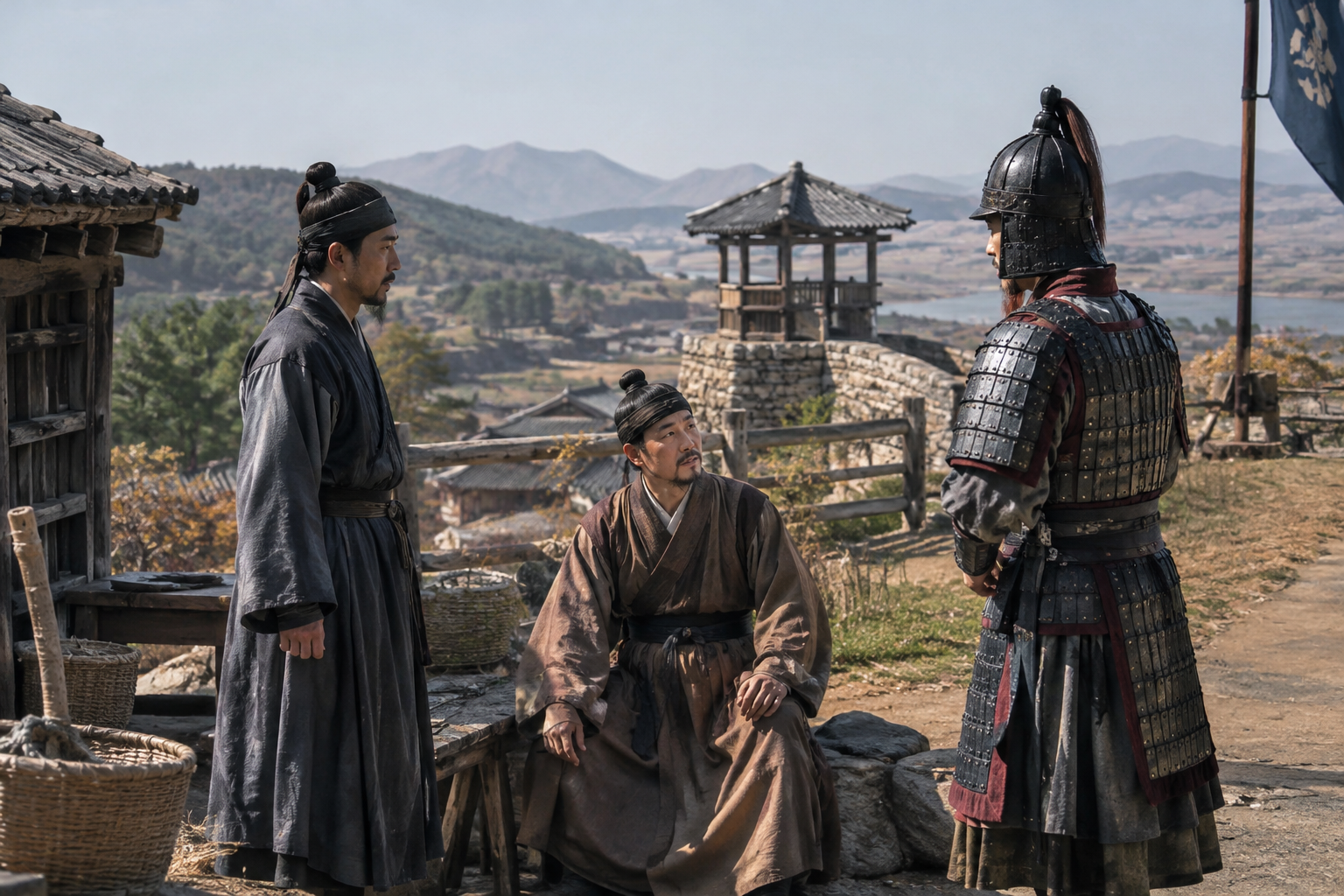
At Joyeong-dong in Gyeongsan, in southeastern Korea, one ancient man has become unexpectedly important for tracing a very specific paternal line. The sample known as JOY007, dated to around AD 500, comes from the Three Kingdoms period, when the Korean peninsula was divided among powerful rival states and local communities were tied into wider political networks. In genetic reporting associated with this burial, his Y-chromosome is linked to the haplogroup O2a1b1a1a1a1e1.
That may look like a forbidding string of letters and numbers, but it matters because Y-DNA follows one direct paternal line: father to son, back through time. It does not tell us everything about a person's ancestry, language, or identity. What it can do, when attached to an excavated individual like JOY007, is pin one branch of male descent to a real place, a real archaeological context, and a real historical moment.
Gyeongsan sits in a region long entangled with the history of Silla, one of the major kingdoms of early Korea. Around AD 500, this was not a quiet backwater. It was a landscape of emerging state power, elite consolidation, shifting alliances, and local communities negotiating their place within larger political structures. A man buried at Joyeong-dong belonged to that world, whether as a local resident, a member of a kin group, or simply one person within a broader cemetery population.
What makes JOY007 especially useful is not that he can be turned into a grand historical hero, but that he gives us a fixed point. Haplogroup O2a1b1a1a1a1e1 is not here floating abstractly in a modern testing database; it is anchored in an excavated Three Kingdoms-period individual from southeastern Korea. That is exactly the sort of evidence ancient DNA does best.
An ancient DNA study of burials from Silla-period Korea has helped illuminate kinship, endogamy, and local population structure in this era, and it provides the wider setting in which finds like JOY007 become meaningful. For readers interested in that broader archaeological context, MyTrueAncestry has also covered ancient DNA from a Three Kingdoms Silla community.
The branch name O2a1b1a1a1a1e1 is a very narrow part of a much larger Y-chromosome family tree within haplogroup O, one of the major paternal lineages in East and Southeast Asia. The longer the label, the deeper into the branching structure we usually are. That does not mean we can simply transfer every story told about haplogroup O, or even about broader O2 lineages, onto this exact sub-branch.
That distinction matters. A narrow branch may have a different history from its parent clades, with its own local expansions, bottlenecks, and regional concentrations. So the responsible way to read JOY007 is quite modest and quite powerful at the same time: by about AD 500, a paternal line classified as O2a1b1a1a1a1e1 was present in southeastern Korea, in a society shaped by the political world of the Three Kingdoms.
In other words, this is evidence of presence, not a complete migration map. We should resist the temptation to turn one man into a stand-in for an entire kingdom. But equally, we should not underestimate what a securely dated ancient individual can do. He shows that this lineage was part of the lived human landscape of early historic Korea.
There is a tendency, especially in popular discussions of ancient DNA, to assume that only huge sample sets count. Of course larger datasets are better for reconstructing population history. But archaeology often advances by accumulation: one burial here, another cemetery there, a third site in a neighboring valley, each giving us a firmer sense of who was actually present.
JOY007 belongs to that kind of evidence. Even without invented drama about grave goods or status, he helps connect genetics to archaeology in a disciplined way. We are not dealing with a vague "Korean" signal untethered from time. We are dealing with a dated individual from Joyeong-dong, near Gyeongsan, in the centuries when Silla was growing into a major power.
That is also why the archaeological setting matters so much. The Three Kingdoms period was one of regional differentiation as much as later political unification. A paternal lineage found in southeastern Korea during this period may reflect deep local continuity, movement within the peninsula, or broader demographic patterns across East Asia, but deciding among those possibilities requires many sites, not one.
The historical backdrop is worth pausing over. By the fifth and sixth centuries AD, the southeastern peninsula was central to the rise of Silla, a kingdom that would eventually play the leading role in unifying much of Korea. Cemeteries from this period are therefore more than collections of burials; they are evidence for how local populations were organized during a decisive stage of state formation.
Ancient DNA has begun to show that these societies cannot be reduced to simple labels. Kinship, marriage patterns, and local burial communities could be quite structured. The presence of O2a1b1a1a1a1e1 in JOY007 fits neatly with that larger lesson: paternal lines persisted within social worlds that were historically dynamic, but not necessarily demographically chaotic.
Research materials associated with these Korean ancient DNA datasets are available through this archived genetic study resource, which underlines how much current work depends on linking excavated remains, dating, and genome data rather than relying on later legend or retrospective identity claims.
The same broad point appears in other East Asian studies as well. Ancient Y-chromosome work is steadily replacing old sweeping origin stories with something more interesting: multiple regional histories, some continuous, some mixed, and many still only partly known.
Haplogroup O lineages are central to the paternal history of East Asia, but their internal diversity is immense. That is why ancient finds are so valuable. They help break up the illusion that a modern distribution map can tell the whole story. A branch found in Korea today may have been there for many centuries, or it may represent more recent expansions within a larger family of related lineages; only ancient samples can sort that out.
JOY007 does not, by himself, answer every question about O2a1b1a1a1a1e1. He does something more precise. He places that branch, or a reported association with that branch, into the archaeological record of early medieval Korea. For descendants exploring this haplogroup now, that is a rare and useful kind of anchor.
There is also a useful historical caution here. A Y-line can persist through enormous cultural change. The man from Joyeong-dong lived in a Korea of competing kingdoms, before later dynastic periods transformed the peninsula's political map. Yet one paternal branch can pass through all that upheaval, carried quietly through ordinary generations who never imagined they would one day be studied in a laboratory.
For someone whose paternal line falls under O2a1b1a1a1a1e1, the most solid takeaway is not a romantic claim about kings or a single ancient migration. It is that this lineage has an attested place in the archaeology of southeastern Korea by around AD 500, through the individual JOY007 from Joyeong-dong in Gyeongsan. That makes the branch part of the documented human story of the Three Kingdoms period.
As more Korean and East Asian burials are sequenced, the picture will sharpen: perhaps this branch will turn up repeatedly in nearby cemeteries, perhaps across several regions, or perhaps in more socially specific contexts. For now, JOY007 is valuable because he is concrete. He reminds us that even a narrow haplogroup is not just a code on a screen, but a line once carried by a man living in the contested, politically vibrant landscape of early Korea.
Comments