Haplogroup I2a1a1a1a2b

– 4 min read


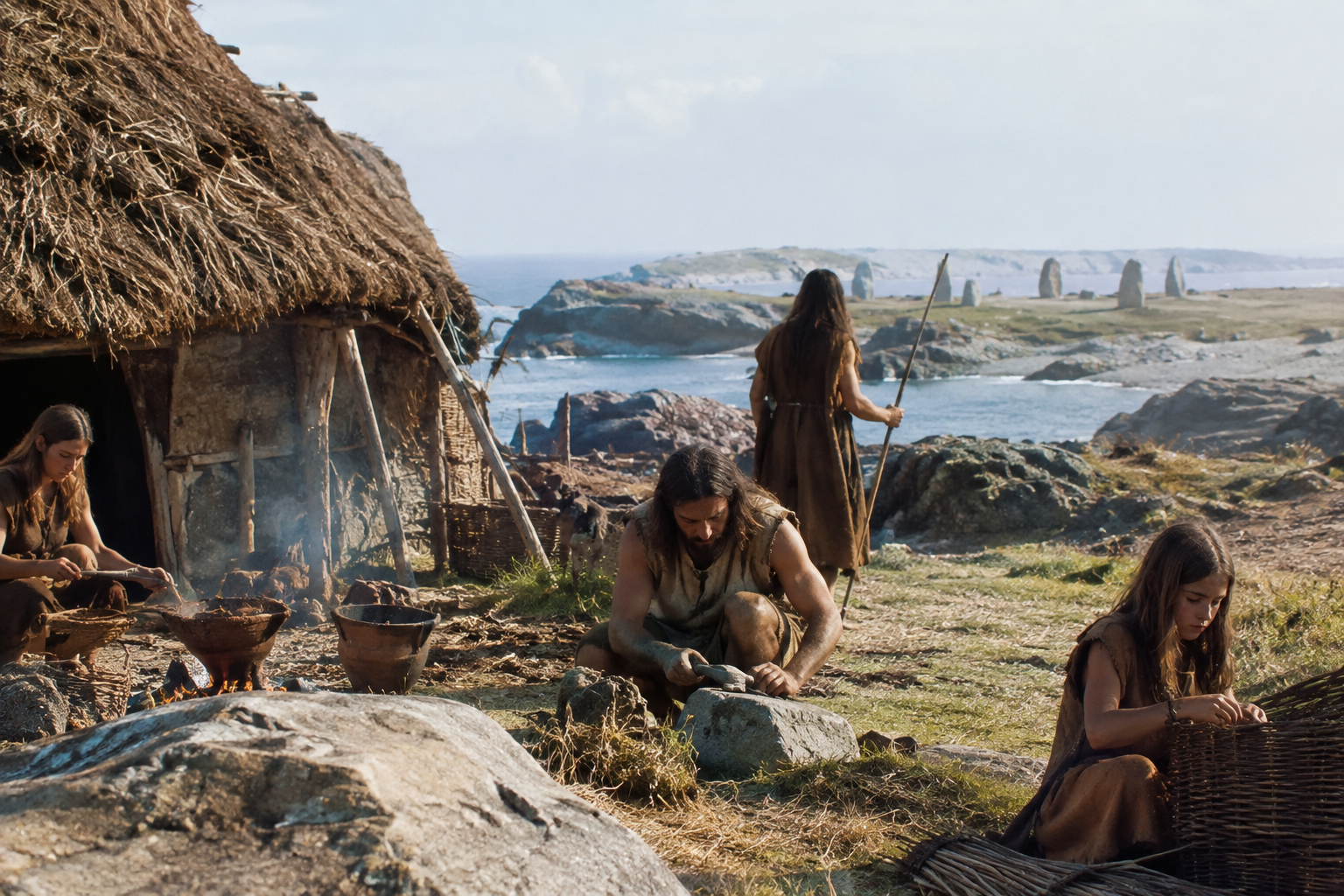
At Ile Thinic, on the coast near Saint-Pierre-Quiberon in Brittany, one ancient male sample stands out for anyone interested in the paternal line I2a1a1a1a2b. The individual known as I15024, dated to around 1700 BC, places this branch in a very specific archaeological landscape: Bronze Age northwestern France, in a peninsula long shaped by seaways, local continuity, and contact across the Atlantic facade.
That matters because a Y-DNA haplogroup is not a whole people, nor a ready-made ethnic label. It traces one direct paternal line. But when a lineage like I2a1a1a1a2b appears in a Bronze Age Breton context, it gives us a useful fixed point: not a legend about wandering ancestors, but a real man from a real place, living in a region where older Neolithic traditions and newer Bronze Age social worlds overlapped.
The archaeological interest of Ile Thinic lies partly in its location. Quiberon projects into the sea, and Brittany in the Bronze Age was anything but isolated. Coastal communities here participated in exchange networks that linked Armorica with Britain, Iberia, and other parts of Atlantic Europe. A male line identified in this setting is therefore immediately more interesting than a bare haplogroup label on a modern map.
Sample I15024 is the core evidence in this case. With only one directly named ancient individual, the responsible approach is a careful one: this sample shows that a paternal line reported as I2a1a1a1a2b was present in Bronze Age Brittany, but it does not by itself prove how common the branch was, whether it belonged to a local elite, or whether it marked a newcomer or a long-established family in the region.
What it does suggest is persistence. Haplogroup I2 in its wider sense is deeply tied to European prehistory, especially to lineages already present in Europe before the great population shifts of later prehistory. By the Bronze Age, however, such older paternal lines survived within societies that had already been transformed many times over by farming expansions, maritime contacts, and the arrival of new ancestry streams. In other words, a branch like I2a1a1a1a2b in Brittany is a reminder that prehistoric change was never simple replacement.
Brittany has a habit of making archaeologists think twice about easy stories. It is famous for monumental Neolithic traditions, megaliths, and long-lived regional identities in material culture. By around 1700 BC, those older worlds had not simply vanished; they had been absorbed into new Bronze Age realities. Metalworking, exchange, and shifting burial customs belonged to that later period, but they unfolded in landscapes already thick with ancestral memory.
That broader setting helps frame I15024. A paternal lineage found here may have roots that run far deeper than the Bronze Age horizon itself, even if the exact subclade history of I2a1a1a1a2b cannot be reconstructed from this one man alone. This is where genetics and archaeology make a useful pair: the Y-chromosome gives the direct male-line signal, while the site and date tell us what sort of society that line had become part of.
A genetic study of ancient individuals from this wider research framework is linked through the Harvard Dataverse project record here: https://dataverse.harvard.edu/dataset.xhtml?persistentId=doi:10.7910/DVN/7RVV9N. Even where a single sample is all we can safely discuss in detail, such research has helped place Atlantic French prehistory into the larger map of European population change.
The most tempting mistake with a haplogroup like I2a1a1a1a2b is to treat it as if it carried one unbroken cultural identity across millennia. It did not. Men with related I2 branches lived in very different worlds: Mesolithic forager landscapes, Neolithic farming societies, and later Bronze Age communities shaped by exchange, hierarchy, and new technologies. The chromosome line persisted, but everything around it could change dramatically.
That is exactly why I15024 is so useful. He shows one of those older European male-line traditions still present in Bronze Age Brittany, not in some untouched survival zone, but in a region linked to broader continental and maritime developments. For people researching this haplogroup today, that is a more realistic and more interesting picture than any claim of a single tribe or a neat migration tale.
This also fits a wider lesson emerging from ancient DNA across Europe: paternal continuity and cultural transformation often run side by side. Communities can adopt new customs, languages, alliances, and burial practices while retaining a mixture of older and newer male lines. In that sense, I2a1a1a1a2b belongs to the long European habit of continuity within change.
Because Brittany faces the sea, it is natural to wonder whether a Bronze Age Breton Y-line points toward Britain, Iberia, or some wider Atlantic network. Archaeologically, those connections were real. Coastal exchange linked communities across the western seaways, and Bronze Age material culture often reflects that web of contact. But contact is not the same as proof of one man's personal migration route.
So the strongest historical reading is a modest one. I15024 belonged to a coastal Breton society that lived within Atlantic Europe, and his paternal line, I2a1a1a1a2b, was part of that human landscape. Whether his direct male ancestors had been in Armorica for many generations or had arrived from elsewhere before his lifetime is not something this single record can settle.
Still, one sample can do important work when it is securely placed in time and space. It shows that this branch was not merely a modern distribution pattern reconstructed backward. It existed on the ground in Bronze Age Brittany, among the communities who inhabited one of western Europe's most archaeologically resonant coastlines.
Forager Ancestry and Bell Beakers
If your Y-DNA falls under I2a1a1a1a2b, the best-supported ancient anchor here is not a king, not a medieval dynasty, and not a romanticized tribal founder. It is I15024, a man from around 1700 BC at Ile Thinic in Brittany. That is valuable precisely because it is concrete. It places your wider paternal story in the world of Bronze Age Atlantic Europe, where old European male lines persisted inside dynamic, connected societies.
The lesson of this haplogroup, at least from the evidence now in view, is one of durability rather than spectacle. A direct male line could survive enormous shifts in culture and ancestry around it, and still reappear in the record at a windswept Breton site more than three thousand years ago.


Comments