Haplogroup ZZ11

– 5 min read


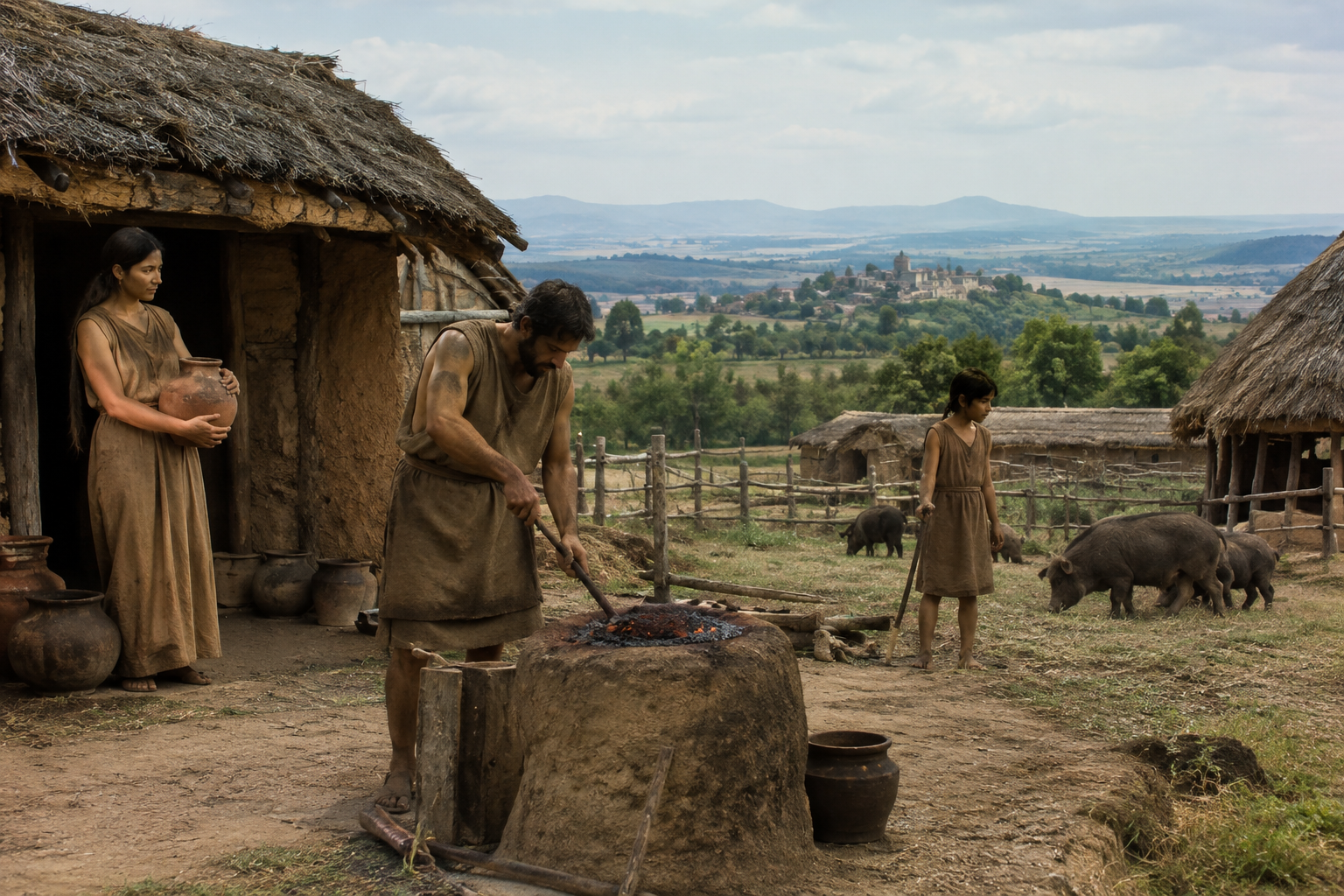
In the seventh century BC, at Felsina, the settlement that would become Bologna, one man now known as I29678 was buried in the Po Valley world archaeologists call Villanovan or proto-Etruscan. That label matters, because this was a period before the full historical flowering of Etruscan city culture, yet already one of intense social and cultural change in northern Italy. For anyone carrying the Y-DNA haplogroup ZZ11, this individual is a striking anchor point: a direct paternal line detected in an Iron Age man from one of the most important crossroads in early Italian history.
That does not mean ZZ11 was an "Etruscan haplogroup" in any simple ethnic sense. Y-DNA follows one paternal line only, not a person's whole ancestry, language, or identity. But when a branch appears in a securely placed ancient individual like I29678, it gives us something far better than myth: a documented man, in a documented landscape, at a documented historical moment.
Felsina sat in the Po Valley, where routes from central Italy, the Adriatic, and transalpine Europe met. By around 700 BC, this region was no backwater. It was one of the places where communities associated with the Villanovan cultural horizon developed into the urban, literate, and highly distinctive world later identified as Etruscan.
The sample I29678 is described as a Villanovan proto-Etruscan individual from Felsina, Bologna, dated around 700 BC. Even with that minimal description, the setting is historically rich. Felsina was one of the northernmost major Etruscan centers, so a paternal lineage found here belongs to a zone of contact: not an isolated hilltop, but a city-in-the-making connected to trade, craft production, and the wider reorganization of Iron Age Italy.
That matters for ZZ11 because the evidence places this paternal line in a community that was both local and outward-looking. Northern Etruria and the Po Valley were shaped by continuity from earlier Italian populations, but also by constant contact with neighboring regions. A lineage present here may reflect deep local roots, movements within the peninsula, or broader links across Iron Age Europe; with one sample alone, we should not pretend to know which. What we can say is that ZZ11 had reached, or persisted in, one of the most dynamic societies of pre-Roman Italy.
There is a temptation, whenever an ancient Y-chromosome result appears, to turn it into a grand tribal badge. Ancient history is rarely so tidy. Haplogroup ZZ11 is a paternal branch, and this article's evidence links it specifically to one ancient man from Felsina. That is already useful, but it is not the same as proving that all Villanovans, all Etruscans, or all inhabitants of Bologna shared the same lineage.
Still, one sample can be historically meaningful when the archaeological setting is strong. The Villanovan period in northern Italy sits right on the edge of several long arguments: were the Etruscans mostly local? how much movement came through the Po Valley? how much changed between the Late Bronze Age and the early urban world? A man like I29678 cannot answer all of those questions by himself, but he belongs to the population in which those questions have to be asked.
A broader ancient DNA study of Bologna and its surrounding region has helped frame these issues, and readers wanting the larger context can explore related work through research associated with the ancient population history of the area. The key point for ZZ11 is modest but solid: this paternal line is not floating free in abstraction, but tied to a real Iron Age community at the moment proto-Etruscan Bologna was taking shape.
If one had to choose a single historical theme for Felsina, it would be connection. The Po Valley was open to influences from the Apennines, central Tyrrhenian Italy, the Adriatic, and lands beyond the Alps. Archaeologists have long treated the region as a place where material culture changed quickly not because one people simply replaced another, but because networks widened and local elites participated in them.
That makes the appearance of ZZ11 here especially interesting. It places the branch in a human setting shaped by mobility and exchange, but not necessarily by large-scale replacement. In other words, the lineage may have been part of the local substrate that helped form Etruscan Bologna, or part of the circulating male lines moving through connected Iron Age communities. Both possibilities fit the nature of the site; neither can be forced into certainty.
For family historians, this is often the most valuable lesson from archaeology. Ancient DNA does not just pin a lineage to a map; it pins it to a type of place. ZZ11, in this case, is associated with an early urbanizing center where identities were being made through trade, burial custom, craft, and politics rather than through some timeless biological essence.
The description of I29678 as "Villanovan Proto-Etruscan" is worth slowing down over. Villanovan is an archaeological term, based on material culture and burial traditions, not a genetic label. "Proto-Etruscan" signals a historical transition: these communities belong to the cultural formation out of which the historical Etruscan city-states emerged.
That distinction is important because it keeps us from flattening the evidence. The man carrying ZZ11 at Felsina lived before the classical age of Etruscan inscriptions, monumental tombs, and full political prominence. He belongs to the formative stage, when northern Italian communities were developing the institutions and identities that later historians would recognize more clearly.
So the significance of ZZ11 here is not that it gives us a neat ethnic slogan. It is that it places a paternal line inside the making of Etruscan northern Italy. That is a more interesting result anyway. History is usually built in phases, and this sample belongs to one of those phases rather than to a finished civilizational label.
Many ancient DNA samples come from cemeteries that are archaeologically useful but historically obscure. Felsina is different. Bologna's deep past matters because the city later became one of the best-known urban centers of northern Italy, yet its earlier development reaches back into this Villanovan horizon. A lineage found here is therefore attached not just to an isolated burial, but to the early history of a place that remained important for centuries.
That wider continuity is one reason the Bologna evidence has attracted attention in MyTrueAncestry's own coverage of the region. The question is not only who lived there at one moment, but how local populations changed, persisted, and mixed across the long arc from the Iron Age into later periods.
Seen in that light, I29678 becomes more than a code in a laboratory table. He is evidence that ZZ11 was part of the paternal diversity present in a major north Italian center before Roman domination. For descendants exploring the branch today, that is a concrete and valuable piece of historical placement.
For haplogroup ZZ11, the strongest ancient evidence here is focused and clear: sample I29678, from Villanovan proto-Etruscan Felsina in Bologna around 700 BC, shows this paternal line in the Po Valley during a formative moment in early Italian history. It suggests a lineage present within the communities that helped shape northern Etruscan society, in a region defined by both continuity and connection. If ZZ11 is part of your paternal story, this find does not tell you everything about your origins, but it does place your line in one of Iron Age Italy's most consequential archaeological landscapes.
Comments