Ancient DNA, Diet and Mobility of Iron Age Umbrians at Spoleto

– 3 min read


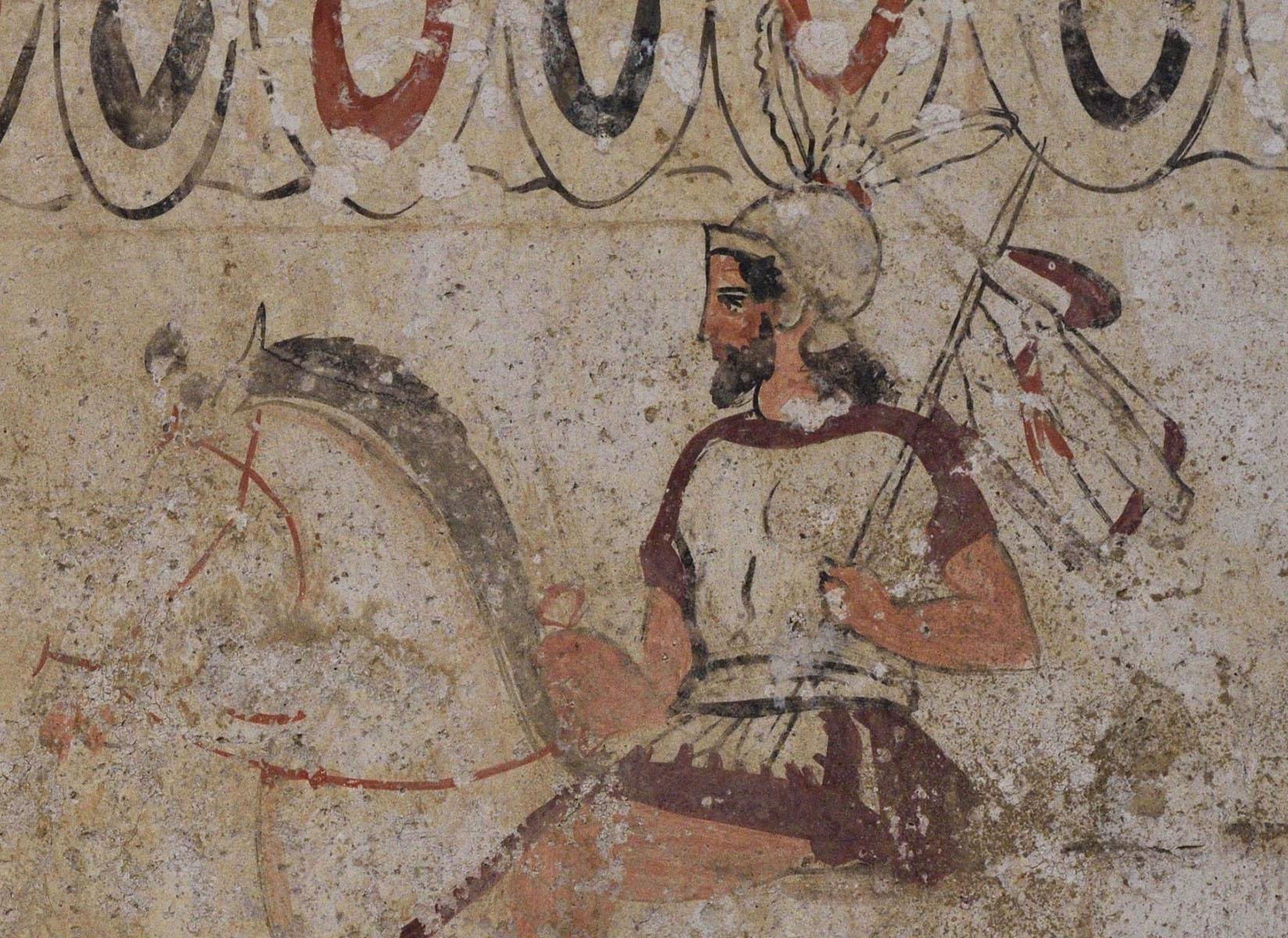
High above the valleys of central Italy, the necropolis of Piazza d'Armi near Spoleto opens a remarkable window onto a wealthy, ambitious community connected to the wider world. Used between roughly 720 and 580 BC during the Orientalising age, this cemetery was discovered in 1982 and excavated over several decades. What emerged was not a random collection of graves but a carefully staged social theatre of an Umbrian elite, where the dead were buried with objects loudly proclaiming power, family standing, and identity.
The site captures a world in transition. Spoleto's position along Apennine routes made it a crossroads rather than a backwater. The mountains were corridors as much as barriers, linking inland communities to coasts and exchange networks. The objects in the graves confirm that these people were active participants in a lively, competitive, glittering world — not provincial figures tucked away from history.
If one feature makes Piazza d'Armi truly unforgettable, it is the startling importance given to children and women. A surprisingly high number of non-adults appear among the wealthiest burials, some accompanied by weapons and fine ceremonial vessels. These objects proclaimed lineage and family prestige — a fierce insistence that even a young child belonged to a powerful house. A small skeleton beside grave goods fit for ceremony still shocks the modern observer, blending grief with fierce social ambition.
Women's graves are equally compelling. Some contained objects interpreted as priestly or ritual in character, implying that elite women at Spoleto held publicly recognised forms of symbolic authority. Meanwhile, one man's grave contained four sceptres — an exceptional declaration of status that contrasts vividly with the women's ritual items and children's prestigious goods, revealing that power here had multiple forms and multiple bearers.
Ancient DNA from thirty-eight individuals places the people of Spoleto firmly within the complex genetic blend typical of Iron Age Italy. Compared against a large body of ancient and modern data, they cluster closest to modern Italians and show stronger overlap with Etruscan groups than with Adriatic communities such as the Picenes. Their ancestry reflects the long, layered peopling of Europe — early farmers, hunter-gatherers, and later migrants — rather than any isolated or fixed population.
This finding matters culturally as well as scientifically. Cultural labels in ancient Italy did not map neatly onto biological divisions. A community could be culturally Umbrian yet genetically overlap strongly with neighbours, confirming that central Italy was always a zone of interaction where genes, pottery styles, and prestige goods alike crossed boundaries freely.
The chemistry of human bones offers a quieter, more intimate story. Isotopic analysis reveals a diet based on temperate crops such as wheat and barley, with protein from land animals — no marine foods, no exotic imports. This places Spoleto comfortably within the standard central Italian agricultural world, making its elite feel less like mythic princes and more like a real community rooted in Umbrian soil and seasons.
One especially human detail emerges from the children's bones: traces of breastfeeding still preserved in their chemistry. Amid all the symbols of rank, the graves also hold evidence of maternal care. Archaeology is at its best when it holds both truths together — what these people wanted displayed at death, and how they actually lived and grew.
Strontium isotope analysis reveals that four of twenty-eight tested individuals did not grow up on local ground. That small number carries enormous significance. Some of those buried with honour at Spoleto had childhoods elsewhere, arriving perhaps through marriage, alliance, or elite circulation between neighbouring groups. One individual from tomb 5 is especially intriguing: both the grave goods, echoing Etruscan and Sabine culture, and the isotopic evidence independently point toward a biography shaped by movement across cultural boundaries.
The broader implication is that Spoleto's upper classes were open to outsiders — not merely in taste but in people. Rather than a closed and rigid group, this elite may have been strategically strengthened by selected newcomers, using marriage and alliance as political tools. Piazza d'Armi ultimately leaves an impression of movement as well as memory: aristocrats who displayed wealth with confidence, honoured women and children in startling ways, shared the farming diet of central Italy, and welcomed individuals from beyond the local horizon. In these graves, one sees not isolation but connection — lives pointing outward across the Apennines and into the wider web of early Italian history.
https://www.bioarcheospoleto.it/wp-content/uploads/2026/02/PosterAAI_Spoleto_print.pdf
Comments