Ancient DNA and Migrations in the Northern Black Sea Region
– 6 min read


The Northern Black Sea region in the first millennium CE was where history never sat still. Sea met steppe, Greek-speaking town met horse-borne nomad, and every generation inherited a landscape layered with ruins, graves, old loyalties, and distant newcomers. Crimea, the lower Dnieper, the Don, the Sea of Azov, the Caucasus foothills, and the broad grasslands beyond formed a world where movement was normal and cultural mixture was part of daily life.
Coastal cities with deep classical roots—Olbia, Chersonesos, Panticapaeum, Phanagoria—were not isolated Greek islands in a barbarian sea but busy contact zones. Traders, soldiers and local elites moved through them carrying objects, ideas and languages. No single people held this region unchanged for long. Sarmatians spread across the grasslands, then came Alans, Huns, Germanic groups, Great Bulgaria, the Khazar Khaganate, and expanding Slavic settlement, while old coastal towns adapted to each new political weather.
Archaeology gives this movement physical form. Cemeteries mark changing customs through pit graves, catacombs and kurgan burials. A burial is never just a body in a hole—it is a performance of belonging, declaring who mattered and how the living wanted the dead remembered. Rare individuals step from this mass of history: a Late Scythian man from Belyaus, a Sarmatian woman whose descendants connect astonishing steppe distances, an Alan from Solnechnodolsk-4, a Chernyakhov individual whose maternal line echoes among medieval Slavic populations. Their bones, grave settings and DNA now help map an ancient human landscape where continuity and disruption existed in constant, thrilling tension.
By the first centuries CE the great Scythian steppe dominance was past, yet communities still lived within that cultural inheritance. At sites such as Neapolis Scythian and Belyaus—originally a Greek settlement later transformed into a Late Scythian centre—archaeology captures that late chapter with unusual vividness. The transformation hints at changing control and identity: streets that once spoke one social language reinterpreted by another community already familiar with both local and Greek ways.
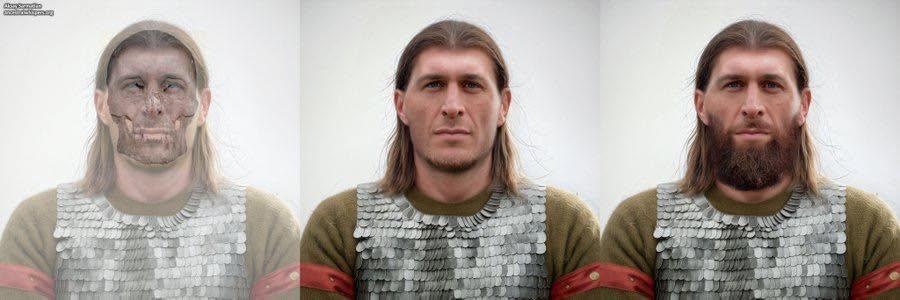
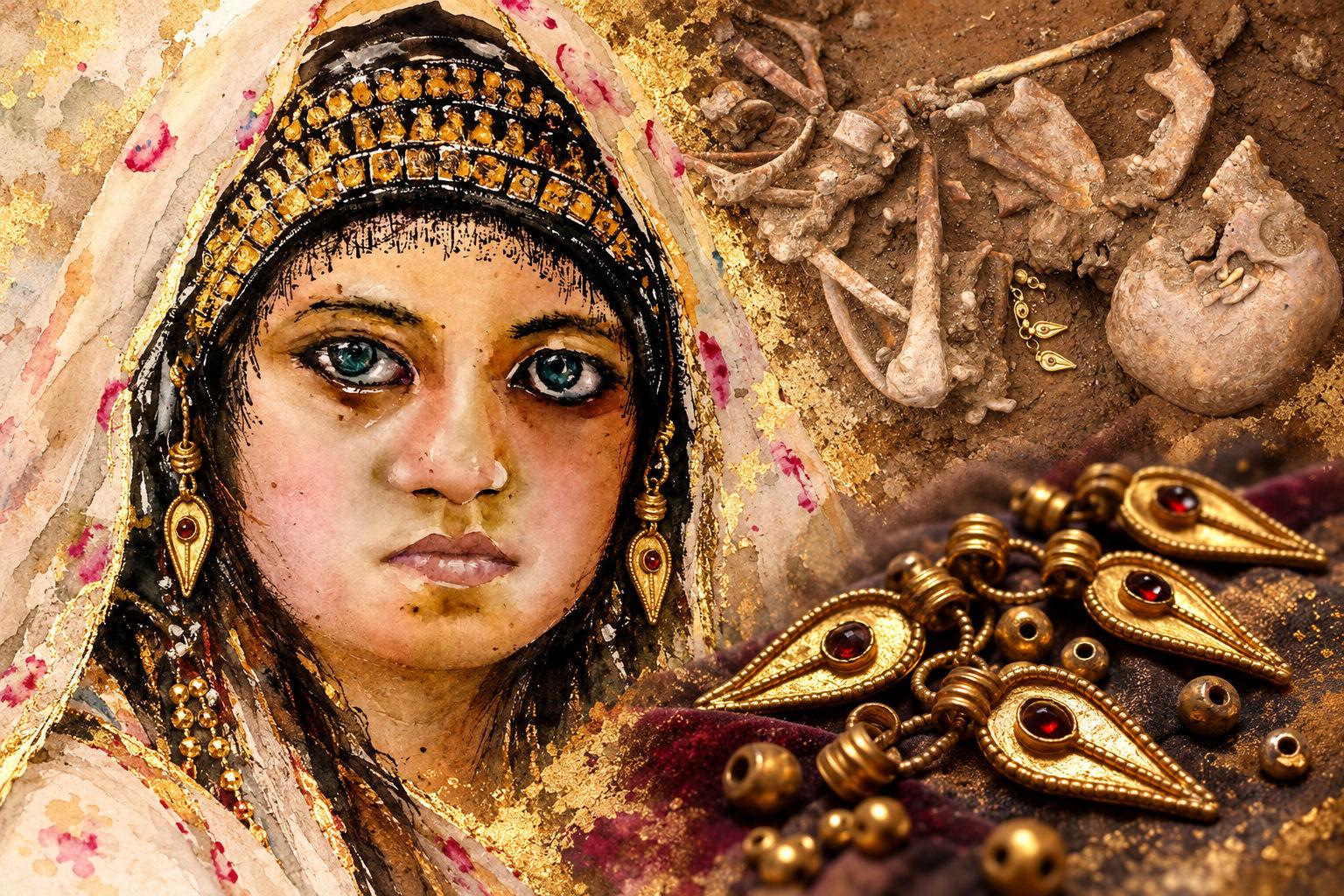
Two individuals illuminate this world. One clusters closely with Crimean Scythians across both earlier and later periods, suggesting local continuity across centuries of steppe turbulence. The other carries a notable ancient Siberian element, reminding us that Scythian identity was a steppe identity shaped by mobility over huge distances. One person might show strong local roots; another might embody wide eastern links. Ancient societies were mixed because human societies are mixed. A physical reconstruction adds life to one figure: likely brown hair, brown eyes, intermediate skin tone—not an abstract sample but a real person with a face, colouring and a place in a community that buried its dead with care.
These individuals stand at a threshold. After them, stronger Sarmatian influence would reshape the steppe, yet these Crimean burials confirm that later history does not simply erase earlier communities. Some local lines continued. Some identities persisted while changing in content. Each skeleton from a secure context can reopen arguments about who the Late Scythians were—which is archaeology at its most thrilling.
If one wanted a dramatic example of how the steppe connected enormous distances, the Sarmatians provide it. Their expansion across the Northern Black Sea region and beyond appears in both archaeology and biology with striking force. The web stretched from the southern Urals across the grasslands to the Lower Danube and Carpathian Basin. A burial from Lyubovka, placed in an older Scythian settlement layer, captures this process perfectly: a newly dominant cultural horizon placing its dead into a landscape already marked by earlier peoples.
The most arresting evidence involves shared ancestry across vast distances. A man from the Carpathian Basin shared close genetic links with a woman from the Rostov region, who in turn shared strong links with a Sarmatian woman from the Orenburg area. Behind these findings lies an extraordinary human reality: kin networks stretching thousands of kilometres. The steppe was not empty space—it was a highway. In Romania, Sarmatian individuals show deep biological ties to Ural and Central Asian populations, confirming that those buried in the west were not locals adopting Sarmatian costume but people with genuine eastern roots. Meanwhile, Sarmatians of the Carpathian Basin shared very little ancestry with preceding Scythian-era inhabitants—suggesting rapid, large-scale population replacement that written sources had long implied but biology now electrifyingly confirms.
To stand at a Sarmatian burial site is to stand in the presence of continental-scale movement. A skeleton, a burial pit, a few ornaments, a weapon or horse fitting—tiny things in themselves—together reveal one of the grand migrations of the early Common Era, written not by chroniclers but by the dead themselves.
Few subjects in Northern Black Sea archaeology are more enticing than the relationship between Alans, Bulgars and the Saltovo-Mayaki culture—an early medieval world of the Don, the Seversky Donets, the North Caucasus foothills and the orbit of Khazar power. The Alans straddle several worlds at once. Often linked to Sarmatian roots and an Iranian-speaking heritage, many Alan communities had by the later first millennium become deeply entangled with Caucasian peoples. Yet an Alan burial from Bratskie I Kurgans in the Chechen Republic shows both old Koban cultural background and a steppe element, while an Alan from Solnechnodolsk-4 appears close to both Sarmatian groups and the Koban population from the same site—evidence not of abrupt rupture but of local continuity across changing labels.
At Verkhniy Saltov, the great Saltovo-Mayaki complex in the forest-steppe zone, Alan individuals reveal striking diversity: some closest to North Caucasian populations, others with stronger Central Asian ties. Burial rite sharpens the picture further. Alans favoured catacomb graves while Bulgars used pit burials—a difference expressing deep symbolic identity—yet both groups could be biologically very close. Three Bulgar individuals from Bochkov resemble nearby Alan groups so strongly that both populations may share a common background. A lineage now found among Mongolian and Chinese populations appears in one Alan case, hinting at very long-distance eastern connections threading through this society.
What emerges is a world of layered identities where catacomb and pit grave, mountain site and forest-steppe settlement, Khazar political umbrella and Caucasian ancestry all belong to one dense historical fabric. The dead did not live in isolated ethnic boxes. They lived in a world of movement and strategic belonging—and their graves still show it.
The Chernyakhov culture, spread across the forest-steppe in the third to fifth centuries CE, stubbornly refuses reduction to a single people—and that makes it all the more fascinating. Its settlements show farming, craftwork and exchange connecting steppe and provincial Roman worlds. Biological evidence confirms the mixture: studied individuals fall into several clusters, some closest to eastern and central European populations, others aligned with Thracian backgrounds, one showing a pronounced eastern Mediterranean signal. It is an astonishing range, perfectly matching the archaeological character of a culture shaped by local communities, northwestern newcomers and Roman economic influence.
The most exciting evidence concerns continuity into later Slavic groups. One genetic cluster within the Chernyakhov population feeds directly into later medieval populations of the Seversky Donets basin. More intimate still is the maternal link between a third-century individual from the Odessa region and a person of Slavic origin buried centuries later at Minino II in the Vologda region—an exact maternal-line match, a thread of descent stretching from the Late Antique Black Sea world into the medieval north.
This does not mean Chernyakhov culture simply "was" early Slavic. Some of its populations contributed to later Slavic communities; others had different destinies. This is what one expects from a broad cultural horizon shaped by several sources. The Chernyakhov dead belong both to the ending of one world and the beginning of another—offering not simple origins but real history: mixture, adaptation, mobility and survival. Their graves preserve that long shadow, and one need only look closely enough to see it.
 Correspondence to: E.D. Aituganova
ajtuganova.edtalantiuspeh.ru; evivrecc@gmail.com
Correspondence to: E.D. Aituganova
ajtuganova.edtalantiuspeh.ru; evivrecc@gmail.com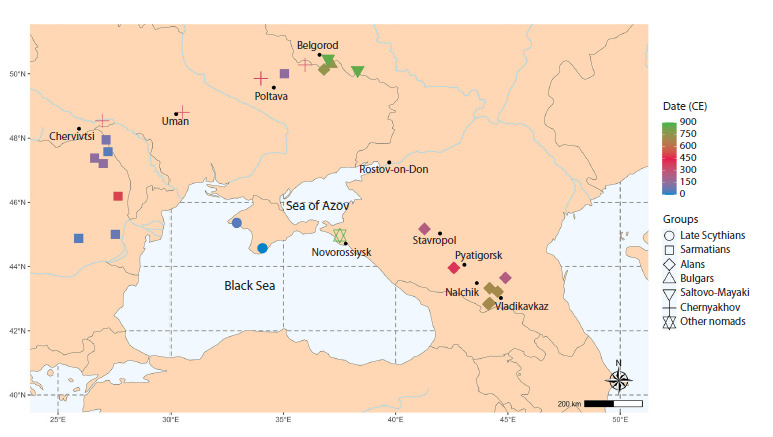
Comments