Haplogroup J1a3

– 5 min read


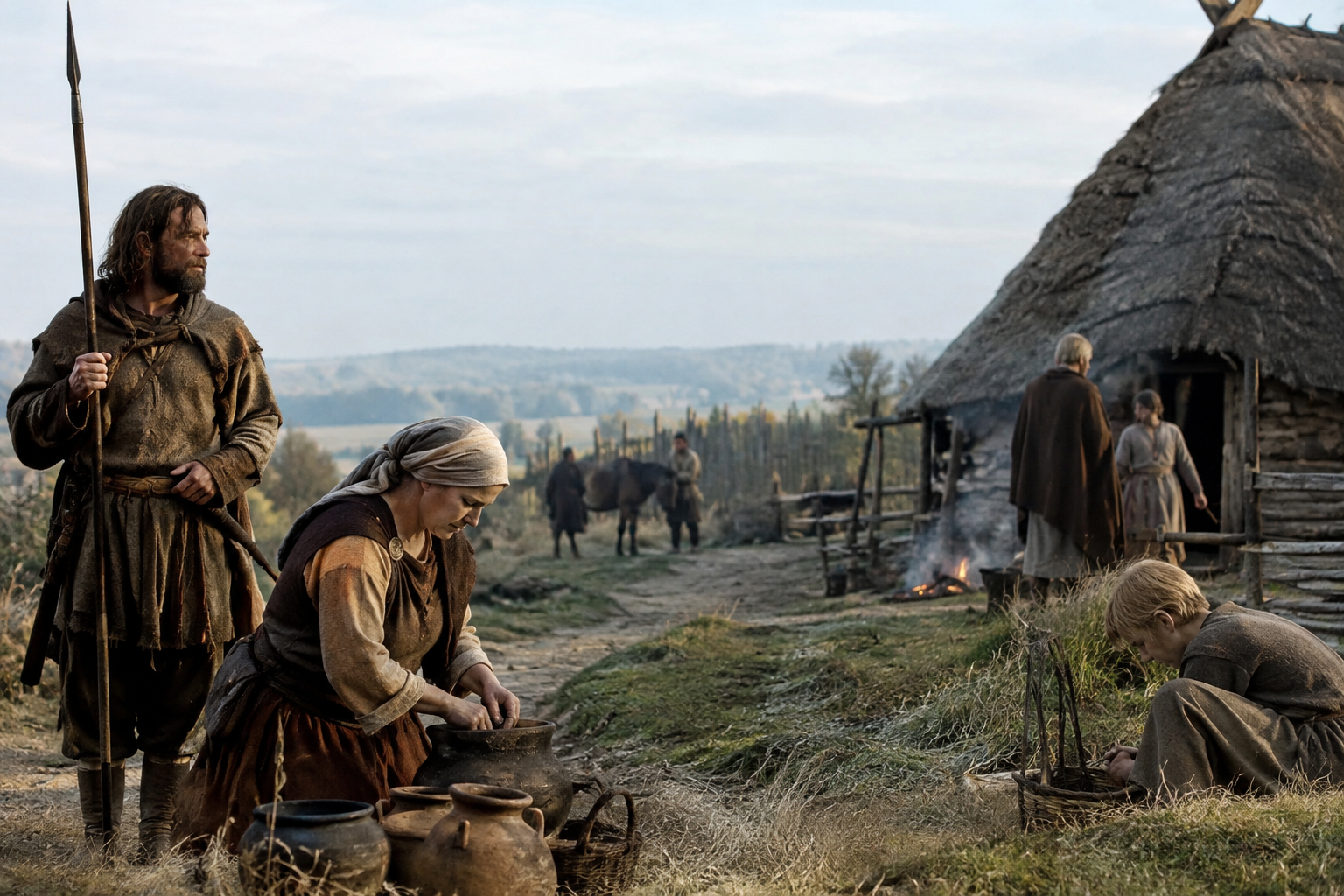
At Deersheim in Saxony-Anhalt, one early medieval man has become unexpectedly important for the history of paternal ancestry in post-Roman Europe. The individual catalogued as DRH043, dated to around AD 500, comes from Migration Period Germany, a world usually described in broad labels such as "Germanic," "Roman," or "barbarian." Yet one Y-chromosome result linked with him, J1a3, points in a more complicated direction.
That matters because J1 is a wider paternal lineage most strongly associated today with parts of the Near East and adjacent regions, while J1a3 is a much narrower branch within that larger family tree. Y-DNA follows only one direct paternal line - father to son to grandson - so it does not define a person's whole ancestry or identity. But when a branch like this appears in an early medieval burial in central Germany, it asks a splendidly awkward historical question: who exactly was moving through this landscape after Rome, and how mixed were these communities really?
Deersheim lay in a region that, by the late 5th and early 6th centuries, had already experienced centuries of imperial frontier politics, military movement, trade, and resettlement. By AD 500, the Western Roman Empire had formally fallen, but the social world of central Europe had not suddenly reset into neat ethnic boxes. Cemeteries, settlements, and bioarchaeological studies across the region increasingly suggest populations shaped by continuity, mobility, and local mixture rather than single-wave replacement.
In that setting, DRH043 is interesting not because one sample can stand for a whole people, but because he widens the range of paternal lines documented in early medieval Germany. A lineage assigned to J1a3 in this context does not automatically mean a recent migrant from one particular homeland, nor does it let us label the man by language or ethnicity. What it does show is that the paternal landscape of Migration Period Europe could include lineages with deeper connections beyond the usual north-central European expectations.
A recent ancient DNA project connected with these early medieval German burials is available through this research archive, which provides the scientific backdrop for samples such as DRH043. Even without overstating what one burial can prove, the result fits a broader archaeological pattern: the frontier and post-frontier zones of Europe were full of people whose family histories did not map tidily onto later national stories.
For many readers, the surprise lies in the contrast between place and lineage. Central Germany in the Migration Period is often imagined through local or regional archaeological cultures, while haplogroup J1 is more commonly discussed in relation to the Near East, Arabia, the Caucasus, and parts of the Mediterranean world. But ancient history is full of movements that do not leave behind convenient labels.
There are several historically plausible mechanisms by which a narrower J1 branch could appear in early medieval Germany. The Roman Empire had long recruited soldiers, officials, craftsmen, and dependants from across its territories. Frontier communities absorbed incomers over generations, and after Roman authority fragmented, those inherited networks did not vanish. A paternal line may have arrived centuries before DRH043 himself lived, or it may reflect more recent movement through military, mercantile, or family connections.
The key point is restraint. We should not compress all of J1 into one story, and we should certainly not pretend that J1a3 by itself identifies a tribe, language, or faith. Still, in archaeological terms, DRH043 is a useful reminder that early medieval cemeteries in Germany can preserve lineages that speak to a far wider world than the local map suggests.
Deersheim makes most sense when placed beside the wider history of western and central Europe after Rome. Regions such as the Rhineland, the Elbe-Saale zone, and the old frontier corridors were not closed ethnic containers. They were landscapes where Roman provincial populations, incoming groups, soldiers, and mobile families overlapped in different proportions from one district to another.
That is why isolated-seeming Y-DNA findings are so valuable. A single paternal lineage does not rewrite the whole demographic history of a region, but it can expose how misleading tidy historical stereotypes are. The old habit of imagining a sharply bounded "Germanic" world on one side and a "Mediterranean" or "eastern" world on the other has been steadily weakened by archaeogenetics.
MyTrueAncestry readers who want a broader regional frame will find it helpful to compare this with work on western German populations in the early Middle Ages.
Studies of early medieval cemeteries repeatedly show that communities could be locally rooted yet still genetically varied. That variability does not mean constant long-distance migration for every individual; often it reflects the accumulated legacy of earlier imperial integration, marriage networks, and small-scale mobility over centuries. DRH043 belongs very comfortably in that sort of historical picture.
One of the most useful things about a sample like DRH043 is that it forces us to separate categories that are too often muddled together. Archaeologists may classify a burial by date and material context. Historians may discuss political groupings or the spread of Germanic languages. Geneticists may identify ancestry components or Y-chromosome branches. These are related questions, but they are not the same question.
A man carrying J1a3 in Migration Period Germany was not therefore "less Germanic," any more than someone with another Y lineage would automatically be "more Roman." Language can spread without mass paternal replacement; political allegiance can change within a lifetime; and local communities can incorporate newcomers while keeping familiar burial customs. The Y chromosome is one very narrow but very precise line of evidence, and its strength lies in exposing these hidden paternal threads.
That makes DRH043 especially interesting for discussions of how cultural identities formed in post-Roman Europe. The period saw major linguistic and political transformations, but the underlying population history was seldom simple. The spread of Germanic-speaking communities, like the formation of many early medieval societies, involved blending as much as movement.
Because the evidence here is slim, it is worth being exact. DRH043 gives us a documented ancient occurrence of J1a3 in early medieval Germany, around AD 500, at Deersheim in Saxony-Anhalt. That is already valuable. It places this paternal branch within a real archaeological setting shaped by the aftermath of empire and the formation of new regional societies.
What it does not do is provide a complete origin story for J1a3, a dynastic pedigree, or a straight-line migration route from one ancient homeland to one medieval grave. With only one clearly supplied ancient individual in this article's evidence base, broad claims would be foolish. But modest claims can be historically powerful: this branch was present in central Europe during a famously fluid period, and its presence fits a continent connected by long, uneven histories of movement.
There is a useful comparison here with other early medieval sites in Iberia and frontier Europe, where ancient DNA has also revealed communities of mixed background rather than sealed populations. The lesson is less about a single exotic arrival than about how normal complexity was in the centuries after Rome.
Diverse Origins in Medieval Madrid
If your paternal line belongs to J1a3, DRH043 offers something modest but real: evidence that this branch had reached, or persisted in, central Germany by the Migration Period. That does not tell you your whole ancestry, and it does not lock your line to one people or kingdom. What it does suggest is that the history of J1a3 in Europe may run through precisely the sort of connected, post-Roman worlds that archaeology is now revealing in finer detail - worlds where family lines crossed political frontiers long before modern identities were invented.

Comments