Iron Age Ritual Cave Burial in Asturias

– 5 min read


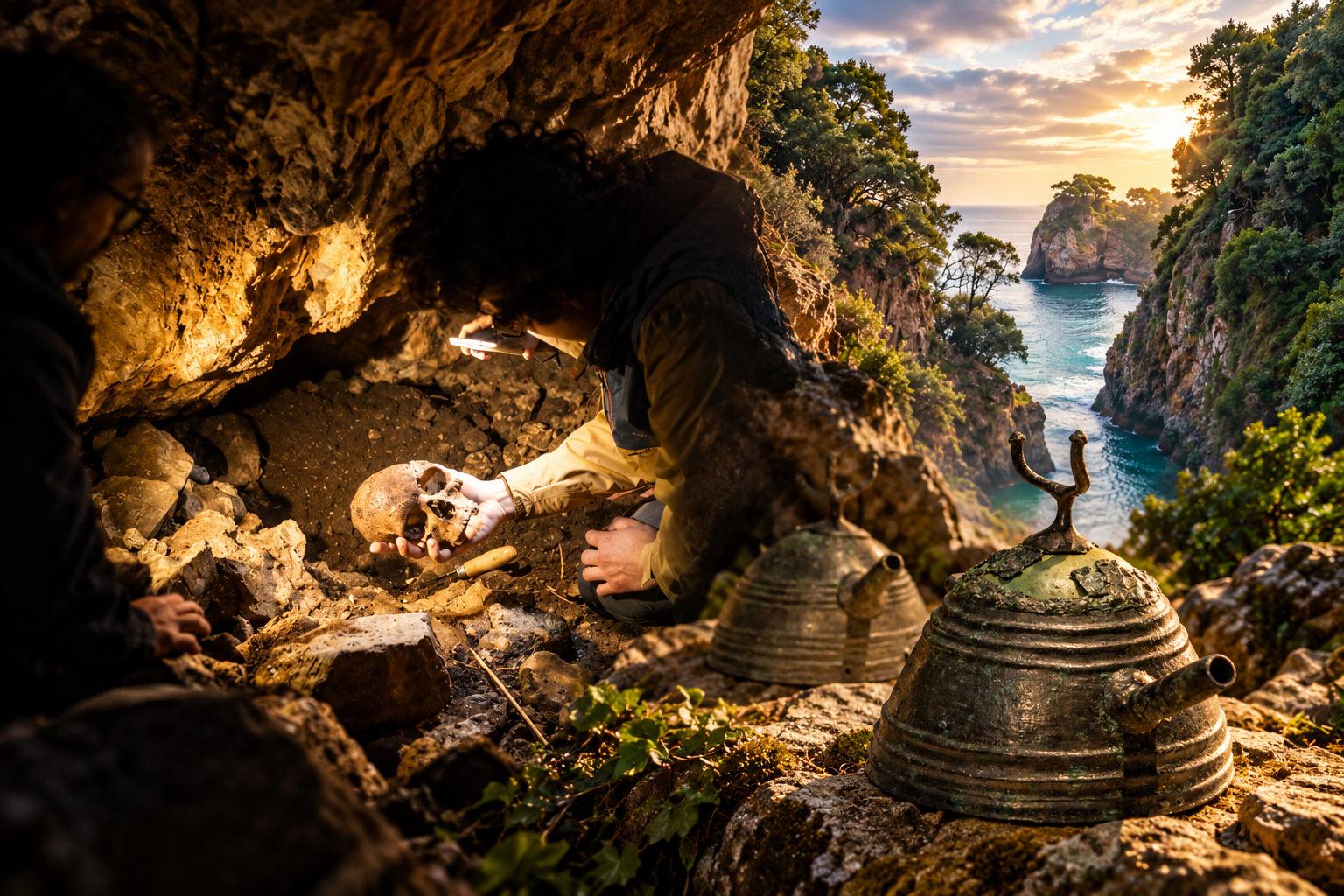
High in the limestone country of northern Spain, caves became places where the living approached the dead and perhaps the divine. In the central Cantabrian region, spanning Asturias, Cantabria, and northern Burgos, traces of Iron Age funerary custom are frustratingly rare—which is precisely why caves matter so much. They preserve moments of choice. Someone decided to carry a body into darkness, selected a chamber or ledge, left ornaments or bones, then withdrew into daylight.
These were not simply holes in the ground. They were dramatic natural places, already ancient in the Iron Age, thick with the memory of earlier human use. To enter was to step into a world already occupied by the past.
Discoveries across the region reveal striking variety: whole bodies, disarticulated bones, brooches, beads, and belts. At La Cerrosa-Lagaña there were several individuals; at Les Pedroses, an elderly man represented by a skull; at Picu Torres, a newborn infant. In other caves the human body is absent but dress items remain, as if clothing could stand in for the person.
These sites resist easy classification. They belong to a murky zone where ritual, remembrance, fear, and social display converge. Radiocarbon dating and close interior study have shown that deposits once thought unified actually span very different centuries, and objects without bodies point to offering rather than burial. Iron Age communities used caves with great selectivity—returning to old subterranean places because they were secluded, memorable, and old enough to lend deep authority to new acts.
Fuentenegroso lies in Asturias's Sierra de Cuera, roughly six kilometres from the sea but perched at around 850 metres elevation—a difficult karst landscape of rock hollows and hidden cavities. Reaching it required purpose. Discovered in 2001 by speleologists, the cave yielded a human skeleton in its innermost chamber with a metal bracelet on each wrist: darkness, final chamber, body, bronze.
The cave spans just 25 metres with a 15-metre vertical drop, but small caves can be powerful ones. The route inward is physically distinctive: a steep entrance passage narrowing from one and a half metres to less than one, a sharp elbow turn, a vertical shaft above it, then a helical antechamber before the final chamber—the cave's only flat area, roughly four metres long and two and a half metres wide, with walls rising to three and a half metres. Enough room for a small group to stand and witness a deliberate act.
Three concentrations of animal remains were identified inside. Radiocarbon dating revealed they were not contemporary with the young woman: two caprines belonged to much later centuries, while a roe deer dated to the Neolithic. The cave was not a sealed single event but a layered place used across immense stretches of time. The woman was laid above remains already thousands of years old—a body of the Iron Age placed above a creature from a far older world, in a cave already carrying the weight of memory.
At the heart of Fuentenegroso lies a young woman, dead in late adolescence—perhaps between sixteen and twenty years old. Her bones were found in anatomical connection, meaning the body was deposited whole and left to decompose in place. That alone speaks of placement and intention, not accident.
Identified as female from the pelvis and skull, she appears to have been physically active, with muscular attachment marks especially around the shoulders. Her oral health was generally good, with no cavities or abscesses. Yet both femora showed cribra femoralis, a porous change linked to physiological stress—nutritional strain or illness. She was not fragile, but her body recorded hardship alongside strength.
The body lay on the left side with legs slightly flexed, though analysts suggest the original deposited position may have been face down, with the left arm beneath. The corpse decomposed in open space with little post-mortem bone movement, again arguing against accidental death. She was put there.
One bronze bracelet remained on each wrist. In a region where comparable cave finds rarely include grave goods, these ornaments are extraordinary. Their retention signals honour, identity preserved at death, or objects considered inseparable from the person. The scene in the final chamber—a young woman wearing bronze in a mountain cave—is both intimate and unforgettable.
Her genetic profile fits well within the Iron Age population of northern Iberia—she was local, not a captive or stranger from afar. Her maternal line belonged to haplogroup U5a1, a lineage with deep roots among ancient western European hunter-gatherers, a thread of very old ancestry persisting into the Iron Age. Her broader genetic background also reflected the steppe-related ancestry characteristic of the period in northern Iberia.
Isotopic analysis of her bones reveals a diet heavily dependent on millet—one of the earliest strong examples in Iberia of such reliance on this crop. Animal protein was present but modest. She was not feasting on rich foods; she lived on practical, cultivated staples.
Sulphur values indicate strong marine environmental influence despite the inland mountain setting. The cave sits only kilometres from the Atlantic coast, and her chemistry suggests either occasional use of coastal foods or consumption of resources raised in sea-spray-affected zones. Fuentenegroso may have been remote, but she was not. Her life connected upland and shore across a mobile, seasonally rhythmic landscape.
Both bracelets are simple open bronze forms—solid, undecorated, one heavier and one lighter, with polished reddish-gold surfaces. Composed of copper with roughly ten percent tin, they fit comfortably within Late Bronze Age and Iron Age Iberian traditions. Familiar objects, but powerful ones: a bracelet worn in life becomes charged in death precisely because it is intimate.
Their retention on the wrists is one of the strongest signs of deliberate, meaningful deposition. Valuable metal was not stripped away. Social identity was not erased. Whoever arranged her in the cave marked her personhood rather than abolishing it.
The animal remains, once suggestive of sacrifice or funerary banquet, dissolved under radiocarbon scrutiny into separate, unconnected episodes. Yet the Neolithic roe deer beneath her may still have mattered—its presence potentially visible or perceptible when she was placed there, lending the chamber the force of ancient occupation. The cave was not empty ground. It was a place already inhabited by antiquity.
Accidental death lacks supporting evidence. Simple concealment is undermined by the effort required and the bracelets left in place. The most compelling reading is a symbolic act—funerary, votive, or both. Ancient ritual readily combined mourning with offering, the care of the dead with the appeasement of powers beyond the human. Comparison with neighbouring cave sites, where women, children, skulls, and personal ornaments also appear in liminal subterranean settings, confirms that Fuentenegroso was not an isolated curiosity but part of a broader regional habit of staging meaningful acts in places set apart from ordinary life.
A young local woman of the Iron Age, nourished by millet and connected to coast and mountain, was carried into a hard-to-reach cave and laid in its innermost chamber with bronze bracelets still on her wrists, above traces of a deposit thousands of years older. That is not random. It is a choreographed act in a place saturated with memory—and one of the most arresting intersections of death, belief, and landscape that Iron Age northern Spain has left us.
Comments