Nekht-Ankh Egyptian Noble
– 5 min read


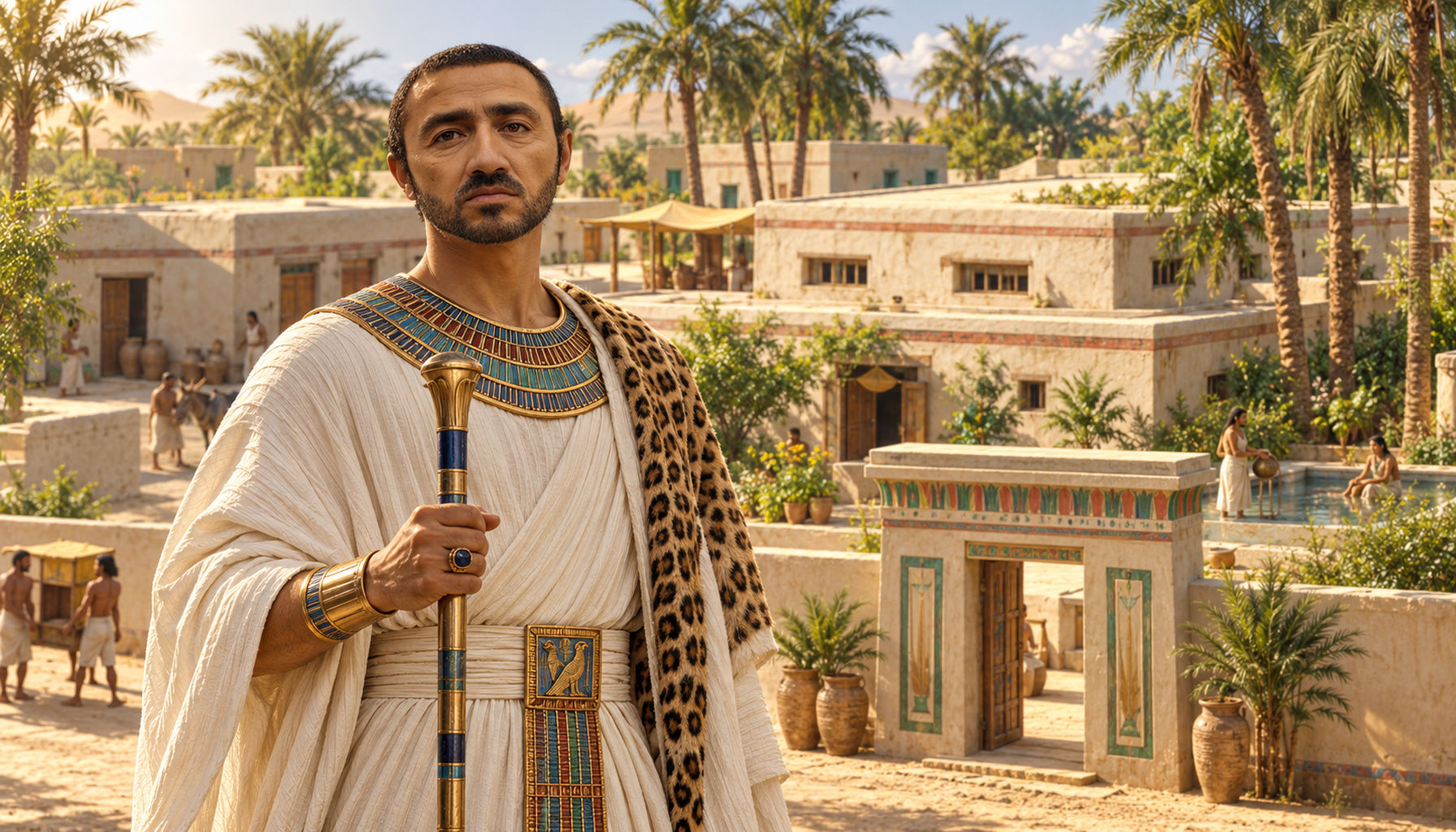
Nekht-Ankh was a high-status Egyptian nobleman who lived in Middle Egypt around 1800 BC, in the later Middle Kingdom, a period when Egypt was governed through a mixture of royal authority and powerful provincial families. His inscriptions identify him as the son of a provincial governor, which places him firmly inside the administrative elite rather than among the anonymous dead so often recovered by archaeology. He is historically important not because he was a pharaoh, but because he gives us something rarer in its own way: a close look at the family world of a wealthy regional household.
He is best known from the remarkable tomb discovered at Rifeh in 1907 near ancient Shashotep, where he was buried together with Khnum-Nakht, long described as his brother. Their burial, famous as that of the “Two Brothers,” preserved decorated coffins, statues, funerary equipment, and other objects of considerable quality. It is one of those wonderfully awkward archaeological cases where text, bodies, and later science all have a say, and not always in quite the same voice.
Nekht-Ankh lived in a world that was sophisticated, bureaucratic, and deeply local as well as royal. By about 1800 BC, Egypt’s Middle Kingdom had behind it centuries of state formation, temple wealth, literary culture, and carefully managed administration along the Nile. A man identified as the son of a governor belonged to a social stratum that connected local power with the wider kingdom. He would have grown up in a household accustomed to rank, ritual, estate management, and the expectations of proper burial. His tomb at Rifeh reflects exactly that sort of status: not ostentatious on a royal scale, but richly furnished and carefully prepared in the manner of men who expected remembrance and had the means to secure it.
The later fame of Nekht-Ankh comes from more than his own lifetime. The “Two Brothers” became a classic case in Egyptian archaeology and mummy studies, attracting anatomical examination, facial reconstruction, and eventually ancient DNA research. The enduring interest lies in the fact that this is not just a Middle Kingdom coffin with a name on it. It is a named individual from Egypt’s provincial governing class whose family relationships can now be approached through both inscriptions and genetics.
Explore Ancient Egypt at Nuwayrat
The sample associated with this individual is identified as Nekht-Ankh Ancient Egypt, dated approximately to 1800 BC. The archaeological context is unusually strong by the standards of ancient DNA. Nekht-Ankh is not a speculative legendary figure attached to an anonymous skeleton centuries later; he is a historically named person from a well-known tomb group discovered with inscriptions and funerary equipment. That makes this a securely identified historical individual in the ordinary archaeological sense, even though, as always, scientific caution remains sensible when dealing with ancient human remains.
The tomb at Rifeh was exceptionally well preserved, and the associated material culture helped make the identification of the occupants unusually persuasive. Nekht-Ankh and Khnum-Nakht were buried together in a context that strongly supported the traditional reading of them as close family members. The reference material from the Manchester museum project on the Two Brothers has long emphasized the richness of the burial and the continuing attempts to understand these two men through a combination of archaeology and science. What ancient DNA later added was not the discovery of Nekht-Ankh’s existence, but a sharper biological angle on his family story.
Most strikingly, genetic testing showed that Nekht-Ankh and Khnum-Nakht shared the same mother but had different fathers. In plain terms, they were maternal half-brothers, not full brothers. That is a splendid example of how genetics can illuminate a social label without demolishing it. Ancient texts and burial language may still present people as brothers for household, social, or practical reasons; DNA simply tells us that the direct biological relationship along the paternal line was not the same for both men.
Nekht-Ankh’s reported Y-DNA haplogroup is H2, while his mitochondrial DNA haplogroup is M1a1. These two results describe different inherited lines. Y-DNA follows the direct paternal line, passed from father to son, so H2 refers only to Nekht-Ankh’s father’s father’s father line. mtDNA follows the direct maternal line, inherited from the mother by all her children, so M1a1 reflects Nekht-Ankh’s mother’s mother’s mother line.
Historically, that matters because the Y-DNA result belongs specifically to Nekht-Ankh’s own paternal lineage, while the shared maternal relationship with Khnum-Nakht makes the mtDNA especially useful in understanding why the two men could be close kin without sharing the same father. The mtDNA evidence fits the broader conclusion that they had one mother in common. The Y-chromosome, by contrast, helps explain why they did not belong to the same direct paternal line.
H2 is an ancient paternal lineage better known in published ancient DNA from Neolithic and later prehistoric western Eurasia than from pharaonic Egypt. Related H2-linked ancient samples have been reported from places such as Çatalhöyük in Late Neolithic Anatolia (cch279), Arukhlo in Neolithic Georgia (ARO008), Motza in the Neolithic Levant (I0867), Ain Ghazal in Jordan (I1700), Arslantepe in Anatolia (ART032 and ART042), Barcın Höyük in northwest Anatolia (I0709x), and a wide scatter of Neolithic and Bronze Age sites in Germany, Hungary, France, Spain, Sardinia, Bulgaria, Ireland, and Alalakh. That does not mean Nekht-Ankh was “from” those places, still less that one can draw a simple migration arrow from a Neolithic village to a Middle Kingdom nobleman. What it does show is that his direct paternal lineage belonged to a branch with a deep and geographically broad prehistoric record across parts of western Eurasia and the Near East.
For M1a1, the picture is a little different. M1 lineages are often discussed in connection with northeastern Africa and adjacent regions of the Mediterranean and Near East. In Nekht-Ankh’s case, M1a1 is best understood as a maternal lineage marker, not an ethnic badge. It tells us something real but narrow: the long maternal thread behind this provincial Egyptian nobleman. Without a fuller list of securely comparable ancient M1a1 individuals supplied here, it is wiser not to overstate specific sample-to-sample parallels. The important point is that Nekht-Ankh’s mtDNA adds one more ancient data point to the maternal genetic landscape of Egypt and its wider connections.
Discover North Africa’s Genetic History
The genetic results are historically interesting because Nekht-Ankh is not just any ancient individual. He is a named member of the provincial elite of Middle Kingdom Egypt, recovered from a famous tomb and linked to a specific family puzzle. DNA helps clarify that puzzle by confirming a maternal half-brother relationship with Khnum-Nakht. That is a very concrete historical gain. It does not, however, tell us everything about identity, language, office, or social self-understanding. Haplogroups cannot by themselves define someone’s ethnicity, culture, or status. Nor do they reveal the whole of a person’s ancestry, which is far broader than one paternal line and one maternal line.
What they do offer is something more modest and more useful: a direct glimpse into two lineages carried by a real Egyptian nobleman around 1800 BC, and a way of checking biological kinship within one of archaeology’s best-known burials from provincial Egypt. In other words, the DNA does not replace the coffin inscriptions, the tomb goods, or the historical setting. It joins them, like another witness brought into the room after a very long wait.
Read about the Rise of Ancient DNA
MyTrueAncestry lets you compare your DNA with ancient populations and archaeological samples from the worlds that shaped early history, including the wider genetic landscapes connected to ancient Egypt, North Africa, and the eastern Mediterranean. It cannot prove direct descent from Nekht-Ankh, but it can help you explore whether your DNA shows connections to the kinds of ancient lineages and populations that formed his world.
Comments