The Alan Rufus Family of Bawsey: Norman Conquest, a Saxon Princess, and the Lost Church of St James
– 11 min read


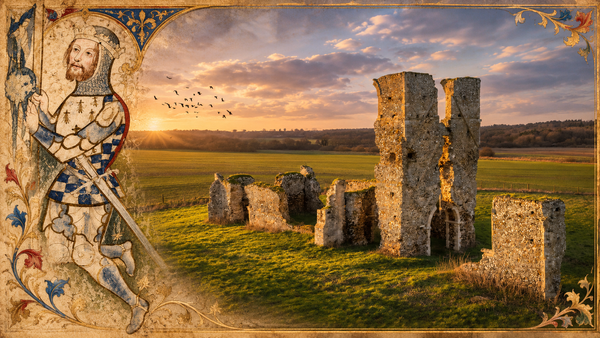
On a lonely hill overlooking the Norfolk countryside stand the haunting ruins of St James's Church at Bawsey. Its broken medieval tower, weathered stone arches and roofless walls are almost all that remain of a settlement whose history stretches back more than a thousand years. Yet behind these quiet ruins lies an extraordinary story of Norman conquest, immense aristocratic wealth, a forbidden royal romance and the transformation of England after 1066.
At the centre of this story stands Alan Rufus, known as Alan the Red, a powerful Breton nobleman whose loyalty to William the Conqueror helped establish one of the greatest landholding fortunes in medieval England. Alongside him were members of his remarkable family, including his brother Ribald, who held the manor of Bawsey, and Gunhild of Wessex, a daughter of England's defeated Anglo-Saxon king, whose relationship with Alan became the subject of some of the most dramatic surviving letters of the Norman period.
The ruins at Bawsey offer a remarkable window into the world these families inhabited, when noble marriages carried political consequences, estates changed hands through conquest, and the descendants of Norman and Anglo-Saxon households began shaping a new aristocratic England.
The story begins in 1066, when William, Duke of Normandy, crossed the English Channel to claim the throne of England. His invasion culminated in the Battle of Hastings on 14 October, where the forces of King Harold Godwinson were defeated and Harold himself was killed. The victory transformed the political landscape of England, placing a new ruling elite over a kingdom previously governed by powerful Anglo-Saxon families.
Among William's important supporters was Alan Rufus, a member of the Breton House of Penthièvre and a relative of the Norman duke. Medieval traditions associate him with the Breton contingent at Hastings, although his precise role in the battle remains uncertain. Later accounts sometimes describe him as commanding part of William's army, but the surviving contemporary evidence does not establish exactly where he fought. What is beyond doubt is that Alan became one of the greatest beneficiaries of the Norman victory.
William rewarded his followers by granting them estates confiscated or reorganised after the conquest. Alan Rufus received enormous holdings, particularly across Yorkshire and East Anglia, where his authority extended over numerous manors, villages, agricultural estates and dependent households. By the time of the Domesday survey of 1086, he had become one of the wealthiest and most influential aristocrats in the kingdom.
His most celebrated possession was the Honour of Richmond in Yorkshire, a vast group of estates organised around Richmond Castle. Established during the decades following the conquest, the castle occupied a commanding position above the River Swale. Its formidable stone walls helped secure Norman authority over northern England and remain among the most impressive surviving examples of early Norman castle architecture.
Richmond Castle was more than a defensive fortress. It was the administrative centre of a far-reaching aristocratic estate, supported by revenues from agricultural land, mills, tenants and villages scattered across the country. Alan's holdings connected the Yorkshire Dales with the fertile landscapes of Norfolk, creating a network of wealth and influence that reached into the daily lives of thousands of people.
Modern attempts to express Alan Rufus's fortune in today's money have sometimes placed him among the richest individuals in British history. Such calculations are highly speculative, since medieval landownership and modern personal wealth cannot be directly compared. Nevertheless, his extraordinary concentration of estates makes clear how much power could be accumulated by a nobleman who enjoyed the favour of William the Conqueror.
Among Alan's Norfolk possessions was Bawsey, a settlement east of the modern town of King's Lynn. The Domesday Book identifies Count Alan as a tenant-in-chief there and records his brother Ribald as lord of one of its manors in 1086. This is particularly significant because it places the family directly within the documented history of Bawsey, rather than relying solely on later genealogical tradition.
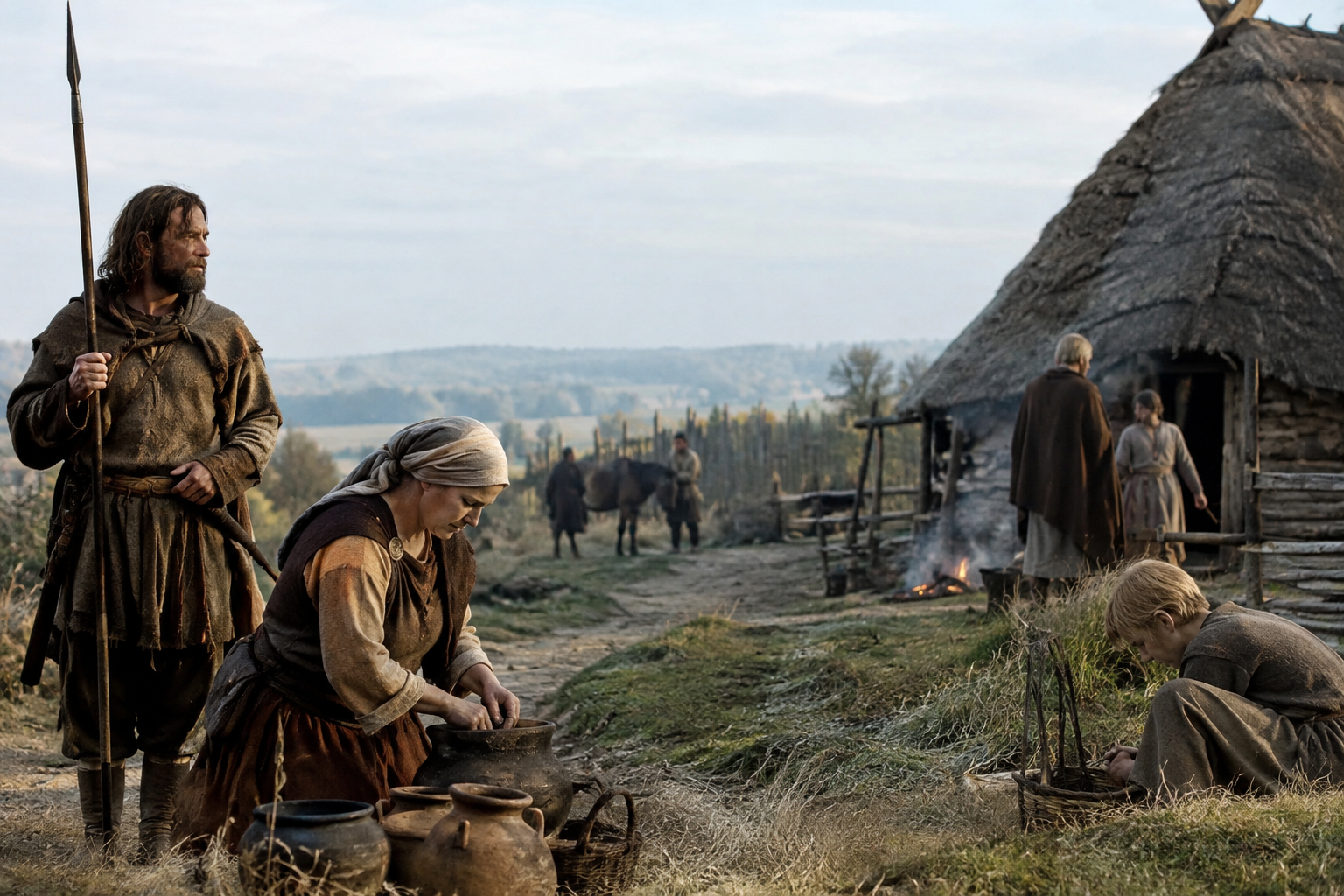
The Domesday survey describes a working agricultural community with villagers, smallholders, a priest, ploughland, meadow and resources associated with mills and salt production. These details reveal a settlement with an established economy, supported by the fertile but challenging landscape of western Norfolk. Other interests at Bawsey were associated with Robert Malet, reflecting the complicated network of lordship through which the Norman aristocracy governed its new possessions.
Ribald's connection to Bawsey formed part of a larger pattern. He held numerous estates under Count Alan, including properties in Norfolk and Yorkshire, and became closely associated with Middleham in the Yorkshire Dales. There, the family's influence helped establish a lordship that would eventually become one of the great centres of northern English aristocratic power.
Middleham later became associated with the Neville family and with Richard III, who spent important periods of his life at Middleham Castle. These later connections do not mean that every family associated with Middleham shared the same direct lineage. They do, however, show how estates established under the early Norman rulers could remain centres of noble influence for centuries, passing through inheritance, marriage and political alliances.
Bawsey itself, however, had a history far older than Alan Rufus or the Norman Conquest. Archaeological evidence indicates that the hill had been occupied during the Anglo-Saxon period, when the surrounding landscape was very different from the open farmland visible today. The site stood above marshes and waterways connected with the Gaywood valley and may once have formed a prominent island-like settlement within the wetland environment.
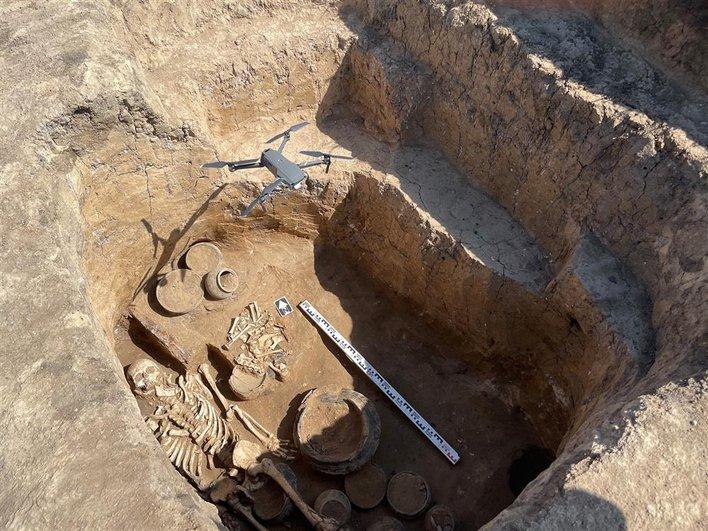
Excavations, aerial photography and geophysical surveys have revealed traces of a substantial early settlement, including ditches, enclosures, burials and evidence of industrial activity. Archaeologists have recovered coins, pottery, metalwork and writing implements, suggesting that Bawsey may have functioned as a significant local centre during the Middle and Late Saxon periods.
The discovery of writing implements is especially intriguing. Literacy was uncommon in early medieval rural communities, and these finds have encouraged the interpretation that Bawsey may once have supported a religious institution or minster. Such establishments often served communities across a wide surrounding district, providing religious services, administration and education before the later medieval parish system became fully established.
Fragments of decorated Anglo-Saxon grave slabs and an early medieval burial discovered near the church provide further evidence of religious activity before the surviving Norman-period building was erected. The ruins visible today therefore belong to a longer history of worship and settlement, rather than marking the first religious presence on the hill.
The surviving Church of St James, sometimes historically called St Mary's, dates principally from the eleventh and twelfth centuries, with later medieval alterations. Its architectural character is unmistakably Romanesque, reflecting the building traditions that spread across England after the Norman Conquest. The church was constructed largely from local carstone and iron-rich stone, with flint and limestone dressings, giving its surviving walls a distinctive appearance.
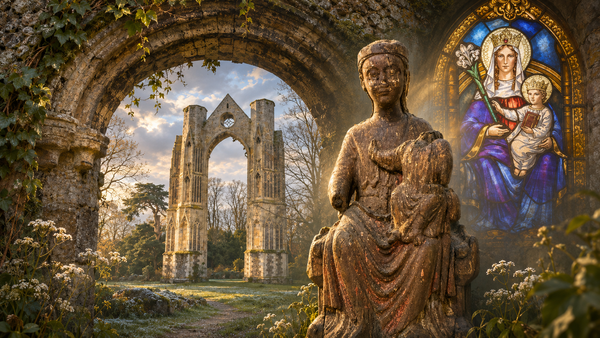
One of its most remarkable features is the central tower. Unlike the more familiar west towers of many English parish churches, the tower at Bawsey rises between the nave and chancel. Its surviving arches and masonry suggest a building of unusual ambition for a rural parish, possibly reflecting the site's earlier religious importance.
Although Ribald held Bawsey in 1086, no surviving evidence securely identifies him as the personal founder of the existing stone church. Its construction belongs broadly to the period following the conquest, when the establishment and patronage of churches formed an important part of the new aristocratic order. Whether financed directly by Ribald, his successors or other patrons, the building reflects the transformation of religious and social life under Anglo-Norman lordship.
Yet the most dramatic personal story associated with Alan Rufus is not one of castles, churches or estates. It concerns Gunhild of Wessex, a daughter of King Harold Godwinson, the man defeated and killed at Hastings.
Following the Norman victory, members of the former English royal family faced an uncertain future. Some fled abroad, some entered religious communities, and others attempted to preserve their position through political alliances. Gunhild spent time at Wilton Abbey in Wiltshire, an important religious house with longstanding connections to aristocratic and royal women.
Wilton was more than a place of religious devotion. In the turbulent years following the conquest, institutions such as Wilton could also provide protection and refuge for women whose families had suffered political defeat. The exact circumstances of Gunhild's residence, and whether she had undertaken binding religious vows, became matters of intense controversy.
At some point, Gunhild became involved with Alan Rufus. The surviving evidence describes a relationship between the daughter of the defeated Anglo-Saxon king and one of William the Conqueror's most powerful followers. Later accounts have portrayed it as an abduction, an elopement or a forbidden romance, although historians have differed over the precise circumstances and legal status of their union.
The political significance of such a relationship was considerable. Alan had received estates formerly associated with the Anglo-Saxon ruling class, while Gunhild belonged to the family of the king whose defeat had enabled the Norman redistribution of land. A marriage or recognised partnership between them could have linked Norman authority with the prestige of the old English royal dynasty.
The relationship also raised an uncomfortable question for the Church. If Gunhild had entered religious life and made binding vows, could she legitimately leave the monastery to live with a nobleman? That question attracted the attention of Anselm, Archbishop of Canterbury, one of the most influential theologians of the medieval world.
Anselm's surviving correspondence with Gunhild provides an extraordinary glimpse into the dispute. He urged her to abandon worldly attachments and return to religious life, warning of the spiritual consequences of rejecting her obligations. His letters reveal both the authority exercised by the Church and the determination of noblewomen whose choices could challenge ecclesiastical expectations.
After Alan Rufus died in 1093, Anselm sent Gunhild a particularly severe letter. He invoked the death of her former companion and described the decay of his body in graphic detail, urging her to recognise the temporary nature of physical love and earthly splendour. His language was deliberately shocking, intended to force a moral confrontation rather than offer consolation.
The account becomes even more remarkable with the appearance of Alan's brother and successor, Alan Niger, known as Alan the Black. He inherited important interests following Alan Rufus's death and was also linked with Gunhild in Anselm's correspondence. Some historians interpret the evidence as indicating a proposed marriage, though the full circumstances remain uncertain.
Anselm strongly opposed this renewed attachment. His objections reveal a striking clash between ecclesiastical authority and the aristocratic practice of using relationships and marriage to preserve estates, political alliances and family influence. For Gunhild, the controversy reflected the limited but sometimes fiercely defended independence available to women of royal birth.
The story has also generated intriguing genealogical interpretations. Historical research has explored possible connections between Gunhild, Alan Rufus and the d'Aincourt family, whose medieval memorial evidence includes claims of royal descent. These interpretations offer a potential link between the defeated Anglo-Saxon dynasty and later Anglo-Norman aristocratic families, but the precise relationships remain debated and should not be treated as a universally accepted pedigree.
The careers of Alan Rufus, Ribald and Alan the Black demonstrate that the Norman aristocracy was never a single, uncomplicated family tree. The House of Penthièvre belonged to the complex noble world of Brittany, Normandy and England, while relationships with the Godwinson family, the Malets, the Taillebois family and other landholding houses created networks that crossed regional and political boundaries.
Such connections helped shape the emergence of a new Anglo-Norman society. The Norman Conquest replaced much of England's ruling class, but it did not erase the older population or every connection to its noble families. Marriage, estate administration, religious patronage and everyday settlement gradually brought people of different backgrounds into the same communities.
At Bawsey, these profound changes would have been experienced through the ordinary routines of medieval life. Farmers worked the land, priests served the church, families buried their dead, and local craftspeople contributed to an economy linked with settlements across Norfolk. The surrounding district also became known for medieval tile production. Archaeological investigations have identified kilns and substantial quantities of pottery and decorated tiles, helping restore a sense of activity to a landscape that now seems almost entirely deserted.
For centuries, the village and church continued to serve their community. But the environment and economy of western Norfolk gradually changed. Waterways shifted and silted, agricultural priorities evolved, and landowners increasingly sought to consolidate fields and expand pasture for livestock.
By the beginning of the sixteenth century, the medieval settlement at Bawsey was disappearing. Historical evidence records approximately sixty acres being converted to pasture by 1517, and the village is thought to have been largely evacuated during this period. The expansion of sheep grazing and the enclosure of land could bring substantial profits to estate owners, but such changes frequently came at a severe cost to rural tenants and their families.
The disappearance of the village did not immediately bring the complete abandonment of its church. Although the surrounding settlement had contracted, St James's continued to retain a religious and funerary role. Historic England records that the building remained in use until 1773, when its last burial was recorded, despite evidence of deterioration during the seventeenth century.
By the early nineteenth century, the church had become the roofless ruin that forms the basis of its modern appearance. The tower had fractured, walls had collapsed, and the once-busy settlement had vanished beneath the surrounding fields. Today, the site is protected as a Grade I listed building and Scheduled Monument, recognising both its architectural importance and the buried archaeological remains of the earlier community.
Archaeological investigations have continued to reveal fragments of Bawsey's lost history. Excavations in 1998 examined features around the church and settlement, confirming the importance of the Anglo-Saxon occupation. The presence of earlier religious activity beneath and around the surviving church makes the hill particularly valuable for understanding the transition from Anglo-Saxon England to Norman rule.
Standing among the broken arches of St James's Church, it is possible to imagine the generations who passed through this landscape. Anglo-Saxon worshippers may have gathered here before William the Conqueror ever approached England's shores. Norman tenants later worked estates controlled by Ribald and Count Alan. Medieval families attended services, celebrated marriages and buried their relatives in the churchyard. Centuries later, the settlement disappeared as the demands of agriculture and landownership changed.
The contrast is extraordinary. Alan Rufus held immense estates and wielded power that few of his contemporaries could rival, yet his name is now unfamiliar to many visitors. Gunhild, born into the family of England's last crowned Anglo-Saxon king, became entangled in a personal and political controversy preserved through the letters of an archbishop. Ribald governed lands extending from Yorkshire to Norfolk, but at Bawsey the most visible surviving monument is a church whose exact medieval patronage remains uncertain.
For those researching ancestors in Norfolk, Yorkshire, Brittany or the wider Anglo-Norman world, the histories of Alan Rufus and Ribald provide a fascinating connection between local records and the broader transformation of medieval England. Genetic comparisons with ancient archaeological samples can add another dimension to this investigation, although a genetic match to an ancient population or individual cannot by itself prove descent from a particular noble family.
Watch Simon Howard's on-location visit to the ruins of St James's Church
The ruined Church of St James at Bawsey remains an extraordinary monument to this lost world. What began as an important settlement in the Anglo-Saxon landscape became part of a vast Norman estate, survived centuries of religious and agricultural change, and ultimately disappeared from everyday village life.
Today its shattered tower stands against the Norfolk sky, a reminder that even the wealthiest and most powerful families cannot prevent the passage of time. Alan Rufus's immense fortune is gone, his political world has vanished, and the houses that governed Bawsey have long since surrendered their estates to history. Yet the stones of St James's still preserve something of their age.
By exploring historical records, archaeological discoveries and ancient DNA, MyTrueAncestry helps bring that wider human past into focus. Visitors who already possess raw DNA data can upload it to MyTrueAncestry and compare their results with ancient individuals and populations, including samples relevant to the broader Anglo-Saxon, Norman and medieval British worlds. You may not be able to prove direct descent from Alan Rufus, Ribald or Gunhild of Wessex, but you can see whether your DNA shows connections to the ancient populations and archaeological samples that shaped their world.
Explore the Royal House of Stewart
The story of Bawsey is ultimately more than the tale of a wealthy Norman nobleman or a deserted medieval village. It is a story of conquest, inheritance, forbidden love, religious tradition and the ordinary people whose lives unfolded beneath the authority of powerful families. Upload your DNA to MyTrueAncestry to see whether you match this family's wider world or related ancient DNA samples.
Comments