Chalcolithic Anatolia: Mobility, Gene Flow, and Population Change
– 5 min read


For a long time, middle prehistory in Anatolia was treated as a historical shrug—fewer large settlements, fewer obvious mounds, a dramatic collapse. Yet the picture now looks far more interesting, and far more human.
What emerges is not a dead landscape, but a moving one. Instead of population collapse, the evidence points to communities changing how they lived: more mobile, more scattered, less tied to permanent settlements. They may not have vanished at all. They may simply have become harder to spot.
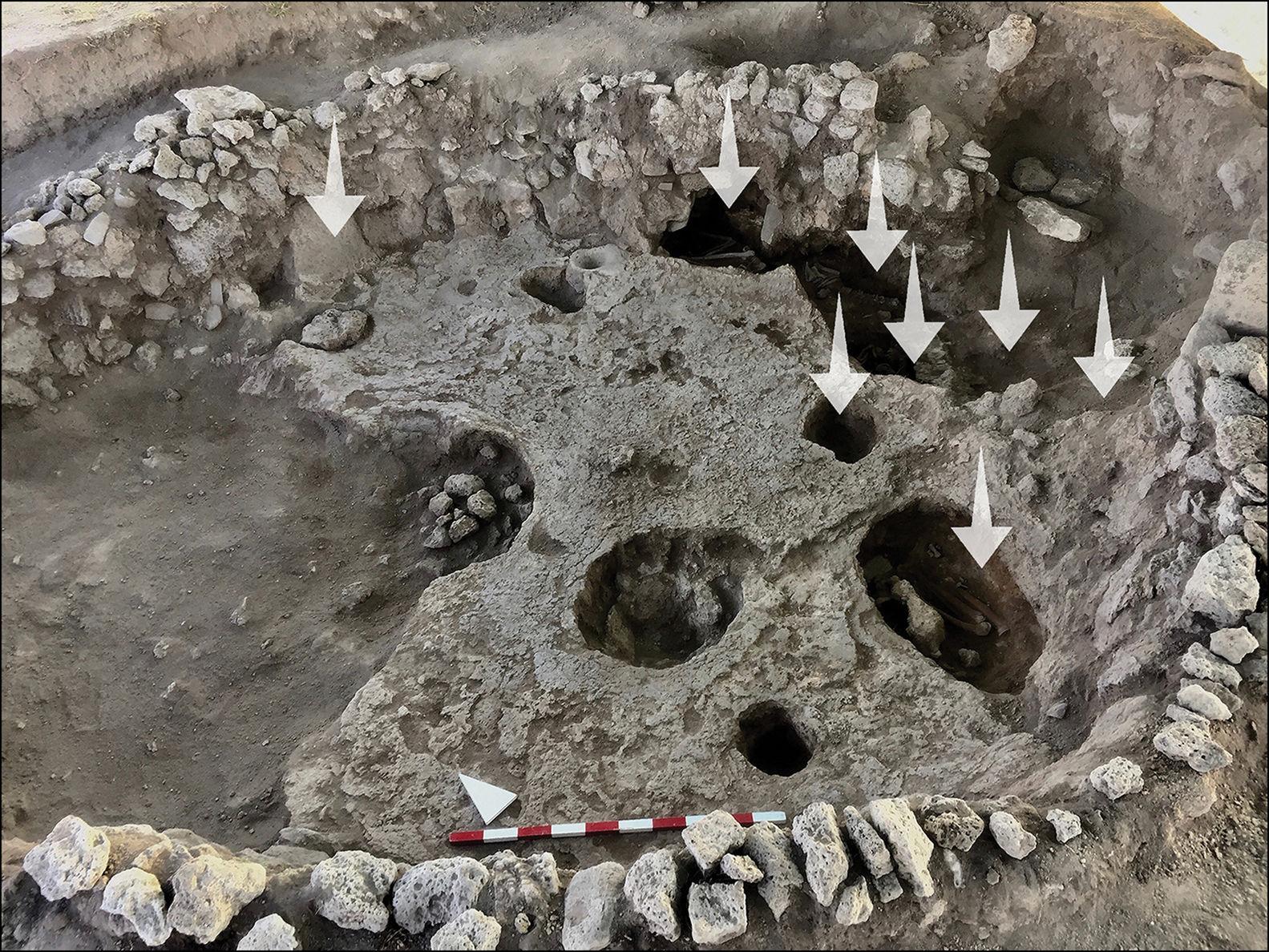
This is where burial evidence becomes especially gripping. Skeletons from across Anatolia allow ancient lives to speak through their bones, suggesting not catastrophe but a society in motion. Some cemeteries yield crouched burials with beads, stone tools, and ornaments. Others preserve people laid out in ways that hint at local customs and family memory—communities actively remaking life, not retreating from it.
The apparent drop in large settlements between roughly 7000 and 5000 years ago once encouraged bleak labels such as a "dark age." But this darkness may be our own: a tendency to equate fewer tells with fewer people. Consider judging a modern country only by counting skyscrapers. If populations shifted into smaller towns or mobile households, the skyline shrinks even if the people have not disappeared. That may be precisely what happened here.
Explore another prehistoric population transition
One of prehistory's most dramatic stories is the gradual arrival of ancestry linked to regions east of Anatolia—not a single thunderclap, but a tide. Across millennia, communities became increasingly connected with peoples from the South Caucasus, Upper Mesopotamia, and nearby eastern lands through movement, intermarriage, and local blending. Real life, in other words.
Several sites capture this vividly. Certain ancient individuals carried more eastern ancestry than those around them—not conquerors, but clues to movement on the scale of households and kin groups. Some outlier individuals show eastern connections before such ancestry became widespread, suggesting isolated arrivals long before broader patterns emerged: little streams feeding a larger river.
The process was uneven. Central and western Anatolia absorbed eastern ancestry differently and at different paces, revealing Anatolia not as one social block but a mosaic of communities, each participating differently in wider networks. By the later Chalcolithic, eastern ancestry had become a regular part of the population mix—yet the story remains one of blending, not replacement. Older local ancestry remained strong while new elements merged with long-established communities.
The most eloquent evidence lies in the skeletons of ancient individuals who, thousands of years later, still carry the imprint of those journeys.
Graves reveal something more intimate than houses or pottery: how communities imagined personhood, kinship, and memory. One of the most striking developments is a change in family patterns during the Chalcolithic—some ancient individuals show DNA patterns indicating that they were children of fairly close kin.
This contrast is what makes the evidence so intriguing. On the large scale, populations were blending. On the small scale, some families were marrying within narrower circles. Mobility and endogamy coexisted: a region open in one sense, socially restrictive in another.
What might this mean in human terms? If herding became central to wealth, animals were inheritance on the hoof. That reshapes marriage strategies—families preferring unions that keep wealth close, reinforce known alliances, or preserve rights over land and stock. Such choices shape births, households, and village structure. At sites in central Anatolia, cemetery evidence sits against backgrounds of changing economies in which herding and wool production grew increasingly important. A society more invested in mobile flocks may organise family ties very differently from one rooted in farming villages.
Every grave is not only an endpoint but evidence for a web of relations: who could marry whom, how families organised themselves, and what counted as proper closeness. The dead quietly register those tensions. This turns prehistory from faceless migration into a story of social choices. Family organisation was not static, but adapted alongside mobility, economy, and regional contact.
Among all the ancient individuals in this story, one stands out with almost theatrical force: a young male buried at Balıklı in central Anatolia, dating to the mid-fifth millennium. His remains provide rare evidence of connection between Anatolia and steppe populations to the north. If many prehistoric discoveries are about trends, this one is thrillingly personal.
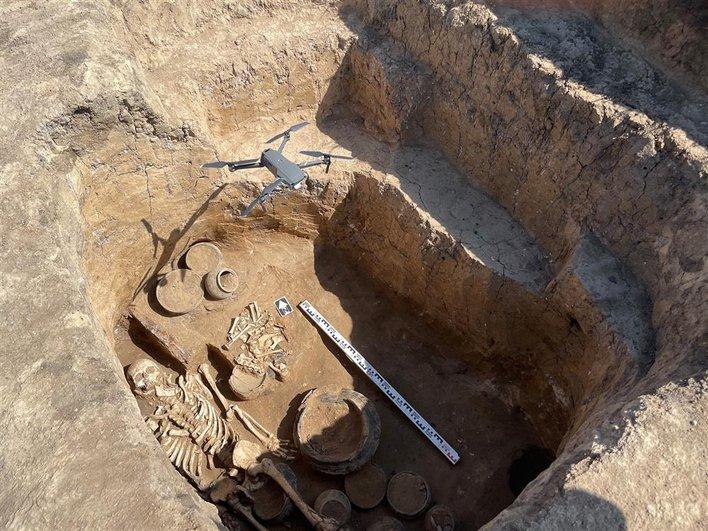
The burial is memorable. The grave was stone-lined; the body placed semi-supine with bent knees, adorned with red ochre, stone items, and copper ornaments. This was no casual disposal. Someone mattered here. His ancestry linked him, at least in part, to steppe-related groups—not wholly steppe in origin, but enough to point to real movement across considerable distance, likely running from steppe regions through the Caucasus into Anatolia.
He was not buried with an obvious settlement around him, which raises fascinating possibilities. Was he part of a mobile group whose living places left little trace? Was the community moving seasonally? Archaeology cannot yet answer fully, but the questions are rich.
What makes him historically important is the scale of the evidence. There is no sign of a massive steppe-derived influx—rather, something smaller, more human, and more interesting: a modest but real movement of people. No skeleton comes labelled with the language it spoke, but Balıklı shows that contact of the relevant kind was possible, real, and earlier than silence alone might suggest.
He reminds us that prehistory is not only about anonymous populations. The boy from Balıklı was one person whose life sat at the intersection of worlds. In his grave, a local burial and a long-distance journey meet.
Read more on North Pontic migrations
The final great theme concerns the temptation to force archaeology, ancestry, and language into one tidy package. The evidence from Chalcolithic Anatolia insists on something messier and more realistic: culture, language, and ancestry do not always travel together.
Connections between Anatolia and Greece show archaeological evidence of exchange, yet the spread of objects or ideas was not always matched by movement of ancestry. A style of pottery, a metalworking technique, or a mortuary gesture might travel far more easily than whole populations. This is crucial: prehistoric communities could borrow, imitate, trade, and transform without being demographically overrun.
The null hypothesis should be modesty. Cultural change does not automatically mean population replacement. Ancestry change does not automatically imply a specific language. Languages shift through bilingualism, patronage, elite influence, or the slow prestige of a neighbouring speech community. Human societies are flexible—they adopt, absorb, resist, and reinvent.
It is easy to fall in love with dramatic tales of conquering peoples sweeping across maps. Much harder, but truer, is picturing generations of mixed communities, bilingual households, mobile herders, and local traditions stubbornly persisting even as people and ideas circulate. Ancient Anatolia shows a history of entanglement, where biological, cultural, and linguistic histories intersect without simply matching.
That is perhaps the most important takeaway. The past was not arranged for modern convenience. Instead, ancient Anatolia shows a world whose complexity is the source of its fascination. And if that resists simple stories, so much the better. History is usually most interesting when it refuses to behave.
Explore ancient DNA and archaeogenetics
https://www.cell.com/cell/fulltext/S0092-8674(26)01334-6
Upload your DNA to MyTrueAncestry to see whether you match this family or related ancient DNA samples, and explore how your own ancestry connects with the deeper human history revealed by archaeology and genetics.
Comments