Denmark’s Mesolithic–Neolithic Transition: Culture, Genetics, and Timing
– 4 min read


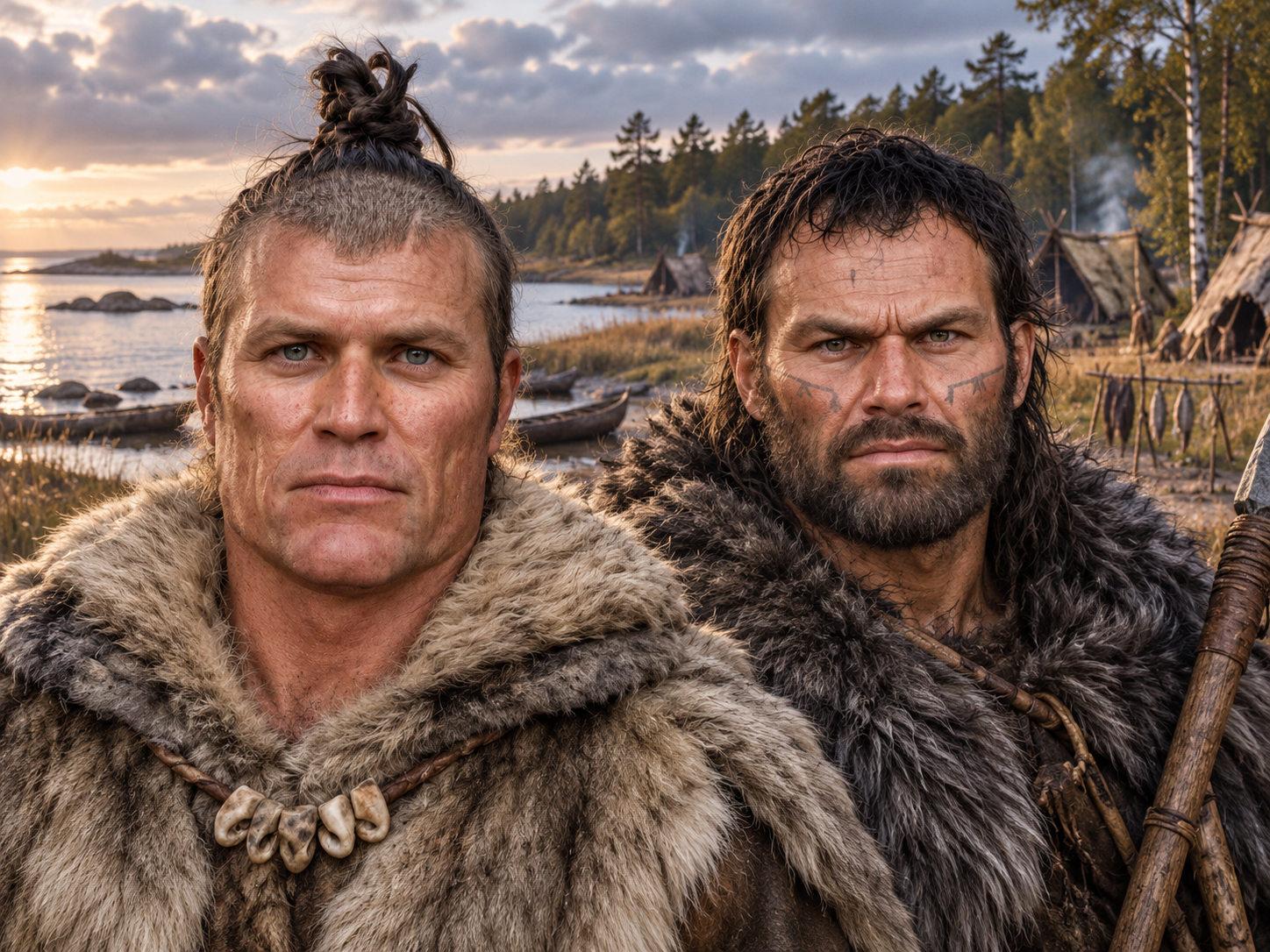
For thousands of years, communities across prehistoric Denmark lived by sea, marsh, river, and forest. Then, around 4000 BC, farming arrived with startling force: cattle, crops, new pottery, and new burial customs grouped under the Funnel Beaker tradition. This was not a technical upgrade but a different rhythm of life entirely.
What makes the transition so compelling is that the old world did not vanish when the new one appeared. Mesolithic traditions continued for generations alongside farming. Shell middens still speak of communities deeply invested in older coastal foodways, even after domesticated animals and crops had arrived. Denmark did not wake up one morning as a farming land. It lived for a while in two worlds at once.
Even within the spread of farming there was no single neat package. Cattle and sheep appeared before pigs, and before cereals became established. Exotic imports found in late hunter-gatherer settings, including jadeite objects, shoe-last axes, and early copper artefacts, hint at contacts reaching far beyond Denmark. The ground had been prepared by generations of exchange before the Funnel Beaker tradition took firm hold.
The archaeological power of this story comes from place. Coastal shell middens preserve the stubborn strength of older lifeways in layers of shells, fish bones, flint tools, and hearth remains. At Syltholm Fjord, wooden fishing structures continued from the Mesolithic into the Neolithic and beyond, a reminder that practical knowledge does not dissolve overnight simply because cattle have appeared elsewhere.
Graves bring individual people into view. At Dragsholm, a young man of around twenty was buried with Funnel Beaker grave goods despite carrying hunter-gatherer ancestry. His burial is a meeting point of multiple histories, proof that pots, people, and identity do not always align tidily. Bogs add an eerier dimension. The Vittrup body, preserved with dreadful immediacy in wetland, may lie outside the local strontium range, raising the possibility that he came from elsewhere entirely.
Evidence drawn from 130 sites and hundreds of radiocarbon dates creates an unusually rich mosaic. Coastal middens insist on continuity, fjord installations show enduring skill, graves reveal shifting identities, and bogs preserve haunting singular individuals. Together they show that this transition was rooted in real environments and the different possibilities each landscape offered.
The Dragsholm man has become almost emblematic of the period's complexity. His ancestry linked him to hunter-gatherer populations, yet his burial goods and diet both point toward the early farming world. Ancestry and cultural belonging were plainly not the same thing. One body, several histories.
Rødhals provides a striking contrast, retaining a strongly marine dietary signal long after farming had spread. Ravnsbjerggård II and Elkenøre, also late individuals with hunter-gatherer ancestry, show diets closer to farming patterns, proving that old population history persisted even when economic habits had shifted. Vittrup and Svinninge Vejle, both linked to Baltic hunter-gatherer ancestry, again refuse uniformity: one shows a diet closer to farming groups, the other a substantially higher marine signal.
These individuals collectively demonstrate that human identity is layered. Descent, diet, burial custom, and place of upbringing need not point in the same direction. They prevent the past from becoming cartoonish and make the transition feel like a real human drama rather than a textbook category shift.
Diet reveals habit, environment, and sometimes identity with unusual sharpness. For Mesolithic communities the sea was a foundation, not a supplement, and isotope evidence from bones confirms this strongly. With the Neolithic came a marked shift toward terrestrial food, yet aquatic resources continued to matter. Farming did not mean an instant farewell to fish.
Individuals with hunter-gatherer ancestry tend to show higher marine dietary contributions on average, while those with early farmer ancestry show reduced marine intake. Yet the exceptions are the most exciting part. Dragsholm crossed expected boundaries. Rødhals did not. People could inherit one population history and live by another food tradition entirely, because diet is culture in action, reflecting knowledge, landscape, labour, and social ties.
Strontium values hint at mobility. Most tested individuals fall within the local range, suggesting that much of the population lived within familiar landscapes rather than wandering constantly. Yet Vittrup and one individual from Henriksholm-Bøgebakken may lie outside that range, opening questions of migration, marriage, or resettlement that archaeology can only partly reconstruct. Food and movement together turn broad history into something imaginable at the scale of the human body.
The most arresting question is whether farming spread because new people arrived, because locals adopted new practices, or both. The evidence points firmly away from any single tidy answer. Neolithic culture became visible around 4000 BC, but widespread farmer ancestry appears later, separated by a gap of several centuries. Culture transformed before demography caught up.
This gap is historically explosive. It allows for a period of genuine coexistence in which coastal foragers continued exploiting marine resources while inland farming communities established stock keeping and cultivation. The genetic evidence suggests local hunter-gatherers made only a limited early contribution to the farming gene pool, yet some of their descendants clearly survived well into the Neolithic, as the dietary and burial evidence makes undeniable.
A three-stage picture emerges. First, an interaction phase before 4000 BC marked by contact, imported objects, and early domesticates. Then the rapid establishment of Funnel Beaker culture across Denmark. Finally, a slower demographic transformation over following centuries during which farmer ancestry became widespread while Mesolithic lifeways and populations gradually faded. This is far richer than any stark tale of invasion or simple adoption. It has room for migrants and locals, borrowing and resistance, children of one ancestry growing up in households shaped by another cultural world. History, as usual, was messier and more exciting than any single headline.




Comments