The de Faverches Family of Walsingham: The Noble Lineage Behind England’s Great Medieval Shrine

– 7 min read


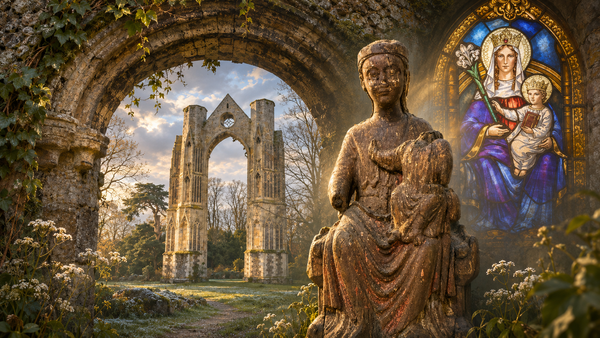
Deep in the countryside of northern Norfolk stands one of England’s most remarkable medieval ruins. At Little Walsingham, a magnificent Gothic arch rises above the remains of a once-great religious complex, recalling a time when this quiet village attracted pilgrims from across England and Europe. Behind the famous Priory of Walsingham lies the story of the de Faverches family, a medieval landowning household whose influence extended far beyond the boundaries of its Norfolk manor.
The family's legacy begins with a woman remembered as Lady Richeldis de Faverches, also recorded under the spellings Favarches and Favereches. She is traditionally associated with the foundation of the Holy House of Walsingham, a sanctuary dedicated to the Virgin Mary that became one of the most celebrated pilgrimage destinations in medieval England. Her son, Geoffrey de Faverches, would help transform that private religious foundation into an institution capable of surviving for centuries.
The story belongs to the changing world of Anglo-Norman England, when the Norman Conquest of 1066 reshaped the kingdom's political and landholding elite. William the Conqueror redistributed estates among powerful supporters, while older English families continued to negotiate their positions within the new aristocratic order. Norfolk was a landscape of manors, parish churches, agricultural wealth, and emerging religious institutions, all interconnected through the authority of noble families.
The precise origins of the de Faverches household remain uncertain. Although the name is associated with the Anglo-Norman aristocratic world, some religious traditions describe Richeldis herself as a Saxon noblewoman married to the lord of Little Walsingham. The surviving evidence does not establish a complete family pedigree. What is clear is that Richeldis belonged to the local landowning class and possessed the resources and authority needed to establish a religious foundation on her estate.
Read more on Norman Conquest DNA
According to the celebrated Walsingham tradition, Richeldis was a widow whose life was transformed by a series of extraordinary visions. The conventional date is 1061, five years before the Norman Conquest. She was said to have experienced three visions of the Virgin Mary, who showed her the house in Nazareth associated with the Annunciation, when the angel Gabriel announced that Mary would become the mother of Jesus. Richeldis was instructed to construct a faithful copy of that Holy House on her Norfolk property.
The legend continues with the selection of a site in a meadow. Two areas of ground reportedly remained dry despite the surrounding dew, and Richeldis chose one as the location for the new chapel. When workmen struggled to complete the structure, she spent the night in prayer. By morning, the building was said to have been miraculously completed and moved to the other dry site through angelic intervention. This extraordinary account became central to the identity of Walsingham, eventually earning it the title of England's Nazareth.
The distinction between medieval tradition and documented history is important. The familiar date of 1061 and the detailed account of the visions are preserved in later medieval sources, including a fifteenth-century ballad. Modern historians have questioned whether the traditional chronology accurately reflects Richeldis's lifetime, with some placing her activity closer to the early twelfth century. The Oxford Dictionary of National Biography associates her with approximately 1130. Nevertheless, medieval documentary evidence confirms the existence of a chapel founded by Geoffrey's mother, giving the family's connection to Walsingham a firmer historical foundation than the miraculous details alone.
That documentary evidence centres on Geoffrey de Faverches, whose surviving foundation charter offers an unusually valuable glimpse into the family's religious patronage. Geoffrey granted the chapel established by his mother, together with rights associated with the parish church of All Saints and other property, to his clerk Edwin, also recorded as Edwy. The gift was intended to support the establishment of a religious community dedicated to the Virgin Mary.
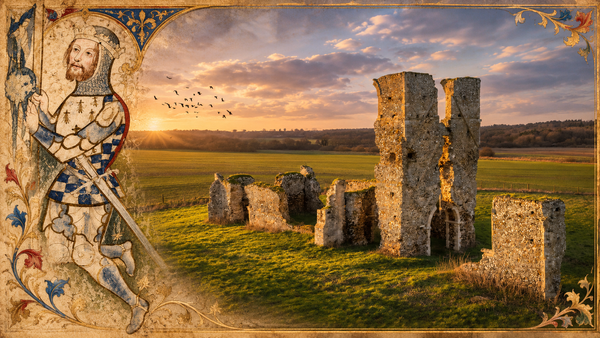
The charter refers to Geoffrey's intended journey to Jerusalem, an undertaking that connected the Norfolk household with the wider religious world of medieval Europe. Later accounts associate his departure with the age of the Second Crusade, although the surviving charter does not establish every detail of his journey or its precise date. For medieval noble families, such grants served several purposes: they provided spiritual benefits for relatives, endowed religious communities with income and land, and created institutions that could preserve family memory long after individual members had died.
Geoffrey's generosity also reflected the practical realities of medieval lordship. Churches, mills, rents, fields, and agricultural tithes formed the economic foundations of religious establishments. The development of Walsingham was therefore not simply a spiritual event. It required landholding rights, legal agreements, financial support, and relationships with influential families whose patronage could protect the institution.
Among those associated with Walsingham's early development were members of the powerful de Clare family. Roger de Clare, Earl of Hertford, appears in surviving charter evidence concerning the chapel, its possessions, and the establishment of a religious community. The de Clare dynasty was one of the great aristocratic houses of medieval England, holding extensive estates and exercising influence within the political world of the Norman and Angevin kings. Its connection with Walsingham illustrates how a relatively local foundation could become part of a much wider network of noble patronage.
By the middle of the twelfth century, the religious establishment at Walsingham had developed into an Augustinian priory. Its canons followed a communal religious life while serving the needs of the growing pilgrimage destination. The foundation is commonly dated to approximately 1153, although the development of the community and its formal arrangements extended across several decades. What began as a chapel associated with one landowning family was becoming a major institution within the medieval Church.
As Walsingham's reputation spread, it attracted the attention of the English monarchy. Henry III was particularly devoted to the shrine, and later royal pilgrims included Edward II, Edward III, Henry IV, Edward IV, Henry VII, and Henry VIII. The Plantagenet and Tudor dynasties contributed to its prestige through visits and patronage. For ordinary pilgrims, a journey to Walsingham offered a way to participate in a sacred tradition without undertaking the dangerous and expensive voyage to the Holy Land.
The expansion of pilgrimage transformed the surrounding village. Inns, markets, roads, and services developed to accommodate travellers, while the priory accumulated estates and endowments. The original Holy House became enclosed within a larger stone chapel, and the Augustinian complex expanded through successive building campaigns. By the later Middle Ages, Walsingham was among the wealthiest and most prominent religious houses in Norfolk.
The surviving architecture provides a remarkable physical record of that prosperity. The great fourteenth-century East Window, commonly called the Arch, still dominates the former priory grounds. Its soaring Gothic stonework gives an impression of the scale of the vanished church, which once extended approximately 244 feet. Other remains include parts of the refectory, medieval masonry, and the area associated with the Holy House. These fragments allow visitors to imagine the impressive religious complex that grew from the original family foundation.
Walsingham also attracted notable visitors beyond the royal household. The humanist scholar Erasmus visited in the early sixteenth century and later described the richness of the shrine, its religious imagery, and the attention devoted to its sacred objects. His observations reveal an institution deeply embedded in the devotional culture of Europe, but also vulnerable to criticism over the wealth and practices associated with pilgrimage.
Explore Roman and Early Medieval Britain DNA
That vulnerability became decisive during the reign of Henry VIII. The king who had once visited Walsingham as a pilgrim eventually presided over the dissolution of its religious community. In 1538, royal commissioners dismantled the shrine, removed its treasures, and brought the revered image of Our Lady of Walsingham to London, where it was reportedly destroyed. The Holy House was demolished, and the Augustinian priory was surrendered to the Crown.
The suppression was accompanied by political suspicion and harsh punishment. Nicholas Mileham, the sub-prior, was among those executed following accusations of resistance to the royal campaign against the monasteries. The last prior, Richard Vowell, surrendered the institution and received a substantial pension. These events brought an abrupt end to nearly four centuries of religious life and pilgrimage centred on the foundation associated with Richeldis and Geoffrey de Faverches.
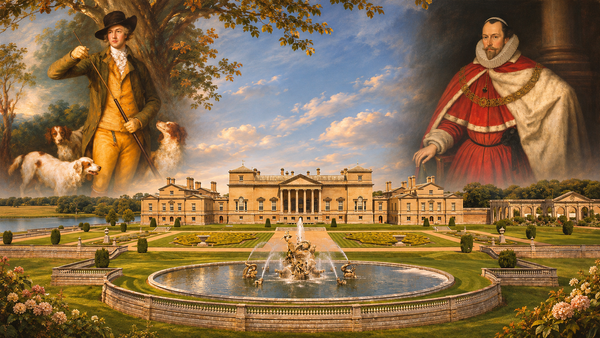
The site subsequently entered a different phase of aristocratic ownership. Thomas Sidney acquired the former priory property after the dissolution, and the estate later passed through other notable hands, including those of the Earl of Leicester and the Warner family. A country house developed among the surviving medieval buildings, ultimately giving the grounds the name Walsingham Abbey, although the original medieval institution had always been a priory.
The de Faverches story thus intersects with a remarkable succession of historical families and dynasties: the de Clare earls, the Plantagenet kings, the Tudor monarchy, and later Norfolk landowners such as the Sidney and Warner families. These connections represent changing patterns of patronage and ownership rather than proof that all these houses shared a single family lineage. Together, however, they demonstrate the extraordinary reach of an institution founded through the actions of a comparatively little-known medieval household.
Today the ruins of Walsingham Priory stand as a reminder that the influence of a family can extend far beyond the survival of its surname or direct descendants. The de Faverches household left behind something more enduring than a manor: a sacred landscape that shaped religious life, royal patronage, local commerce, and the architectural history of England for generations.
In a filmed visit to Walsingham, Simon Howard explores the surviving priory and recounts the story of Richeldis, Geoffrey, and the medieval noble world from which the shrine emerged. Standing before the great East Window, the scale of the family's legacy becomes especially striking. The stones that remain are only a fraction of the original buildings, yet they preserve the memory of the remarkable transformation of a Norfolk estate into one of Europe's most celebrated destinations of pilgrimage.
Watch Simon Howard's on-location account of Walsingham Priory
The story of the de Faverches family reminds us that medieval ancestry is not simply a record of names, titles, and inherited estates. It is also a history of beliefs, journeys, alliances, and the institutions that generations chose to build and preserve. Through genealogy, archaeology, and ancient DNA, we can explore the wider historical worlds in which such families lived.
Read more about Anglo-Saxon migration DNA
If you have ancestral roots in Norfolk, the Anglo-Norman aristocracy, or the wider populations of medieval England, you can upload your DNA to MyTrueAncestry to compare with ancient archaeological samples and see whether you match the family’s broader historical world or related ancient DNA samples from medieval Britain and Europe.
Comments