The Coke Family of Holkham Hall: From Tudor Law to Palladian Splendour and the Agricultural Revolution

– 13 min read


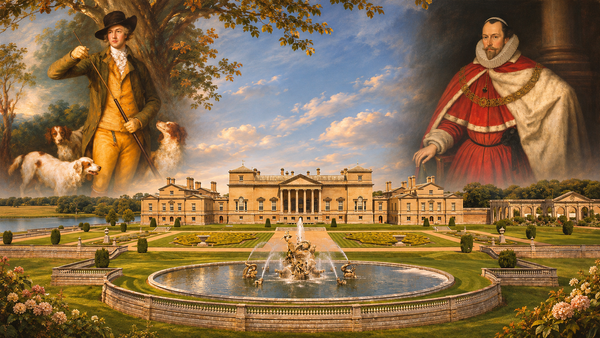
On the north Norfolk coast stands one of England's most magnificent aristocratic residences. Holkham Hall, surrounded by sweeping parkland, ancient woodland and the rich agricultural landscape of East Anglia, is a masterpiece of eighteenth-century Palladian architecture. Its monumental columns, elegant state rooms and remarkable collections of classical art reflect the ambitions of a family whose influence extended far beyond their Norfolk estates.
Behind this extraordinary mansion lies the story of the Coke family, a dynasty whose rise from the Tudor legal profession to the highest ranks of the British aristocracy reflects centuries of social ambition, political influence, marriage alliances and inherited wealth. From Sir Edward Coke, one of the most formidable legal minds in English history, to Thomas Coke, the visionary builder of Holkham Hall, and Thomas William Coke, the agricultural reformer celebrated as Coke of Norfolk, the family played a significant role in shaping the legal, architectural and agricultural history of Britain.
The story begins long before the great mansion existed, in the turbulent world of Tudor England. The Coke family had established roots in Norfolk during the medieval period, with connections to landholding families and the legal profession. Yet it was Sir Edward Coke, born in 1552 at Mileham in Norfolk, who transformed the family's fortunes and laid the foundations for its extraordinary rise.
Educated at Norwich and Trinity College, Cambridge, Edward Coke entered the Inner Temple in London, where he began a legal career that would eventually place him among the most influential jurists in English history. His exceptional command of English common law brought rapid advancement during the reign of Elizabeth I.
Coke served as Speaker of the House of Commons, Attorney General, Chief Justice of the Court of Common Pleas and ultimately Lord Chief Justice of the King's Bench. His career spanned the reigns of Elizabeth I and James I, a period when the powers of the monarchy, Parliament and the courts were increasingly contested.
As Attorney General, Coke participated in some of the most politically significant trials of his age, including proceedings connected with Sir Walter Raleigh and the Gunpowder Plot. His conduct in these prosecutions has attracted criticism, but his later career as a judge showed a growing determination to defend the authority of established law against arbitrary royal interference.
Among his most important contributions was the principle that the monarch could not simply create new laws by personal proclamation. His legal writings and judgments helped shape constitutional arguments about the limits of government, the rights of property holders and the independence of the courts.
In 1628, Coke played an important role in the parliamentary debates surrounding the Petition of Right, which challenged taxation without parliamentary consent, arbitrary imprisonment and other abuses of royal authority. His influence would extend through subsequent generations of legal thinkers and constitutional reformers, including those who helped shape legal traditions in North America.
But the rise of the Coke family was not achieved through professional success alone. Marriage, inheritance and the careful acquisition of landed estates were equally important to the development of an enduring aristocratic dynasty.
In 1582, Edward Coke married Bridget Paston, the daughter of John Paston, a member of one of Norfolk's most historically significant families. The Pastons had risen from relatively modest provincial origins during the later Middle Ages to become wealthy landowners and members of the Norfolk gentry.
Their remarkable family correspondence, preserved in the famous Paston Letters, provides one of the richest surviving records of everyday life among the English gentry during the fifteenth century. The letters reveal the challenges of property ownership, marriage negotiations, legal disputes and political instability during the Wars of the Roses.
By marrying Bridget Paston, Edward Coke linked his own rising legal fortunes to an established Norfolk family whose history was deeply embedded in the social transformations of late medieval England. Bridget brought substantial wealth and property into the marriage, strengthening the economic foundations of the Coke household.
Following Bridget's death in 1598, Coke married Lady Elizabeth Hatton, a wealthy widow and daughter of Thomas Cecil, Earl of Exeter. This second marriage connected him with the influential Cecil family, whose members occupied central positions in Elizabethan and Jacobean government.
The Cecil connection linked the Cokes to one of the great political dynasties of early modern England. William Cecil, Lord Burghley, had served as Elizabeth I's principal adviser, while Robert Cecil, Earl of Salisbury, became a dominant figure in the government of James I. Through marriage and political association, the Coke family's position within England's ruling circles became increasingly secure.
As his legal career flourished, Edward Coke invested heavily in land. In 1609, he acquired property at Holkham in Norfolk, establishing the beginnings of the estate that would become the family's most celebrated possession.
At that time, Holkham looked very different from the landscape visitors encounter today. Instead of the grand Palladian mansion, the estate contained agricultural holdings and an earlier residence known as Hill Hall. Through the marriage of Coke's son to Meriel Wheatley, the family came to occupy this earlier house, beginning an association with Holkham that would continue for centuries.
The acquisition reflected a familiar ambition among successful Tudor and Stuart professionals. Wealth earned through law, commerce or royal service could be transformed into landed property, providing social standing and an inheritance for future generations. In seventeenth-century England, the possession of land remained one of the most important markers of aristocratic identity, supplying rents, agricultural income, political influence and the opportunity to establish a lasting family residence. Sir Edward's investments enabled his descendants to move increasingly into the world of hereditary privilege.
Read more about The Paston Family
Yet the Holkham Hall visible today was not the work of Sir Edward Coke. Its extraordinary creation belonged to a later generation and to a young aristocrat whose fascination with classical civilisation would transform the family's Norfolk home.
Thomas Coke was born in 1697 and inherited the Holkham estate in 1707, following the deaths of his parents while he was still a child. His guardians managed the family's extensive properties until he reached adulthood, allowing him to inherit both substantial wealth and the freedom to pursue an ambitious education.
In 1712, at the age of fifteen, Thomas embarked upon an extended Grand Tour of Europe. Such journeys were considered an essential part of the education of wealthy young British gentlemen, exposing them to continental politics, classical antiquity, art, architecture and the intellectual culture of the European aristocracy.
Thomas travelled through France, the Netherlands, Italy and other parts of Europe, but it was Rome and the architectural heritage of Italy that made the deepest impression on him. There he encountered the surviving monuments of the Roman world and the Renaissance buildings inspired by them.
The architecture of Andrea Palladio, the sixteenth-century Venetian architect whose designs revived the forms and proportions of classical antiquity, became particularly influential. Palladio's villas and palaces combined monumental symmetry with elegant interiors and carefully balanced architectural details.
For Thomas Coke, these buildings offered more than aesthetic inspiration. They represented an ideal of cultivated aristocratic identity, in which scholarship, artistic patronage and wealth could be expressed through architecture.
During his travels, Thomas also met William Kent, an English artist then establishing himself in Rome. Their friendship would become one of the defining relationships in the creation of Holkham Hall.
Kent developed into one of the leading architects and landscape designers of eighteenth-century Britain. His work helped establish a new architectural taste inspired by Roman antiquity and the Renaissance, while his landscape designs contributed to the development of the English landscape garden.
Thomas returned to England in 1718, bringing with him an extraordinary enthusiasm for classical art and architecture, as well as collections of paintings, sculptures, manuscripts and antiquities acquired during his travels.
These objects would eventually form the foundation of the remarkable collections at Holkham. The young landowner envisioned a residence that would not simply accommodate his household but also serve as an architectural setting for the treasures he had gathered across Europe.
The project developed through the contributions of several important figures, including William Kent, Richard Boyle, Earl of Burlington, and the Norfolk architect Matthew Brettingham the Elder.
Lord Burlington was among the leading advocates of Palladian architecture in Britain, and his association with Kent helped promote the classical style among the country's aristocratic patrons.
Brettingham played a crucial role in preparing architectural plans and translating the ambitious designs into a practical building project. Surviving drawings and accounts show that Holkham Hall was not the work of a single architect but the product of an unusually close collaboration between patron, designers and craftsmen.
Construction began in 1734. The new building was to be one of the purest expressions of Palladian architecture in England, constructed from finely made yellow brick and arranged around a monumental central block with four adjoining wings.
The exterior was deliberately restrained. Its massive proportions, symmetrical arrangement and classical portico were intended to convey dignity and architectural harmony rather than the elaborate ornamentation associated with some earlier aristocratic houses.
Inside, however, the mansion displayed spectacular richness. The Marble Hall, one of the building's most celebrated rooms, rises beneath a lofty coffered ceiling supported by imposing columns. Despite its name, much of its striking interior decoration is formed from English alabaster rather than imported marble.
Beyond the Marble Hall, a sequence of state rooms displays classical sculpture, Old Master paintings, antique furniture and elaborate architectural decoration. The Sculpture Gallery was conceived as a setting for the collection of ancient statues that Thomas had assembled during his European travels. Elsewhere, richly decorated drawing rooms, formal dining rooms, libraries and private apartments reflected the scale of the family's artistic ambitions.
The library became particularly significant, incorporating collections that extended back to Sir Edward Coke and his descendants. Rare books, manuscripts and legal works preserved the intellectual interests of successive generations, connecting the mansion's eighteenth-century splendour to the scholarly traditions of the family's Tudor ancestor.
Holkham was therefore designed as far more than a comfortable country residence. It was an architectural declaration of cultural prestige, presenting the Coke family as patrons of learning, art and classical civilisation.
Thomas Coke received the title Earl of Leicester in 1744, marking the family's elevation to the peerage. Yet he would never see his great architectural project fully completed.
He died in 1759, five years before the building was finished. Responsibility for completing Holkham Hall passed to his widow, Lady Margaret Tufton, a daughter of Thomas Tufton, Earl of Thanet.
Lady Margaret continued the project with remarkable determination, overseeing its completion in 1764. Her role is an important reminder that aristocratic women were often essential participants in the management of estates, family finances and major building projects, even when their contributions received less attention than those of male patrons.
Through Margaret's efforts, Holkham emerged as one of the finest country houses in Britain, retaining much of its original architectural character and collections.
The family's influence did not end with the completion of the mansion. During the later eighteenth and early nineteenth centuries, another Thomas Coke would become one of the most celebrated agricultural reformers in Britain.
Thomas William Coke, born in 1754, was the great-nephew of the mansion's creator. He inherited the Holkham estate in 1776, but not the Earl of Leicester title, which had become extinct following the death of his great-uncle.
Known widely as Coke of Norfolk, Thomas William combined an active political career with an extraordinary commitment to agricultural improvement.
As a Whig politician, he represented Norfolk in Parliament for many years and supported a range of political reforms. Yet his most enduring reputation was built on the transformation of the Holkham estate into an influential centre of agricultural experimentation and education.
Eighteenth-century agriculture was undergoing profound change. Traditional farming methods were being challenged by new approaches to crop rotation, animal breeding, soil management, drainage and the organisation of agricultural labour.
Norfolk became one of the leading centres of these developments. Landowners and agricultural improvers sought ways to increase productivity and bring previously marginal land into more profitable cultivation.
Among the most influential techniques was the Norfolk four-course rotation, commonly associated with the cultivation of wheat, turnips, barley and clover or grass in succession.
The system reduced dependence on fallowing fields and helped support larger numbers of livestock, whose manure contributed to soil fertility. Turnips provided winter feed, while clover and grass improved the integration of livestock and arable farming.
Thomas William Coke helped promote and refine these methods, although he was not their sole inventor. Earlier agricultural reformers, including Charles Townshend of Raynham, had already played major roles in developing and popularising the Norfolk system.
Townshend, often remembered as Turnip Townshend, belonged to another prominent Norfolk aristocratic family whose history intersected with the wider landowning world of the Cokes, Howards and Pastons.
At Holkham, Coke of Norfolk encouraged improved crop management, better livestock breeding and more systematic use of the estate's agricultural resources. His experiments and practical demonstrations contributed to the spread of new farming techniques across Britain and beyond.
One of his most celebrated innovations was the organisation of the Holkham sheep-shearings, annual gatherings that brought together farmers, landowners, agricultural specialists and political figures.
Although centred on the practical work of sheep shearing, these meetings became major events for discussing agricultural improvement. Visitors examined livestock, compared farming methods, shared experiences and studied the results of experiments carried out on the Holkham estate.
The gatherings attracted attention far beyond Norfolk, establishing Holkham as an internationally recognised centre of agricultural innovation.
Coke's work also transformed the estate's landscape. Land was reorganised, woodland planted, new roads and boundaries established, and farm buildings improved. Architects and landscape designers contributed to a series of additions intended to combine practical agricultural efficiency with the visual grandeur of the estate.
Such improvements reflected the ambitions of the Agricultural Revolution, but they also belonged to a period of major social change. Agricultural enclosure and estate reorganisation could increase productivity while also altering traditional access to land and reshaping the lives of rural communities.
The experience of agricultural progress was therefore not identical for landlords, tenant farmers and labourers. The transformation of estates such as Holkham was part of a broader restructuring of the English countryside, whose benefits and costs were distributed unevenly.
In 1837, at the age of eighty-three, Thomas William Coke received the newly created title Earl of Leicester, restoring the title to the family in a new peerage creation.
By then, his achievements in agriculture had made him a celebrated figure. He died in 1842, leaving a legacy that extended through successive generations of landowners and agricultural reformers.
One of the most unusual aspects of Holkham's later history concerns an item of clothing that became famous around the world: the bowler hat.
In 1849, during the stewardship of the second Earl of Leicester, a member of the Coke family commissioned the London hatmakers Lock & Co to produce a sturdy hat suitable for the estate's gamekeepers.
Traditional tall hats were impractical for men who needed to ride, walk through wooded areas and protect themselves from low branches. The new design was intended to be compact, durable and capable of withstanding the rigours of outdoor work.
The prototype was produced through the craftsmanship of the Bowler brothers, whose surname eventually became associated with the hat itself.
Originally known as the Coke hat, the design became a familiar part of nineteenth-century British clothing and later developed into an international symbol of urban respectability.
It is a remarkable example of how an innovation commissioned for the practical needs of a Norfolk country estate could become an enduring feature of global fashion.
The family relationships surrounding Holkham are equally fascinating. Through Sir Edward Coke's marriage to Bridget Paston, the family's history became connected with the medieval Pastons, whose correspondence offers an exceptional view into the lives of Norfolk landowners during the fifteenth century. His later marriage to Lady Elizabeth Hatton linked the Cokes with the powerful Cecil family, whose influence over English politics stretched through the Tudor and Stuart periods.
Successive generations established further connections through marriages involving families such as the Tuftons, Cavendishes, Newtons and other members of Britain's landed elite. These relationships show how aristocratic households built and preserved influence through inheritance, marriage settlements, legal careers and the accumulation of property.
Families such as the Howards, Townshends, Pastons and Cokes formed part of the wider social landscape of Norfolk, participating in the political and economic development of the county across generations. Their histories reveal a complex network of local identities and national ambitions, connecting the villages and estates of East Anglia with Parliament, the royal court and the wider European aristocracy.
From a genealogical perspective, however, these connections should be treated carefully. The presence of the same family names within historical records does not establish that every individual belonged to a single documented line of descent, and associations between noble households do not necessarily prove biological relationships.
The Coke family's history spans several centuries, during which branches of the household developed through inheritance, marriage and the transfer of estates. Historical genealogy can reconstruct many of these connections through wills, marriage records, estate documents, pedigrees and surviving correspondence. Yet written genealogies and DNA evidence answer different questions.
The Norman Conquest brought a new aristocratic elite with extensive connections across Normandy, Brittany and other parts of continental Europe. Over subsequent centuries, these families interacted with the existing English population through marriage, settlement and social exchange.
Yet the genetic history of Britain reaches far beyond 1066. Ancient genomes from prehistoric, Roman, Anglo-Saxon and Viking Age contexts reveal successive layers of population change, each contributing to the ancestry of later generations.
For individuals researching family connections to Norfolk or the English aristocracy, combining historical genealogy with ancient DNA comparisons can provide a broader perspective on the populations and migrations that shaped the region.
A genetic similarity to an ancient archaeological individual does not, by itself, prove descent from a named noble family. Instead, it offers an opportunity to explore deeper ancestry alongside the documentary histories preserved in archives and family collections.
Today, Holkham Hall remains closely associated with the Coke family, continuing as both a family residence and one of Britain's most important historic estates.
Its architectural splendour, collections of art and manuscripts, landscaped park and agricultural traditions preserve different chapters of the family's extraordinary history.
The mansion is surrounded by a much larger working estate extending across approximately 25,000 acres of the north Norfolk landscape. Agriculture remains an important part of its identity, alongside conservation, heritage tourism and the management of its historic buildings.
Within the Marble Hall and the great state rooms, visitors encounter the artistic ambitions of Thomas Coke and the architectural vision of William Kent. In the surrounding fields and farm buildings, the influence of Coke of Norfolk's agricultural reforms can still be recognised.
The family's story connects the intellectual world of Elizabethan law with the artistic culture of eighteenth-century Europe and the practical transformations of the Agricultural Revolution.
In an on-location film at Holkham Hall, Simon Howard explores this extraordinary history, tracing the rise of the Coke family from Sir Edward's legal achievements to the creation of the Palladian mansion and the agricultural innovations of later generations.
Filmed at the estate itself, the account offers a direct view of the setting in which centuries of family ambition, political influence and artistic patronage came together.
Watch Simon Howard's visit to Holkham Hall
Standing before the magnificent façade of Holkham Hall, it is difficult not to reflect on the remarkable distance travelled by the family since the days of Sir Edward Coke.
What began with the legal career of a Tudor lawyer developed into a great landowning dynasty whose descendants helped shape English architecture, agriculture and aristocratic society.
The story of Holkham is not simply one of inherited wealth or magnificent buildings. It is also a history of education, legal ambition, family alliances, artistic patronage and the changing relationship between landowners and the wider population.
Through historical documents, archaeology and ancient DNA, we can investigate the deeper human histories that lie behind these remarkable family narratives.
Read more about The House of Cavendish
For those with ancestral connections to Norfolk, the wider Anglo-Norman world or the historic populations of Britain, MyTrueAncestry offers the opportunity to compare existing raw DNA data with ancient archaeological samples and explore the population history behind their heritage. Upload your DNA to see whether you match the Coke family's wider historical world or related ancient DNA samples from the populations that shaped Britain.

Comments