The House of de Clare
– 3 min read


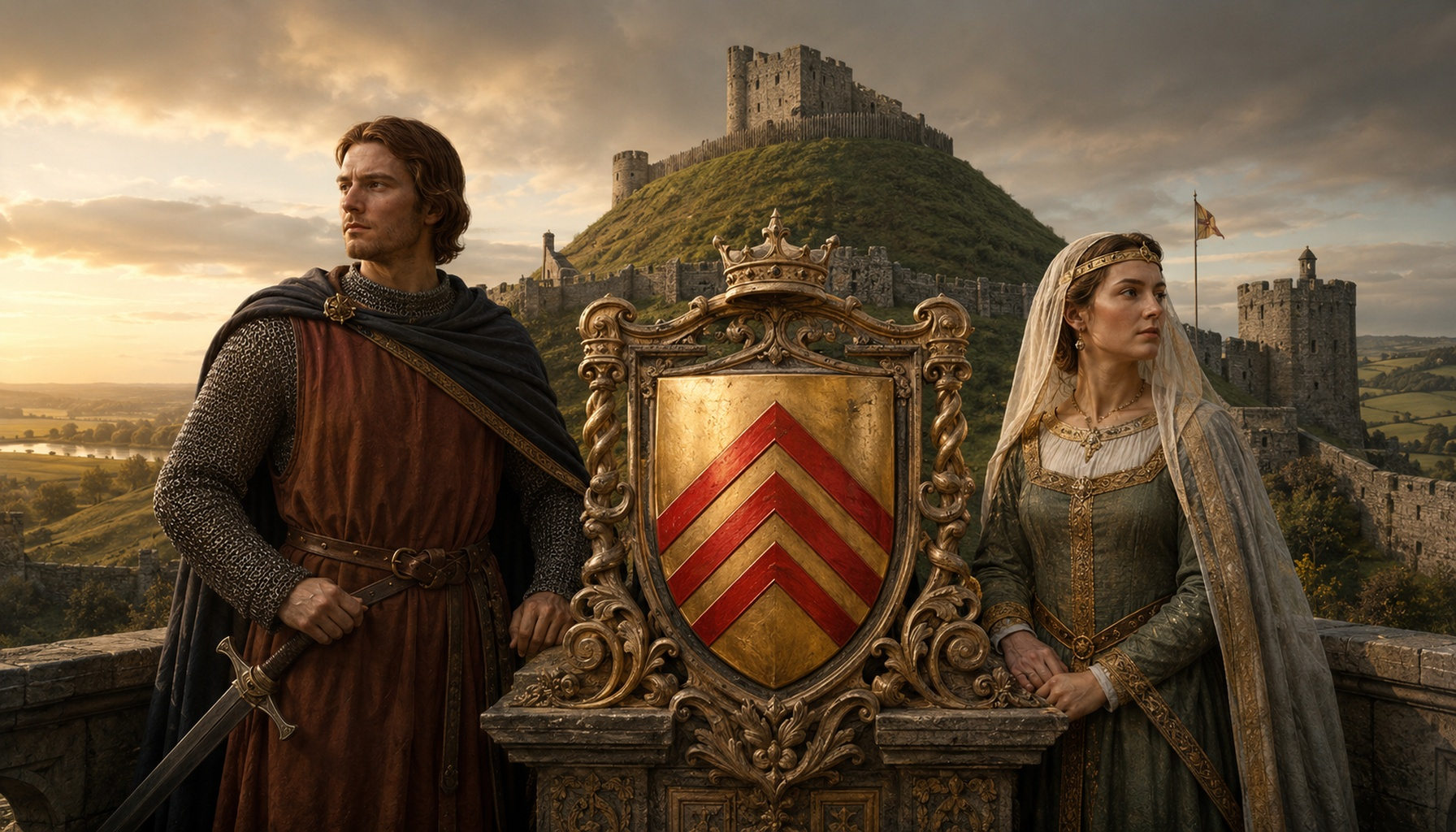
The House of de Clare was one of the great Norman and Anglo-Norman families of medieval Britain and Ireland, a dynasty built on conquest, landholding, castle power, and fierce usefulness to kings. Their name points back to Clare in Suffolk, though the family itself had deeper roots in the Norman world that crossed the Channel after 1066. In haplogroup terms, the primary family association here is R1b1a1b1a1a2c1a5d3a1, a lineage tag that links this house into a much older paternal story stretching far beyond the age of earls and marcher lords.
The de Clares were not merely rich aristocrats sitting prettily on estates. They were frontier lords, castle builders, royal operators, and political heavyweights whose lands reached across England, into Wales, and on into Ireland. Richard fitz Gilbert de Clare, who lived circa 1030 to 1090, stands near the beginning of their great rise in post-Conquest England. By the later Middle Ages, figures such as Gilbert de Clare, 7th Earl of Gloucester, born in 1243 and dead in 1295, show the family at the height of its influence, entangled in kingship, baronial politics, and the hard practical business of ruling contested territories. In many ways the de Clares are the textbook Norman magnates: continental in origin, dazzlingly martial in posture, heraldic in self-presentation, and always alert to what marriage and masonry could achieve.
Explore the House of de Warenne
If you want one place that anchors the de Clare story in stone, Tonbridge Castle in Kent is a very good choice indeed. The castle was founded soon after the Norman Conquest, traditionally associated with Richard fitz Gilbert, and began as a motte-and-bailey fortress, that wonderfully blunt Norman answer to political uncertainty: build fast, build high, and dominate the landscape. Over time it developed into a more substantial stronghold, with impressive defensive earthworks and later masonry additions. Set beside the River Medway, it controlled movement and projected authority in exactly the way Norman castles were meant to do. What survives today still gives a strong sense of that original ambition. The gatehouse is especially notable, and the site remains one of the most evocative reminders of how the de Clares translated conquest into durable local power. Better still, Tonbridge Castle can still be visited today, which is a pleasingly direct way of standing in the shadow of a family that helped reshape medieval England.
Read more about the House of Clifford
From the ancient-DNA side, the de Clare haplogroup tag R1b1a1b1a1a2c1a5d3a1 can be set alongside a number of related or linked ancient samples from Britain and Ireland, though not as proof of direct descent. These include I11586 from the Early Anglo-Saxon cemetery at West Heslerton in Yorkshire, I12775 from Carsington Pasture Cave in Derbyshire, I12783 from Lechlade-on-Thames in Gloucestershire, I11156 from Bradley Fen in Cambridgeshire, I12785 from Iron Age Greystones Farm in Gloucestershire, and Rathlin1B from Copper Age Ireland. What is striking here is the sheer chronological spread: Copper Age, Iron Age, Celtic Briton, and early medieval contexts all speaking to the long presence of related paternal lines in the islands. That does not make those men de Clares, of course; it does something more interesting. It places a medieval noble house within a much deeper human landscape, where lineages endured, shifted, and resurfaced across thousands of years of British and Irish history.
If the House of de Clare appears in your family story, or if you are simply curious whether your DNA connects with this wider Norman, British, or Irish genetic landscape, you can explore it for yourself. Upload your DNA to MyTrueAncestry and see whether you match the family or any related ancient DNA samples.


Comments